Bible › Reading plans › Genres of the Bible
Study · 10 days
Genres of the Bible
10 kinds of text — story, law, psalm, parable, letter and more — each with a passage and how to read it.
- Day 1
Narrative
Ruth 1:1–18Most of the Bible is narrative, and Hebrew stories are told briefly. The narrator seldom describes faces, rooms or feelings and rarely comments; people show who they are by what they say and do. Ruth opens as many stories do, with a time and a place: “in the days when the judges ruled”, a famine, a family from Bethlehem going to live in Moab. Within five verses three men have died. Then dialogue carries the story: Naomi urges her daughters-in-law again and again to go back, Orpah goes, Ruth stays. Key words are repeated to show what matters, here “return” and “go back”. Read slowly, and notice who speaks, who answers and who keeps silent.
- Day 2
Law
Exod 21:28–36The laws of the Pentateuch come in two main forms. Some are short commands, like the Ten Commandments: you shall, you shall not. Others are cases: if this happens, then this is done. Exodus 21 is full of cases — here an ox that gores a person, an open pit, an ox that kills another ox — each with its variations: did the ox have a habit of goring, was its owner warned? Laws of the same kind survive from Israel’s neighbors: the Code of Hammurabi, king of Babylon in the 18th century BC, also rules on a goring ox. By a common view such collections did not try to cover every case but gave examples from which judges reasoned. The Torah sets its laws inside the story of Israel at Sinai.
- Day 3
Genealogies and lists
Gen 11:10–26Lists are a genre of their own in the Bible: genealogies, censuses, lists of kings, towns, gifts and builders. Genesis 11:10–26 runs from Shem to Abram in a fixed pattern: when he had lived so many years, he became the father of a son; then he lived so many years more and had other sons and daughters. Because the pattern repeats, the reader sees where it breaks: Terah has three sons, and the story of Abram begins. Genesis is built on headings like the one in verse 10, “this is the account of”, in Hebrew toledoth, which open lists and stories alike. Ancient king lists of Mesopotamia, such as the Sumerian King List, also give very long reigns to the earliest rulers. In a list, look for the pattern and for the place where it changes.
- Day 4
Psalm
Ps 121:1–8Hebrew poetry has no rhyme and no fixed meter in our sense. Its mark is parallelism: a line is followed by another that repeats, develops or contrasts it. The term was coined by the English scholar Robert Lowth in 1753. Psalm 121 climbs like a staircase: verse 3 ends “will not slumber”, and verse 4 takes the words up and goes a step further, “will neither slumber nor sleep”. The lines are short and full of images: the hills, a shade on the right hand, the sun by day and the moon by night. Many psalms have a heading; this one is “a song of ascents”, like Psalms 120–134 — by one view sung by pilgrims going up to Jerusalem for the feasts, by another named after the temple steps. Psalms were sung: read them aloud.
- Day 5
Wisdom
Prov 10:1–12The wisdom books — Proverbs, Job, Ecclesiastes, and in some Bibles Wisdom and Sirach — are about how life works: work and laziness, words, money, friends and family. From chapter 10 Proverbs is a collection of single sayings of two lines each, and in these chapters most are contrasts: a wise son and a foolish one, diligent hands and slack ones. Sayings that stand side by side need not make one argument; each can be weighed on its own, and two may even pull against each other, as Proverbs 26:4–5 do on answering a fool. Israel’s neighbors had wisdom writing too: an Egyptian work, the Instruction of Amenemope, is close to Proverbs 22:17–24:22, and scholars discuss how the two are related. Take a few sayings at a time.
- Day 6
Prophecy
Amos 1:1–8The prophets mostly spoke before anything was written; their words were gathered into books, often under a heading that says who the prophet was and when he spoke. Amos 1:1 names a herdsman of Tekoa, the kings of Judah and Israel of the 8th century BC, and “two years before the earthquake”. Much of prophecy is poetry, in short units called oracles. Many begin with the messenger formula, “This is what the LORD says”, the way an envoy began a king’s message. Here one pattern runs through a chain of oracles: “for three transgressions, even four” — Damascus, Gaza, and on into chapter 2 with Tyre, Edom, Ammon and Moab, then Judah and Israel. Knowing the history of the prophet’s time helps more than anything else.
- Day 7
Gospel
Mark 1:1–15The Gospels tell of the life and teaching of Jesus, his death and resurrection. Many scholars compare them with ancient biographies, Greek bioi, which also chose episodes and sayings to show who a person was rather than telling a whole life year by year; others stress how they differ. Mark, by the view of many scholars the earliest, opens with a title line and goes straight to John the Baptist, without a birth story. Its pace is quick: the Greek word euthys, “immediately”, comes about 40 times. Matthew, Mark and Luke share many episodes, often in similar words, and are called the Synoptic Gospels, from the Greek for “seen together”; John tells the story in his own way. Read a Gospel through, as one book.
- Day 8
Parable
Luke 15:11–32A parable (Greek parabolē, Hebrew mashal) is a short story or comparison drawn from everyday life: sowing, fishing, sheep, coins, a wedding feast. The first three Gospels have several dozen parables of Jesus; John’s Gospel uses other figures of speech. Jewish teachers of later centuries also told parables, often opening with “To what may this be compared?” Luke 15 sets three side by side: a lost sheep, a lost coin and a lost son, each with a finding and a celebration. The third is built in two halves, the younger son and the elder, and its ending is open: the reader is not told whether the elder brother goes in. Listen for the details a first hearer would notice — the father running, the ring, the fattened calf — and for the surprise.
- Day 9
Letter
Phlm 1:1–25Twenty-one books of the New Testament are letters. Letters of the time, many found on papyrus in Egypt, follow one pattern: sender, recipient, greeting, often a thanksgiving or a wish for good health, then the body, and greetings at the end. Paul’s letter to Philemon, the shortest of his letters, has every part: Paul and Timothy to Philemon and the church in his house; “grace and peace” in place of the usual Greek greeting, chairein; thanks; the request about Onesimus; greetings from Paul’s companions. Paul dictated to a scribe (Romans 16:22) and sometimes wrote a line in his own hand (verse 19). Letters were read aloud to the gathered church (Colossians 4:16). Each was written for one situation, which the reader rebuilds from the letter itself: read it at one sitting.
- Day 10
Apocalyptic vision
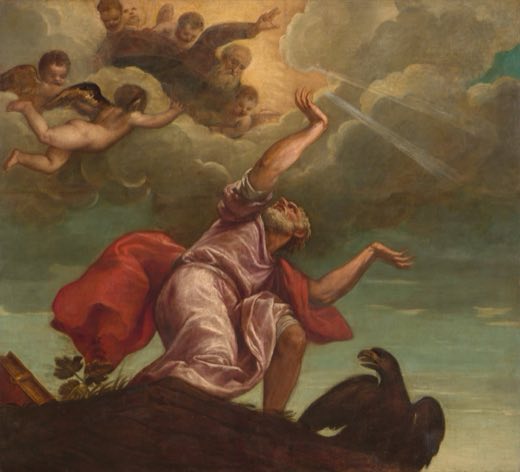
Rev 1:9–20Revelation takes its name from its first word in Greek, apokalypsis, “unveiling”. Apocalyptic writing — in the Bible parts of Daniel and Zechariah and the book of Revelation; outside it Jewish works such as 1 Enoch, written from about the 3rd century BC to the 1st century AD — tells of visions: a seer is shown heaven or the times to come, often with a guide who explains. Its language is symbolic: numbers, colors, beasts, stars. Here John on Patmos sees one like a son of man among seven lampstands, and the text itself explains two of the images: the stars are the angels of the seven churches, the lampstands are the churches. Many images come from the Old Testament prophets. The details are understood in different ways; read the book through as a whole first.
In the app the plan keeps your place, marks the days read and reminds you each day. Berean Standard Bible.
Notes written for Bible Explorer · facts checked against reference works