Bible › Reading plans › Read with commentary
Study · 90 days
Read with commentary
90 key chapters, each with a short note on its history and setting.
- Day 1
In the beginning
Genesis 1About the book. Genesis is the book of beginnings: of the world, of humanity, and of the family of Abraham, Isaac and Jacob. By tradition Moses wrote it. It covers the earliest times and the age of the patriarchs (about 2100–1700 BC), in Mesopotamia, Canaan and Egypt. Its sections open with the Hebrew heading toledoth, "this is the account."
The usual Hebrew word for God, elohim, is plural in form but takes singular verbs, and in the Old Testament the verb bara (create) always has God as its subject. "Formless and empty" renders tohu and bohu, roughly "wild and waste." The sky is pictured as a dome between waters. The sun and moon, worshiped by Israel's neighbors, are not even named. The Hebrew day began at sundown.
- Day 2
The serpent and the garden
Genesis 3The Hebrew word for the serpent's shrewdness, arum, echoes arummim, "naked," at the end of the previous chapter: the man and woman were naked and vulnerable, the serpent was cunning. The phrase often rendered "the cool of the day" most likely means the evening breeze, though some read it as the sound of a storm announcing God's presence. The name Eve (khawah) sounds like the Hebrew verb "to give life." Cherubim, winged guardians of God's presence, block the way back. In Genesis, moving east often means moving away from God's presence or blessing.
- Day 3
The flood
Genesis 7The account dates the start of the flood precisely, to the seventeenth day of the second month, giving it the tone of a record. The waters come both from below and from above, undoing the boundaries set in the creation story, when the waters were separated and dry land appeared. The verb used for the rising waters, "multiplied," is the same one used at creation for living things filling the earth. The extra "clean" animals were for food and for Noah's sacrifice, though the detailed food laws came later at Sinai. Forty is a number often linked with trial in the Bible.
- Day 4
The tower of Babel
Genesis 11The story is set in Babylonia, in southern Mesopotamia, where stone was scarce, so builders used baked brick with tar made from natural bitumen; Canaan, by contrast, had plenty of stone. The tower was probably a ziggurat, a stepped temple-tower that Babylonians saw as a sacred mountain where the gods came down to earth. The name Babel sounds like the Hebrew word for "confuse." The chapter then follows Shem's line to Terah, whose family left Ur, a main city of Sumer near the Persian Gulf, for Haran, a trading center about 550 miles to the northwest known for moon worship.
- Day 5
Abram leaves for Canaan
Genesis 12Abram reached Canaan but lived there as a temporary settler, moving his camp because the Canaanites held the fertile land. The oak of Moreh at Shechem was probably a Canaanite sacred site: Moreh means "teacher," and groves were often holy places in Canaan. Abram built altars there and near Bethel. When famine struck he went to Egypt, which, watered by the Nile, was often the last region to suffer. "Pharaoh" is a title, not a personal name. Calling Sarai his sister may reflect a custom in which a brother arranged his sister's marriage. The episode closely mirrors Israel's later stay in Egypt.
- Day 6
The covenant with Abram
Genesis 15Childless Abram feared that his steward, Eliezer of Damascus, would inherit his estate, as was customary when a man had no son; the Hebrew plays on the sound of "Damascus" and the word for "heir." The ceremony reflects an ancient way of sealing an oath: animals were cut in half, and the one making the promise staked his life on his word (compare Jeremiah 34). The Hebrew idiom is literally to "cut" a covenant. The four hundred years of oppression is apparently a round number. By the Hebrew chronology the Exodus came around 1446 BC, though many scholars date it around 1270 BC.
- Day 7
Abraham and Isaac on Moriah
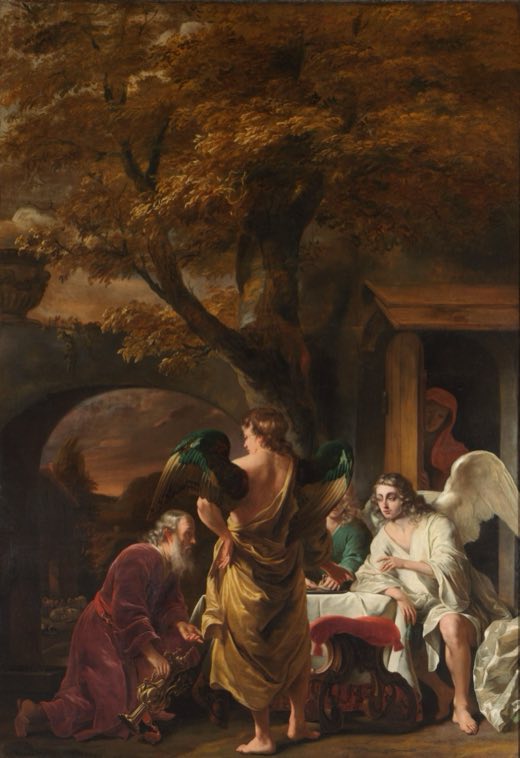
Genesis 22The land of Moriah is identified in the book of Chronicles with the hill where the Temple in Jerusalem later stood, and later Israelites read this story in light of their worship there. The name Abraham gives the place, Yahweh-Yireh, means "the Lord will provide"; patriarchal stories often fix their main point in a name. Israel's law later condemned child sacrifice outright. The chapter closes with news from Abraham's brother Nahor in the east, whose family includes Rebekah, Isaac's future wife, and a son named Uz, possibly an ancestor of Job.
- Day 8
Jacob's dream at Bethel
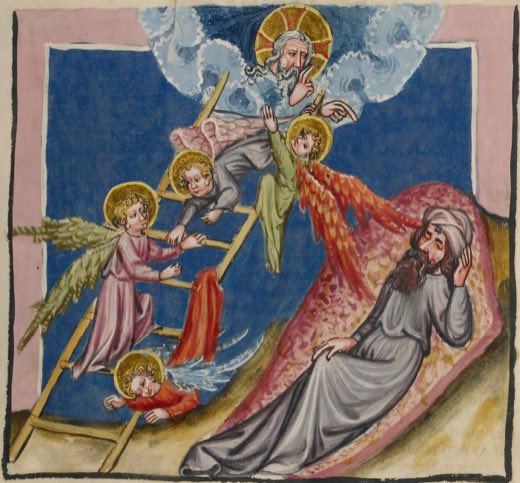
Genesis 28Jacob travels north to his mother's family to find a wife within the clan, as Abraham's family had done before. Isaac blesses him in the name of El-Shaddai, traditionally "God Almighty." The Hebrew word for the "stairway" (traditionally "ladder") appears nowhere else in the Bible; it probably recalled the ramp or staircase up a ziggurat, a temple-tower seen as a link between heaven and earth. The stone by Jacob's head was probably large, for shelter rather than as a pillow. Pouring oil on something set it apart for sacred use, and Bethel ("house of God") later became a major holy site in Israel.
- Day 9
Joseph sold into Egypt
Genesis 37This chapter opens the Joseph story, one continuous narrative that differs in tone from the earlier parts of Genesis. Joseph is seventeen, the first son of Jacob's favorite wife, Rachel. The fine robe signaled that his father meant to give him the largest share of the inheritance; changes of clothing mark changes of status throughout the story. Dreams were taken seriously as divine messages, especially when repeated. The brothers grazed their flocks far from home: Shechem lies about fifty miles north of Hebron, and Dothan about fifteen miles beyond. The traders are called both Ishmaelites and Midianites; "Ishmaelite" may have been a general term for desert tribes.
- Day 10
Jacob and Joseph are buried
Genesis 50Jacob's body was embalmed in the Egyptian manner, and Egypt mourned him seventy days, just two days less than the mourning for a pharaoh. Joseph needed Pharaoh's permission to leave his post and bury his father in Canaan, his first return home in thirty-nine years. The phrase "born on Joseph's knees" describes a symbolic act: placing newborns on one's knees declared that they belonged to the family line. Joseph asked that his bones be carried out of Egypt one day; according to the book of Joshua they were later buried at Shechem. His death closes the age of the patriarchs.
- Day 11
Slavery in Egypt
Exodus 1About the book. Exodus tells how the Israelites were freed from slavery in Egypt, received the covenant at Mount Sinai, and built the Tabernacle. By tradition Moses wrote it, though many scholars question this. The events are usually dated either around 1446 BC or around 1270 BC. The name comes from the Greek exodos, "the way out."
From about 1650 to 1550 BC northern Egypt was ruled by Semitic invaders called the Hyksos; after their expulsion, the new rulers may have distrusted all Semites, including the Israelites. Pithom and Rameses are identified with sites built in the Late Bronze Age. Stone was scarce in the north, so most buildings were of sun-dried brick mixed with straw. The origin of the word "Hebrew" is unclear.
- Day 12
The burning bush
Exodus 3Moses meets God at the mountain here called Horeb, elsewhere usually Sinai; both names probably refer to the same mountain. "Flowing with milk and honey" describes rich land with pasture for herds and blossoms for bees. Canaan, a narrow strip between the Mediterranean and the Arabian Desert, was a crossroads of trade between Egypt and the rest of the Near East and was fiercely contested. The divine name Yahweh is probably a form of the Hebrew verb "to be." Later Jews did not say it aloud and read adonay ("lord") instead; its exact pronunciation is unknown, and "Jehovah" is an artificial blend of the two.
- Day 13
The first Passover
Exodus 12The Passover month, Abib, later called by the Babylonian name Nisan, falls in March and April, when many ancient peoples held spring festivals. Hyssop, a small bush with stiff, compact branches, served as a brush. Unleavened bread recalled a people leaving in haste, and the meal was eaten dressed for travel. Jewish people still keep the Passover today. The figure of 600,000 men is debated: it may be literal or symbolic, or the Hebrew elep ("thousand") may have meant a military unit. The Greek and Samaritan texts count the 430 years from Abraham's time.
- Day 14
Crossing the sea
Exodus 14The exact locations of Pi-hahiroth, Migdol and Baal-zephon, where Israel camped by the sea, are unknown today. Egypt was the greatest military power of the time, and its light chariot was the most advanced weapon: fast and easy to maneuver, it often carried a driver and a warrior, which may be why the text mentions commanders. The Hebrew word for God's "glory," kabod, carries the sense of weight and importance. The phrase about the Egyptians' chariot wheels is understood differently in the ancient versions; perhaps the light wheels broke in deep sand where the water had been.
- Day 15
The Ten Commandments
Exodus 20The covenant at Sinai follows the form of ancient Near Eastern treaties in which a great king set terms for a subject people: the king's name, a review of past events, the terms, a written copy, witnesses, and blessings and curses. Here the opening names the King and recalls the rescue from Egypt. Elsewhere the Hebrew text calls these commands the "Ten Words." The verb in the command against murder means unlawful killing, not every kind of killing. Altars were to be of earth or uncut stone, without steps, perhaps to set Israel's worship apart from Canaanite rites.
- Day 16
The golden calf
Exodus 32The idol may have been a young bull, a common symbol of power and fertility, like images the people had known in Egypt; calling it a "calf" may be a mocking word. Aaron announced a festival to the Lord, blending the idol with Israel's God. The Hebrew word for the people's "play" can have sexual overtones, and fertility worship often included such rites. Grinding the gold to powder and making the people drink it rendered the idol unclean. Smashing the tablets may have signaled that the covenant was broken. The Levites sided with Moses.
- Day 17
The Day of Atonement
Leviticus 16About the book. Leviticus is a book of instructions for Israel's worship: sacrifices, the priesthood of the tribe of Levi, holy days and ritual purity. By tradition it comes from Moses. It is set at the foot of Mount Sinai, after the Tabernacle was built and before the wilderness journey, around either 1446 BC or 1270 BC.
The Day of Atonement, on the tenth day of the seventh month, was Israel's most solemn day and only required fast; it is kept today as Yom Kippur. Only the high priest, dressed in plain linen, entered the innermost room of the sanctuary, pictured as a king's throne room. The meaning of Azazel is uncertain: perhaps "the goat that goes away," a desert demon, "utter removal," or a cliff.
- Day 18
Twelve scouts in Canaan
Numbers 13About the book. Numbers tells of Israel's journey from Mount Sinai through the wilderness to the plains of Moab, across the Jordan from Canaan, as one generation died out and the next grew up. Its name comes from two census lists. By tradition it comes from Moses, with later scribes and editors. The events are dated about 1445–1406 BC or 1269–1230 BC.
The scouts covered about 275 miles, from the wilderness of Zin in the south to Lebo-hamath in Syria. They passed Hebron, where Abraham's family had lived; Zoan, later called Tanis, was a famous city in Egypt's delta. The first ripe grapes come in late July or August. Kadesh is often identified with the spring of Ain el-Qudeirat, though some scholars place it elsewhere.
- Day 19
The Shema
Deuteronomy 6About the book. Deuteronomy is Moses' farewell address on the plains of Moab, across the Jordan from Jericho, forty years after the Exodus. It restates and expands the Sinai covenant for a people about to settle in Canaan, in a form like ancient Near Eastern treaties, especially Hittite ones. By tradition Moses is the author; the setting is about 1406 or 1230 BC.
This chapter contains the Shema, named after its first Hebrew word, shema ("listen"), the central statement of Israel's faith, still recited in Judaism. Later Jewish practice applied the command to bind God's words on hand and forehead literally with tefillin (phylacteries), small boxes holding Torah passages, and the command about doorposts with the mezuzah, a small case fixed to the doorframe.
- Day 20
The fall of Jericho
Joshua 6About the book. Joshua tells how Israel, led by Moses' successor Joshua, crossed the Jordan, took the hill country of Canaan and divided the land among the twelve tribes. Its author is unknown. The events are dated either to about 1406–1376 BC or to about 1230–1200 BC, when Canaan was a patchwork of small city-states, each with its own king.
Jericho, near the Jordan, guarded two main routes into the central hill country, so it had to be taken first. The ram's horn (Hebrew shofar) could sound several notes to signal battle or worship, and warriors shouted to raise their spirits and frighten the enemy. The town was devoted entirely to God, so its metals went to the sanctuary treasury.
- Day 21
The call of Gideon
Judges 6About the book. Judges covers the time between Joshua and the first kings, when Israel's tribes had no central government and were repeatedly oppressed by neighbors. Local heroes, called judges, led them in times of crisis. The author is unknown. The period is dated to either about 1376–1050 BC or about 1200–1050 BC.
The Midianites, once thought purely nomadic, are now known to have built cities and dominated parts of Arabia and southern Transjordan. Their seasonal raids may be among the first records of camels used in a large military force. Baal was the Canaanite storm and fertility god, and Asherah was often represented by a sacred tree or pole; Gideon's father kept the local Baal shrine.
- Day 22
Ruth stays with Naomi
Ruth 1About the book. Ruth is a short story from the time of the judges, around 1100 BC, about a Moabite widow who stays loyal to her Israelite mother-in-law and becomes the great-grandmother of King David. Its author is unknown. Unlike the violent events in Judges, it shows ordinary family and farm life in Bethlehem.
Famine in Israel's hill country usually came from drought, and Moab, southeast of Judah, sometimes had rain when Judah did not. Each nation was thought to have its own territorial god, so returning to Moab meant returning to its gods. Naomi calls God shadday ("Almighty"), a word suggesting strength and provision. The barley harvest began between late March and mid-April.
- Day 23
The Lord calls Samuel
1 Samuel 3About the book. First Samuel tells how Israel moved from a loose federation of tribes led by judges to a kingdom, through the stories of Samuel, Saul and young David. Its author is unknown. It covers events around 1050–1011 BC. In the Hebrew Bible, First and Second Samuel were originally a single book.
Samuel served as a boy at the sanctuary at Shiloh, where the Ark of the Covenant was kept. The priests had to keep the sanctuary lamp burning through the night. Calling a name twice marks a solemn moment, as with Abraham and Moses. By the end, Samuel is known as a prophet "from Dan to Beersheba," the traditional phrase for the whole land, north to south.
- Day 24
David and Goliath
1 Samuel 17The armies faced each other across the valley of Elah, a fertile valley about fifteen miles southwest of Bethlehem, on the way toward Philistine land. In ancient warfare, the two sides sometimes let chosen champions decide a battle to limit losses. Goliath came from Gath, one of five Philistine cities. A sling was a leather pouch on two cords; whirled and released, it hurled a stone with deadly force, and soldiers used it too. Goliath cursed David by his gods; the chief Philistine god was Dagon. Jerusalem was not yet an Israelite city.
- Day 25
David takes Jerusalem
2 Samuel 5About the book. Second Samuel tells of David's reign after Saul's death: civil war, the uniting of the tribes, wars with neighbors, and trouble in his own family. Its author is unknown. It covers about 1011–971 BC. In the Hebrew Bible it formed one book with First Samuel.
Jerusalem, held by the Jebusites, was then a small fortified town of perhaps nine to twelve acres. On the border between Judah and the northern tribes, it made a neutral, central capital with natural defenses and a water supply. How David took it is debated: a rare word often translated "water tunnel" may mean a shaft, or it may be figurative. The valley of Rephaim lies between Bethlehem and Jerusalem.
- Day 26
God's promise to David
2 Samuel 7David, now living in a palace of stone paneled with cedar, wanted to build a permanent temple for the Ark, still kept in a tent. Until then the place of worship had been the Tabernacle, a portable tent-shrine. The chapter plays on the word "house": David wished to build God a house (a temple), but God promises David a house (a dynasty of kings). Kings in the ancient Near East were often called shepherds, fitting for David, a former shepherd. The prophet Nathan appears here for the first of three times in David's story. David's son Solomon would later build the Temple.
- Day 27
Solomon dedicates the Temple
1 Kings 8About the book. First Kings follows Solomon's reign, the split of his kingdom into Israel in the north and Judah in the south after his death in 931 BC, and the later kings down to Ahab. Its author is unknown. It covers about 973–853 BC, when the old powers of Egypt, Assyria and the Hittites were weak.
Solomon apparently waited almost a year after the Temple was finished so that its dedication would fall at the Festival of Shelters, the autumn harvest feast. Priests carried in the Ark, until then kept in a tent, with its poles, as the law required. Solomon prayed with hands raised toward heaven. The crowd came from Lebo-hamath in the north to the Brook of Egypt (Wadi al-Arish) in the south.
- Day 28
The kingdom divides
1 Kings 12After Solomon's death his son Rehoboam, who reigned 931–913 BC, went to Shechem, an old political and religious center of the northern tribes, to be accepted as king. The north demanded relief from Solomon's forced labor and heavy taxes. "Scorpions" probably means a whip with barbs or nails. Rehoboam sent Adoniram, the overseer of forced labor, and he was stoned. The new northern king, Jeroboam, set up gold calves at Bethel, in the south of his kingdom, and at Dan in the far north, both places with long religious traditions; excavations at Dan have found a sanctuary platform, or "high place."
- Day 29
Elijah on Mount Carmel
1 Kings 18During the drought, Ahab searched for grass to keep his horses alive, and horses mattered: an inscription of the Assyrian king Shalmaneser III says Ahab brought about 2,000 chariots to the Battle of Qarqar in 853 BC. Mount Carmel, a ridge reaching the Mediterranean coast, was known for Canaanite worship, and Baal was the Canaanite storm god, the supposed giver of rain. The Hebrew word for the people's "wavering" means to limp, perhaps also hinting at the dance of Baal's prophets. Elijah's taunts mock gods pictured with human needs. Jezreel lay about seventeen miles from Carmel.
- Day 30
Naaman is healed
2 Kings 5About the book. Second Kings continues the story of the two kingdoms, Israel in the north and Judah in the south, from about 853 BC to the fall of Samaria in 722 BC and of Jerusalem in 586 BC. Its author is unknown. Its early chapters center on the prophet Elisha.
Naaman led the army of Aram, Israel's neighbor and frequent enemy. His "leprosy" was probably not modern Hansen's disease but another serious skin disease, since he moved freely in society. People linked a god with the soil of his land, so Naaman asks for Israelite earth. Rimmon was the Aramean storm god Ramman ("the thunderer"); the Hebrew spelling means "pomegranate," perhaps a mocking pun.
- Day 31
The fall of Samaria
2 Kings 17Hoshea, Israel's last king, began to rule around 732 BC as a vassal of Assyria. When Shalmaneser V took the Assyrian throne in 726 BC, Hoshea stopped paying tribute and asked Egypt for help. The Egyptian king called So is hard to identify; scholars suggest Osorkon IV, Piankhy, or the city of Sais. Samaria fell in 722 BC, though Sargon II, the next king, also claimed it. Assyria deported Israelites to Halah, Gozan and the Habor River, where Assyrian records list Israelite names, and settled other peoples in the new province of Samaria. These newcomers added the worship of Israel's God to their own gods, such as Nergal.
- Day 32
Jerusalem falls to Babylon
2 Kings 25The Babylonians built siege ramps against Jerusalem and broke through its wall. King Zedekiah fled at night toward the Jordan Valley but was captured and brought to Riblah, Nebuchadnezzar's field headquarters, where he was blinded, a common punishment for rebel rulers. Nebuzaradan, an official also named in a Babylonian inscription, burned the main buildings, tore down the walls and carried the Temple bronze to Babylon. Only the poorest stayed to farm. Gedaliah, from a family of royal officials, became governor at Mizpah; a seal impression from Lachish confirms his high office. After his murder many fled to Egypt. Babylonian records list the food rations given to the exiled King Jehoiachin.
- Day 33
The decree of Cyrus
Ezra 1About the book. Ezra tells how Jewish exiles returned from Babylon to Jerusalem under Persian rule, rebuilt the Temple, and struggled to keep their identity among neighbors with a mixed religion. By tradition it was written by Ezra the scribe. It covers about 538 to 457 BC, from the first return to Ezra's own arrival in Jerusalem.
Cyrus II of Persia captured Babylon in 539 BC. Unlike the Assyrians and Babylonians, who scattered conquered peoples, the Persians let exiles go home, expecting loyalty and taxes in return. He made a similar statement to the Babylonians about their god Marduk. Many Jews stayed in Babylon and helped those who left. Sheshbazzar, the Persian-appointed governor, carried back the Temple vessels Nebuchadnezzar had taken.
- Day 34
Nehemiah's night inspection
Nehemiah 2About the book. Nehemiah tells how the Persian king's cup-bearer came to Jerusalem to rebuild its walls despite local opposition, and also handled economic and religious problems. By tradition the book was written by Ezra. It covers about 445 to after 432 BC, from the twentieth to the thirty-second year of Artaxerxes I.
A royal servant was never to look sad before the king, and Artaxerxes had earlier halted Jerusalem's rebuilding, so Nehemiah was afraid. The king may have seen the plan as a way to secure a restless province. Sanballat, the main opponent, probably came from Beth-horon northwest of Jerusalem; a document found in Egypt shows he later governed Samaria. Nehemiah inspected the southern walls secretly by night.
- Day 35
Esther's dangerous choice
Esther 4About the book. Esther is set in Susa, the Persian capital, under King Xerxes (486–465 BC), among Jews who stayed in the east after others returned to Judea. A Jewish woman becomes queen and helps save her people from destruction; the book explains the origin of the Festival of Purim. Its author is unknown.
Mordecai's public mourning showed extreme grief, and no one in mourning clothes could enter the palace gate. By court rules, anyone who came before the king unsummoned could be put to death, and Esther had not been called for thirty days. She asked the Jews to fast three days without food or water, longer than the usual one-day fast. God is not named in this chapter.
- Day 36
Job and his losses
Job 1About the book. Job is a poetic reflection on suffering that questions the belief that goodness always brings prosperity. Its author and date are unknown. The story is set early, in the age of the patriarchs, possibly in Edom: Job's wealth is in herds and servants, he offers sacrifices for his own family, and his life is very long.
The story's opening words can begin either a parable or a history. The land of Uz lay east of the Jordan, either in Edom to the south or in Aram to the north, so Job was not an Israelite. Round numbers like seven and three suggest complete blessing. The Sabeans were then desert raiders. Tearing one's robe and shaving the head were common signs of grief.
- Day 37
The Lord answers from the storm
Job 38After the long debate with his friends, God at last answers Job, speaking out of a whirlwind; in the Old Testament storms often accompany God's presence. He asks a long series of questions about nature. The morning stars sing like persons beside the heavenly beings. The sea is shown as a dangerous creature locked behind gates. Snow and hail wait in heavenly storehouses, and the east wind blows hot from the desert. Two words often translated "heart" and "mind" may instead mean "ibis" and "rooster": Egyptians thought the ibis knew when the Nile would flood, and later rabbis thought the rooster could forecast rain.
- Day 38
Two ways of life
Psalms 1About the book. Psalms is a collection of songs and prayers used in Israel's worship: praise, lament, thanksgiving and wisdom. Nearly half are linked with David; others come from various authors. Poets wrote them over many centuries, and editors gradually gathered smaller collections into five books, a process probably completed after the Babylonian exile.
Psalms 1 and 2 were placed first to introduce the whole book. Psalm 1 is a wisdom psalm contrasting two ways of life. Its first word, the Hebrew ashrey (how happy), appears twenty-six times in Psalms; it differs from barak, the usual word for blessing. The word torah means instruction or teaching, not only law. A well-watered, fruitful tree is set against chaff blown away by the wind.
- Day 39
The Lord as shepherd
Psalms 23In the ancient Near East kings and rulers were commonly called shepherds of their people, so this psalm draws on a familiar image. A shepherd let his sheep lie down after they had eaten their fill and looked for calm streams, since sheep drink only from still water. His rod and staff were tools for driving off wild animals and other dangers. The scene then shifts to a feast. A host honored and refreshed his guests by anointing their heads with oil, and here enemies can only watch. Psalms 23 to 28 share themes of guidance, God's goodness and living in God's house.
- Day 40
A prayer for a clean heart
Psalms 51This lament confesses wrongdoing and asks for mercy. Its heading links it with David after the events told in 2 Samuel 11. When the psalmist says he has sinned against God alone, this is a strong figure of speech, since others were harmed too. Hyssop was a small plant used for sprinkling in cleansing rituals, as at the first Passover. The phrase about shedding blood can cover any grave injustice, not only murder. The closing lines about rebuilding the walls of Jerusalem were probably added after the exile, when the whole community prayed this psalm as its own.
- Day 41
By the rivers of Babylon
Psalms 137This psalm comes from the Babylonian exile, after Jerusalem was destroyed. The songs of Jerusalem were tied to the joys of life in the land, so when the captors demanded that the exiles sing them, grief made it impossible, and they hung up their harps in the trees. The psalmist vows never to forget Jerusalem. The bitter closing lines are directed against Edom, Judah's neighbor and long-time rival. In Judah's last days the Edomites handed Judeans over to the Babylonians and rejoiced at Jerusalem's fall. Such a prayer for vengeance is called an imprecation; even ancient readers found it shocking.
- Day 42
The father's first lesson
Proverbs 1About the book. Proverbs is ancient Israel's collection of wise sayings, advice and warnings for everyday life. Many sayings are attributed to Solomon, but other authors are named too. The book was written and gathered over several centuries, from Solomon's reign (971–931 BC) until at least Hezekiah's (728–686 BC). Much of it addresses a young man starting out in life.
As in other ancient Near Eastern wisdom writings, the opening chapters are a father's teaching to his son. The Hebrew khidoth means riddles that need interpretation. Wisdom is pictured as a woman calling in the streets; the Hebrew word for wisdom, khokmah, is feminine. Three kinds of people resist her: simpletons (pethim), fools (kesilim) and mockers (latsonim). Sheol is the Hebrew name for the place of the dead.
- Day 43
A time for everything
Ecclesiastes 3About the book. Ecclesiastes reflects on the meaning and enjoyment of life. Its speaker, the Teacher (Hebrew Qoheleth, one who gathers an assembly), is described as a king and a son of David, which points to Solomon; an editor frames his words. The book is traditionally dated to Solomon's reign (971–931 BC). Its key word, hebel, means vapor or breath.
A famous poem lists pairs of opposite activities, each with its proper time. Planting and harvest followed the natural seasons. In ancient Israel a time to kill meant war and capital punishment, and tearing one's clothes was a common sign of mourning. The courtroom mentioned later is literally "the place of justice": local cases were heard by elders at the city gates.
- Day 44
Isaiah's vision in the Temple
Isaiah 6About the book. Isaiah gathers the messages of the prophet Isaiah, traditionally regarded as its author, who spoke in Jerusalem from around 740 to 685 BC. It warns Judah of coming judgment and offers hope for a surviving remnant. The setting is the rise of Assyria, which conquered the northern kingdom of Israel and threatened Judah.
When King Uzziah died, around 740 BC, Assyria was expanding again. Scholars debate whether this vision was Isaiah's first call, placed here for literary reasons, or a later commission. The seraphim are heavenly beings found only here; their name may be linked with fire. The cry of the seraphim has no verb in Hebrew, so it may mean the earth is full of God's glory now or will be.
- Day 45
Comfort for the exiles
Isaiah 40This chapter opens the last major part of Isaiah, chapters 40 to 66, whose background is the Babylonian exile. The image of a highway through the desert reverses chapter 35, where people travel toward Zion; here the Lord comes toward his people. Lebanon was prized for its forests and wildlife. The word translated "whole earth" literally means coastlands or islands. The poem mocks idols that must be carefully built so they will not fall over. Babylonians and Egyptians widely believed the sun, moon and stars were gods; this chapter presents them as created things. The image of rising on eagles' wings recalls the Exodus.
- Day 46
The suffering servant
Isaiah 53This poem about the Lord's servant begins near the end of chapter 52. Interpreters debate who speaks here: a faithful remnant of Israel, or the prophet with his people. The servant is pictured as a fragile shoot in dry ground, without royal splendor. Being crushed, beaten and whipped were punishments for crimes. The Hebrew shalom, often translated "peace," means wholeness of body, mind and relationships. In Israel, dying in the middle of life was seen as a sign of judgment, while many descendants and long life were rewards of a wise life. The burial line literally says "with the rich in his death."
- Day 47
The call of Jeremiah
Jeremiah 1About the book. Jeremiah collects the messages of the prophet who warned Judah of coming destruction in its last decades. The content comes from Jeremiah himself and was possibly written down by his scribe Baruch. It covers about 627 to 580 BC: the final years of the kingdom, the Babylonian destruction of Jerusalem, and the first years of exile.
Jeremiah was probably a teenager when he was called. The opening list of kings leaves out Jehoahaz and Jehoiachin, who each reigned less than three months. The almond branch is a Hebrew wordplay: the almond (shaqed), first tree to blossom, sounds like watching (shoqed). Babylon lay due east of Judah, but because of the desert between them its armies came from the north.
- Day 48
A letter to the exiles
Jeremiah 29This letter went to the Judeans taken to Babylon in 597 BC. Because the exiles lived in scattered settlements, it was probably read aloud from place to place. Against prophets promising a quick return, Jeremiah told the exiles to build houses, plant gardens, raise families and seek the welfare of the Babylonian towns where they lived, because the exile would last seventy years, as he had said before. Two prophets among the exiles are named as liars. A prophet in Babylon named Shemaiah then wrote to the priest Zephaniah in Jerusalem, urging action against Jeremiah. Zephaniah showed it to Jeremiah, who replied by letter, so messages traveled both ways.
- Day 49
Jerusalem, the lonely city
Lamentations 1About the book. Lamentations is a collection of five poems mourning the destruction of Jerusalem by the Babylonians around 586 BC. Its author is not named; it is likely Jeremiah. The first four poems are acrostics: each stanza begins with the next letter of the twenty-two-letter Hebrew alphabet, a feature lost in translation.
Jerusalem is pictured as a princess who has become a slave. Her "lovers" were probably the fertility gods Baal and Asherah, and her "friends" were allies such as Egypt, which failed to help. People were taken captive in several waves: 605, 597, 586 and 581 BC. Zion is a poetic name for Jerusalem. The siege lasted from January 588 to July 586 BC, and many starved.
- Day 50
The valley of dry bones
Ezekiel 37About the book. Ezekiel was taken to Babylon with other leading people of Judah in 597 BC and began to see visions there in 593 BC, at age thirty. His book, dated about 593 to 571 BC, warns of judgment before Jerusalem's fall in 586 BC and offers hope of restoration after it.
The scattered, completely dried-out bones picture the exiles, who felt their hope was dead. The Hebrew word ruach can mean breath, wind or spirit, and the chapter plays on all three senses. The second half is a sign act: the prophet joins two sticks into one to picture the reunion of the northern and southern kingdoms, which had split after Solomon's death.
- Day 51
Daniel at the Babylonian court
Daniel 1About the book. Daniel tells of Jewish captives serving at the royal court in Babylon and records visions about the future. By tradition it was written by Daniel himself; scholars differ on when the book took its final form. Its stories span about 605 to 535 BC, from the first exiles to the time of Cyrus's decree allowing Jews to return.
In 605 BC Nebuchadnezzar took young men of Judah's royal family to Babylon. The Hebrew saris, often "eunuch," here probably means high officials. Their training covered Babylon's vast literature, in a foreign language. Their new names honored Babylonian gods: Daniel (God is my judge) became Belteshazzar (Bel protects his life). The king's food may have included pork and been offered to idols.
- Day 52
Daniel in the lions' den
Daniel 6Provincial officials reported to three chief administrators, who had to guard the king against rebellion. Daniel, then about eighty, was to be placed over the whole empire. Persian royal decrees were known for being unchangeable, as the book of Esther also shows. Daniel prayed toward Jerusalem even though the Temple lay in ruins. Sealing the den with the king's seal and the nobles' seals meant that no one could open it secretly. The last line can also be read "Darius, that is, Cyrus the Persian," since "and" often has this sense in Aramaic, the language of this part of Daniel; many think the two names refer to one man.
- Day 53
God as a loving parent
Hosea 11About the book. Hosea preached in the northern kingdom of Israel from about 760 BC until shortly before Assyria destroyed it in 722 BC. He began late in the prosperous reign of Jeroboam II; in the next three decades six kings ruled, four of them assassinated. His marriage to an unfaithful wife, Gomer, pictures Israel's worship of Canaanite gods.
The poem pictures God as a parent teaching a little child, Israel, to walk, from the time of the Exodus. Under the law a rebellious son could face death. Admah and Zeboiim were cities near Sodom and Gomorrah that were destroyed with them. In Hebrew thought the heart is the center of thinking and will, not only feelings. The Lord roaring like a lion also appears in Amos.
- Day 54
Let justice roll on
Amos 5About the book. Amos, a shepherd from Tekoa in Judah and not a professional prophet, went north to preach at the shrine of Bethel around 755 BC, under Jeroboam II. In a time of prosperity, the rich grew richer while the poor were oppressed, and worship of the Lord was mixed with the worship of local gods.
It opens with a qinah, a Hebrew funeral song with a 3+2 beat, as if Israel were already dead. Bethel, Gilgal and Beersheba were shrines linked with the patriarchs; the line about Gilgal is a sound-play in Hebrew. Peasants built with mud brick, so cut-stone houses marked the rich. Neighboring peoples worshiped the Pleiades and Orion as gods. Seasonal streams in dry areas held water only in the rainy season.
- Day 55
Nineveh listens
Jonah 3About the book. Jonah tells of a prophet from the northern kingdom of Israel sent to warn Nineveh, a great city of Assyria. Its author is unknown. The story is set around 755 BC, in the reign of Jeroboam II, when Assyrian power had temporarily weakened. Assyria later destroyed Israel in 722 BC, and Babylon destroyed Nineveh in 612 BC.
Nineveh was a key city of the Assyrian Empire. The note that it took three days to see it all may mean the time Jonah needed to spread his message, or may include the surrounding villages. Fasting and sitting in burlap and ashes were signs of mourning, and the Assyrians seem to have had similar customs. Including animals in the fast showed a total emergency.
- Day 56
What the Lord requires
Micah 6About the book. Micah prophesied in Judah under Kings Jotham, Ahaz and Hezekiah, about 735 to 686 BC, while Assyria destroyed the northern kingdom and threatened Jerusalem. He condemned corruption and the oppression of the poor in both Samaria and Jerusalem, and also spoke of a future restoration.
The chapter is shaped like a court case. Mountains and hills are called as witnesses, as gods were in other ancient Near Eastern treaties. Acacia Grove, east of the Jordan, was Israel's last camp before crossing to Gilgal. Key Hebrew words are mishpat (justice) and khesed (loyal love). Omri and Ahab founded a northern dynasty (885–841 BC).
- Day 57
Rebuild the house
Haggai 1About the book. Haggai holds four messages given in Jerusalem in 520 BC, the second year of the Persian king Darius I. They are among the most precisely dated prophecies in the Old Testament. Nearly twenty years after the first exiles returned, the Temple still lay in ruins. Haggai urged the people to rebuild; it was completed in 515 BC.
Zerubbabel was the Persian-appointed governor of Judah, and Jeshua the high priest. Drought and failed harvests had weakened Judah's economy. The people's paneled houses contrasted with the ruined Temple. Local trees could not supply the building work. In Hebrew, "drought" (khoreb) echoes "ruins" (khareb).
- Day 58
The refiner's fire
Malachi 3About the book. Malachi preached to Jews in the Persian province of Judea, probably in the 400s BC, after the Temple had been rebuilt. Priests were careless, worship was half-hearted, and many felt God had failed them. The book is built as a series of debates between God and the people.
In Hebrew "my messenger" is malaki, the same as Malachi's name. The pictures of fire and soap come from the refining of metal and from laundry; the strong soap was an alkaline cleaner made from plants. Sorcerers practiced magic or fortune-telling for gain. A "scroll of remembrance" recalls the Persian custom of recording names and events. The tithe was a tenth of the harvest and the herds, given for the Levites and priests and, every third year, for the poor; in Malachi's day it was brought to storerooms in the Temple.
- Day 59
Wise men from the east
Matthew 2About the book. Matthew is one of the four Gospels, telling the life, teaching, death and resurrection of Jesus. By tradition it was written by Matthew, also called Levi, one of the twelve apostles; it is likely dated between AD 65 and 80. It seems written for Jewish Christians working out how their faith related to Judaism.
The wise men watched the stars, so they were probably astrologers, perhaps from Babylonia, where many Jews lived. Herod the Great ruled Galilee, Judea and Samaria (37–4 BC) as Rome's loyal ally, famous for building and for murdering family members. Tradition counts three wise men from the three gifts; the text gives no number. After Herod's death his kingdom was divided among his sons.
- Day 60
The Sermon on the Mount begins
Matthew 5The Sermon on the Mount is the first of five long blocks of teaching in Matthew. The phrase "will be comforted" uses a passive form, a Jewish way of speaking of God's actions without naming God. "The earth" can also be translated "the land," echoing the land promised to Abraham. Salt was used to preserve food, to flavor it, and in making covenants. Raca is an Aramaic insult meaning roughly "empty head." The word for hell, Gehenna, comes from a valley outside Jerusalem where some kings of Judah had offered human sacrifices by fire. Forced labor for Roman soldiers was a humiliating part of the occupation.
- Day 61
Parables by the lake
Matthew 13This is the third great block of teaching in Matthew. Jesus teaches in parables (Greek parabole, a comparison): short stories that set an everyday scene beside a truth about God's Kingdom. A parable usually turns on one central point, so not every detail needs a hidden meaning. The weeds among the wheat were probably bearded darnel, which looks almost exactly like wheat until it ripens; sowing it in another man's field was a punishable crime. People buried valuables in fields to hide them from thieves and armies. In Nazareth, Jesus is known as a craftsman's son, a word for someone who worked in wood, metal, or stone.
- Day 62
The beginning of the good news
Mark 1About the book. Mark is generally agreed to be the earliest Gospel. By early church tradition, John Mark wrote down the apostle Peter's recollections at the request of the church in Rome after Peter's death. It was likely written in the late 60s AD, as Christians faced persecution and Jerusalem's destruction drew near.
Messiah (Hebrew mashiakh) and Christ (Greek christos) both mean anointed; kings, priests, and prophets were anointed with oil. John the Baptist works in the wilderness near the Jordan, north of the Dead Sea, dressed like the prophet Elijah and eating locusts, which the Law allowed as food. Galilee, ruled by Herod Antipas, was about 40 by 25 miles (65 by 40 km). Leprosy covered many skin diseases and meant exclusion.
- Day 63
Before Pilate and at Golgotha
Mark 15Roman trials usually began at dawn. The Jewish high council could not carry out a death sentence, so it brought Jesus to Pontius Pilate, Roman governor of Judea from AD 26 to 36, who normally lived in Caesarea but came to Jerusalem for Passover. Flogging with leather straps tipped with metal or bone came before crucifixion and could itself kill. The condemned usually carried the crossbeam; Simon came from Cyrene in North Africa. Golgotha is Aramaic for Place of the Skull (Latin calvaria, hence Calvary) and lay outside the city walls. Jesus' cry Eloi is Aramaic, and its sound led some to think he was calling Elijah.
- Day 64
Born in Bethlehem
Luke 2About the book. Luke's Gospel, continued in Acts, sets out to give a careful, orderly account of Jesus' life. By tradition its author is Luke, a physician and occasional companion of Paul. It may date from about AD 59–63, during Paul's imprisonment in Rome, or from AD 70–90, drawing on Mark. It opens with a formal prologue in Greco-Roman style.
Augustus ruled Rome from 27 BC to AD 14; a census registered people for taxes. Jesus was born around 6–4 BC, before Herod the Great died. Bethlehem was a small village five miles south of Jerusalem. The word often rendered inn more likely means a guest room or a travelers' shelter. The family's offering of two birds was the one the Law set for poor families after childbirth.
- Day 65
Lost and found
Luke 15Tax collectors were despised as agents of Rome known for corruption. A hundred sheep was an average flock for a shepherd of modest means. The ten silver coins may have been part of a woman's dowry, and homes were dim, with dirt or stone floors. For a son to ask for his inheritance early was a deep insult, and losing family property among Gentiles in a far country was a disgrace. Pigs were unclean animals under Jewish law. A dignified head of a family did not run. The best robe, the ring, and the fattened calf mark the son as an honored member of the household.
- Day 66
The road to Emmaus
Luke 24The tomb's entrance was probably closed with a large round stone rolled along a track. Jesus rose on the third day by the usual way of counting, with Friday as the first day. Cleopas and his companion, perhaps his wife, are otherwise unknown; they were probably going home after Passover. Romans crucified people at busy public places as a warning, so it seemed impossible that a pilgrim had not heard. Middle Eastern hospitality required offering a stranger food and lodging for the night. The Law, the Prophets, and the Psalms name the three sections of the Hebrew Scriptures. Afterward the disciples kept worshiping in the Temple as Jews.
- Day 67
The Word and John's witness
John 1About the book. John's Gospel, the fourth Gospel, was written so that readers would believe in Jesus as Messiah and Son of God. By tradition it comes from the disciple Jesus loved, identified as John son of Zebedee, writing late in life around AD 90, probably in Ephesus, when Jesus' followers there were in conflict with local synagogues.
The Greek word logos (word) carried rich meaning: for Greek thinkers, the reason that orders the universe; for Jews, God's word, wisdom, and creative power. The verb for the Word living among people literally means pitched a tent, recalling the Tabernacle. Bethsaida, house of fishing, lay on the north shore of the Sea of Galilee. Philip is a Greek name and Nathanael a Hebrew one, reflecting Galilee's mixed cultures.
- Day 68
At Jacob's well
John 4Jews traveling between Judea and Galilee often avoided Samaria, going by Jericho and the Jordan Valley, because of long and bitter hostility between Jews and Samaritans. Sychar lay near Shechem, where Jacob had owned land, and his well was more than 100 feet (30 meters) deep. Women usually drew water in the cooler morning or evening, and social custom kept a Jewish teacher from talking with a Samaritan woman. Living water meant fresh, running water, and Shechem had no rivers. The Samaritans worshiped on Mount Gerizim, which rises above Shechem. The chapter ends at Cana, where Jesus heals an official's son from a distance, his second sign in Galilee.
- Day 69
Lazarus of Bethany
John 11Lazarus is a short form of the Hebrew name Eleazar, God helps, a very common name then. Bethany was a small village just east of Jerusalem, over the Mount of Olives. The dead were buried on the day they died, and relatives and neighbors gathered for seven days of mourning with loud weeping. Tombs were cut into rocky hillsides, with stone benches inside and a rolling stone at the entrance. The council feared that a messianic movement would bring Roman force down on the Temple and the nation. Caiaphas was high priest from AD 18 to 36. Ephraim was a village about twelve miles north of Jerusalem.
- Day 70
The empty tomb
John 20Mary Magdalene came to finish the burial. Many Judean tombs were closed with a rolling stone, and tomb robbery was not unusual, so she first assumes the body was taken. Linen strips wrapped the body, and a separate cloth was tied around the head; both were found left on the burial bench. The other disciple is traditionally identified as John. Jesus greets the disciples with the ordinary Jewish wish of peace (shalom). The meeting with Thomas comes on the following Sunday; ancient counting included the starting day, giving eight days. Many scholars see the end of this chapter as the Gospel's original conclusion, with the next chapter as an appendix.
- Day 71
Pentecost in Jerusalem
Acts 2About the book. Acts continues Luke's Gospel, telling how the message about Jesus spread from Jerusalem across the Roman world, with Peter and then Paul at the center. By tradition it was written by Luke, a physician and companion of Paul. Its story ends in the early 60s AD; it was written then or, as many think, later, by the mid-80s.
Pentecost, the harvest feast, was one of three yearly pilgrim festivals, so Jews from many lands filled Jerusalem. The list of peoples runs from Parthia and Elam in present-day Iran, through Mesopotamia and the Roman provinces of Asia Minor (now Turkey), to Egypt, Libya, Rome, Crete, and Arabia. Peter's speech is the first of about thirty in Acts. The Greek word koinonia means a close, shared life.
- Day 72
Saul on the road to Damascus
Acts 9Luke tells this story three times in Acts, and Paul refers to it in his letters. The synagogue (Greek synagoge, a gathering place) was the local Jewish meeting place for reading the Law and the Prophets, prayer, and teaching, a custom that grew up after the Exile. Damascus, capital of Syria, was the nearest major city outside the land of Israel, four to six days' journey from Jerusalem. Followers of Jesus were called people of the Way. Paul's escape in a basket let down from the city is also told in Second Corinthians. Tarsus, his hometown, was the capital of Cilicia. Tanning hides was an unclean trade in Jewish eyes.
- Day 73
Paul in Thessalonica and Athens
Acts 17Amphipolis and Apollonia lay on the Egnatian Way, the Roman road across Macedonia. In Thessalonica Paul's opponents accused the believers of treason against Caesar, and his host Jason had to post bond. Berea was about 50 miles (80 km) farther west. Epicureans, followers of Epicurus (341–270 BC), sought a calm life free from fear of the gods; Stoics, whose school Zeno founded (335–263 BC), saw the universe as ruled by divine Reason. Paul starts from an altar inscribed to an unknown god and quotes Greek poets, among them the Stoic Aratus of Cilicia. Resurrection sounded foolish to Greek ears. Dionysius belonged to the Areopagus, the city's highest council.
- Day 74
Storm and shipwreck
Acts 27This is one of the most detailed ancient accounts of a sea voyage, told in the first person plural, by tradition by Luke as one of the party. Paul sails in the custody of Julius, a centurion, and at Myra they board an Egyptian grain ship bound for Italy. Late autumn was a dangerous season to sail. Fair Havens, on the south coast of Crete, was a poor winter harbor, so the crew made for Phoenix. A violent northeaster drove them past the small island of Cauda; they bound ropes around the hull to hold it together. The 276 people aboard fits what is known of grain ships.
- Day 75
A letter to Rome
Romans 1About the book. Romans is Paul's letter to the Christians in Rome, a church he had not founded or yet visited. He probably wrote it in Corinth around AD 57, near the end of his third missionary journey, while planning to take a gift to Jerusalem and then visit Rome on his way to Spain. The church included Jewish and Gentile believers.
In AD 49 Emperor Claudius expelled the Jews from Rome, Jewish Christians among them, and Gentile believers took the lead; when the Jews returned, tensions followed. The opening follows the usual pattern of ancient letters: writer, readers, thanksgiving, theme. Greeks called foreigners barbarians, mocking their speech as bar bar. The list of wrongs follows a vice list, a common Greek literary form.
- Day 76
Many members, one body
Romans 12Here the letter turns from teaching to practical instruction, some of it shaped by tensions in the Roman church. Jews commonly divided history into two ages, this age and the age to come, and Paul's word for this world literally means this age. The picture of a community as one body with many parts was familiar in the ancient world; the Roman historian Livy and the Stoic teacher Epictetus also used it. The Greek word analogia (proportion) comes from mathematics and logic. Several instructions closely echo sayings of Jesus, especially about blessing those who persecute you. The call to live in harmony literally reads think the same things.
- Day 77
The way of love
1 Corinthians 13About the book. First Corinthians is Paul's letter answering questions and problems reported by the church he had founded in Corinth, where he first stayed eighteen months around AD 50–52. He wrote it from Ephesus on his third missionary journey, about AD 53–56. Corinth was a busy, cosmopolitan Roman colony on the narrow isthmus joining mainland Greece to the Peloponnese.
This chapter interrupts Paul's discussion of spiritual gifts, which continues in the next chapter. Speaking in tongues was the gift the Corinthians prized most. Manuscripts differ about giving up one's body: some speak of giving it to be burned, others of giving it in order to boast; in Greek the two readings differ by one letter. Mirrors were usually polished bronze and gave only a dim image.
- Day 78
The question of resurrection
1 Corinthians 15Some in Corinth doubted a future resurrection. In the Greco-Roman world many believed in the immortality of the soul, but bodily resurrection was a Jewish idea that seemed strange. Paul passes on a summary of what he had received, listing those who saw the risen Jesus, including more than 500 at once, an event known from no other source, and James, known as the Lord's brother, later a leader of the Jerusalem church. Victorious kings were pictured with their feet on defeated enemies. Watching condemned prisoners face wild beasts was popular entertainment, and Paul quotes a saying about bad company from the Greek poet Menander.
- Day 79
No other message
Galatians 1About the book. Galatians is Paul's letter to churches in the Roman province of Galatia in Asia Minor (now Turkey), probably those he and Barnabas founded on his first missionary journey. It was likely written in AD 48 or 49, just before the Jerusalem council, after other teachers urged Gentile believers to be circumcised and keep the Jewish law.
Ancient letters opened with a greeting and often a thanksgiving; Paul skips the thanksgiving and goes straight to rebuke. His greeting joins Greek charis (grace), which sounds like the usual chairein (greetings), with the Hebrew shalom (peace). Anathema renders the Hebrew kherem, something devoted to destruction. Paul's time in Arabia is known only from this letter. His fifteen-day visit with Peter is probably the one in Acts 9.
- Day 80
Households and armor
Ephesians 6About the book. Ephesians is a letter Paul wrote from prison, probably in Rome or Ephesus, perhaps for several young churches in the Roman province of Asia, whose capital Ephesus was one of the empire's largest cities. It is traditionally dated AD 60–62 but may be earlier, around AD 53–56. It stresses the unity of Jewish and Gentile believers.
Instructions for households, addressed in turn to children and parents and to slaves and masters, were a familiar form in Greek moral writing. Slavery was a fact of life in the Roman world, and Paul speaks to both sides. The armor picture draws on a Roman soldier's equipment, mostly defensive; arrows were sometimes dipped in pitch and set alight. The Greek word for brothers covered both men and women.
- Day 81
Humility and two messengers
Philippians 2About the book. Philippians is a warm letter Paul wrote from prison to the church at Philippi, a Roman colony in Macedonia on the Via Egnatia, which he had founded around AD 50. It thanks the church for a gift brought by Epaphroditus. Traditionally it is dated AD 60–62, but it may be earlier, around AD 53–56.
Many see the central passage as an early Christian hymn. Its Greek literally says he emptied himself. Crucifixion was Rome's cruel and humiliating punishment for criminals. Jews and pagans alike poured out wine as an offering at the altar, and Paul uses the image for his own possible death while he awaits the outcome of his trial. Epaphroditus nearly died of illness and probably carried this letter home.
- Day 82
Faith that became known
1 Thessalonians 1About the book. First Thessalonians is a letter from Paul, with Silas and Timothy, to the young church in Thessalonica, a leading city of Macedonia favored by Rome: it paid no Roman tax, minted its own coins, and had no Roman garrison inside its walls. Paul wrote from Corinth around AD 50, after Timothy brought him good news.
Ancient letters began with the writer's name, the recipients, and a greeting, as this one does. Paul, Silas, and Timothy had founded this church but were forced to leave after a short stay. Most converts were Gentiles who had given up idols; in a world of many gods, abandoning ancestral gods was unusual and brought suffering. Macedonia and Achaia were the Roman provinces of northern and southern Greece.
- Day 83
Paul's last words
2 Timothy 4About the book. Second Timothy is Paul's farewell letter to Timothy, his coworker and delegate, probably then in Ephesus. It was probably written from prison in Rome during a second imprisonment, likely around AD 64, shortly before Paul's death, which he expected soon.
Paul pictures his coming death as a drink offering poured out. Titus had gone to Dalmatia, on the eastern Adriatic coast. Paul asks for the coat, books, and papers he left at the port of Troas. An inscription found at Corinth names an Erastus, a city treasurer, probably the same man. Sea travel stopped from November to March, so Timothy had to come before winter.
- Day 84
A letter for Onesimus
Philemon 1About the book. Philemon, Paul's shortest and most personal letter, was written from prison to Philemon, a Christian leader in Colosse, a small town in the Roman province of Asia about 120 miles (193 km) east of Ephesus. It concerns Onesimus, apparently his runaway slave. Traditionally dated AD 60–62, from Rome, it may be earlier, AD 53–56, from Ephesus.
Roman law required captured runaway slaves to be returned, and owners could whip, brand, or even execute them. The church met in Philemon's house; Apphia was probably his wife and Archippus probably his son. Onesimus means useful, and Paul plays on the name. Paul usually dictated his letters but wrote this pledge in his own hand. This letter and Colossians were probably delivered together.
- Day 85
A gallery of faith
Hebrews 11About the book. Hebrews is a sermon in letter form whose author is unknown. It was most likely written in the early 60s AD, though a date after AD 70 is also possible, probably to house churches in Rome facing persecution. Greco-Roman society distrusted Jews and Christians alike, calling them atheists because they rejected the gods.
The chapter is a long catalog of figures from Israel's history, from Abel to the prophets, each introduced with the same phrase, by faith, followed by an action and its outcome. One detail about Jacob's staff comes from the Greek translation of the Old Testament. Egypt's New Kingdom (about 1550–1069 BC) was an age of great wealth. The tortures may recall Jewish martyrs of the 170s and 160s BC.
- Day 86
Trials and wisdom
James 1About the book. The letter of James is practical teaching on how to live, more focused on conduct than any other New Testament book. By tradition it was written by James, the Lord's brother and leader of the Jerusalem church. Some date it around AD 46, probably from Jerusalem, to Jewish believers scattered abroad after persecution began.
James (Greek Iakobos) bears the name of the patriarch Jacob. The scattered (Greek diaspora) were Jews living outside the land since the Assyrian and Babylonian exiles. The greeting chairein was standard in Greek letters, and James links it to joy (chara). His word for double-minded may be his own coinage. Most people could not read and heard Scripture read aloud. Orphans and widows had no one to support them.
- Day 87
To the scattered exiles
1 Peter 1About the book. First Peter is the apostle Peter's letter to believers in five Roman provinces of northern Asia Minor, now Turkey. It is dated to the early 60s AD, near the end of Peter's life. Its readers faced hostility, since many neighbors saw Christians as strange, secretive, and disloyal to Roman society.
Pontus, Galatia, Cappadocia, Asia, and Bithynia were Roman provinces, perhaps listed in the order a messenger would travel. Calling the readers exiles of the dispersion uses the picture of people living far from home. Preparing the mind for action literally means girding the loins: tucking a long robe into the belt to work or run. A ransom was the price paid to free a captive or slave.
- Day 88
Love and true teaching
1 John 4About the book. First John is a letter, by tradition probably from the apostle John, to churches in the Roman province of Asia (now western Turkey), written around AD 85–90. A group had recently broken away from the community, spreading teachings about Jesus that the letter rejects.
The departing teachers claimed to speak as prophets. Some taught that Jesus only seemed to have a human body, a view later called Docetism, from the Greek word for seem. Another teacher of the time, Cerinthus, said that a divine Christ came upon the man Jesus at his baptism and left him before his death. The Greek word translated perfect means mature or complete rather than flawless.
- Day 89
John's vision on Patmos
Revelation 1About the book. Revelation is a book of visions written by John, by tradition the apostle, while exiled on the island of Patmos. It was most likely written in the AD 90s, possibly in the 60s, to seven churches in the Roman province of Asia (now western Turkey), where refusing to honor the emperor could bring harsh persecution.
The Greek apokalupsis means unveiling and names a kind of writing that speaks through symbols, numbers, and word pictures. The book opens in three ways: a prologue, a greeting in the style of a Greek letter, and a historical setting. Patmos had a Roman fortress that held prisoners and exiles. Alpha and Omega are the first and last letters of the Greek alphabet. The seven lampstands recall the menorah.
- Day 90
The new Jerusalem
Revelation 21Revelation's last vision draws on older images: new heavens and a new earth from Isaiah, a measured city from Ezekiel, and twelve gemstones like those on the high priest's breastplate. In ancient imagery the sea stood for chaos and was sometimes pictured as a monster. The bride city contrasts with Babylon, often taken to mean Rome, pictured earlier as a prostitute. The city is a cube, each side 12,000 stadia (about 1,400 miles), with a wall of 144 cubits (about 216 feet). These multiples of twelve echo the twelve tribes and the twelve apostles. Ancient city gates were shut at night against enemies; these never close.
In the app the plan keeps your place, marks the days read and reminds you each day. Berean Standard Bible.
Adapted and shortened from the Tyndale Open Study Notes · CC BY-SA 4.0 — Tyndale Open Study Notes, © 2022 Tyndale House Publishers, CC BY-SA 4.0.
Adapted from Tyndale Open Study Notes: notes chosen and shortened (history and context only) and, in languages other than English, machine-translated. The original work by Tyndale House Publishers is available for free at tyndaleopenresources.com.