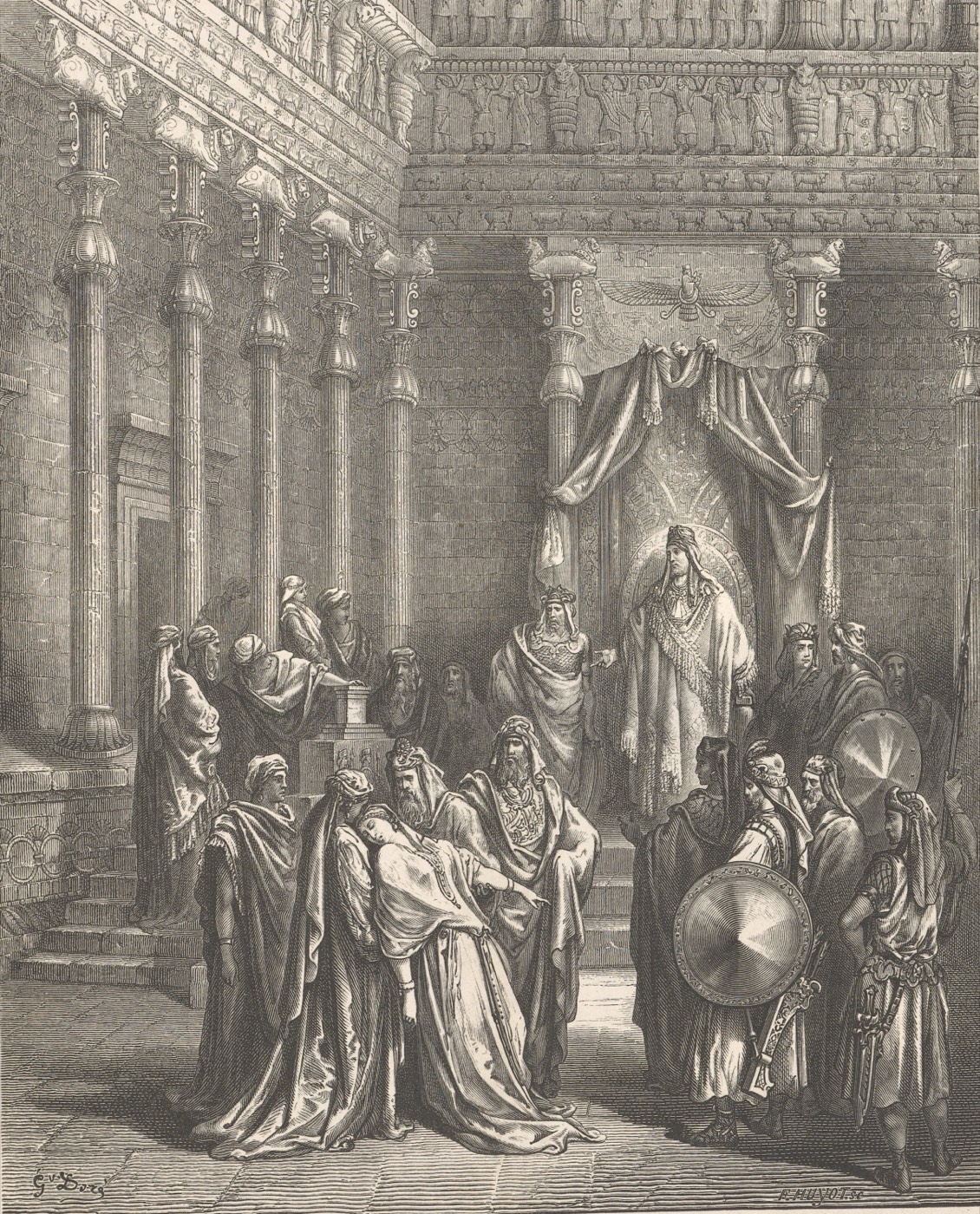
The queen faints into the arms of her attendants.
Bible in art · Esther
Esther Before the King
Gustave Doré · 1866 (designs for La Sainte Bible, Tours); this printing 1873–1874
National Library of Poland, Warsaw
Doré drew this plate for the 1866 Tours Bible, which, like other Catholic Bibles, printed the longer Greek form of Esther. In those added passages Esther faints when she first comes before the king, and that is the moment Doré chose.
In a huge hall with carved friezes and a winged disc above the throne, the king stands under a draped canopy and reaches toward her. Esther collapses into the arms of her attendants, her head fallen back. Guards with round shields and courtiers look on.
From the text
- “Esther put on her royal attire and stood in the inner court of the palace” (Esther 5:1)
- “The king was sitting on his royal throne in the royal courtroom, facing the entrance” (Esther 5:1)
- “The king extended the gold scepter in his hand toward Esther” (Esther 5:2)
The artist’s own
- Esther fainting — from the Greek additions, not in the Hebrew text of these verses
- No scepter in sight; the king reaches out with an open hand
- A winged disc and friezes of figures as in Persian palace carvings
Details
Esther
The king
He stands before his throne and reaches toward her.
The throne
A throne under a draped canopy.
Winged disc
A winged disc is carved above the throne.
Gustave Doré, French, 1832–1883. National Library of Poland (Biblioteka Narodowa), Warsaw — «Pismo Święte Starego i Nowego Testamentu», vol. 1, Warsaw: M. Glücksberg, 1873 (acc. 75.267 A), tabl. 113 · Wood engraving after Gustave Doré’s design · National Library of Poland (Polona): the record of the volume gives the licence «Domena Publiczna» (Public Domain), «copyrightProtected»: false; the scan was uploaded to Wikimedia Commons by the library itself («Polona Upload», GLAM-Wiki partnership: “This file was uploaded to Wikimedia Commons as part of a GLAM-Wiki partnership between the National Library of Poland and Wikimedia Polska”), linking its Polona record.