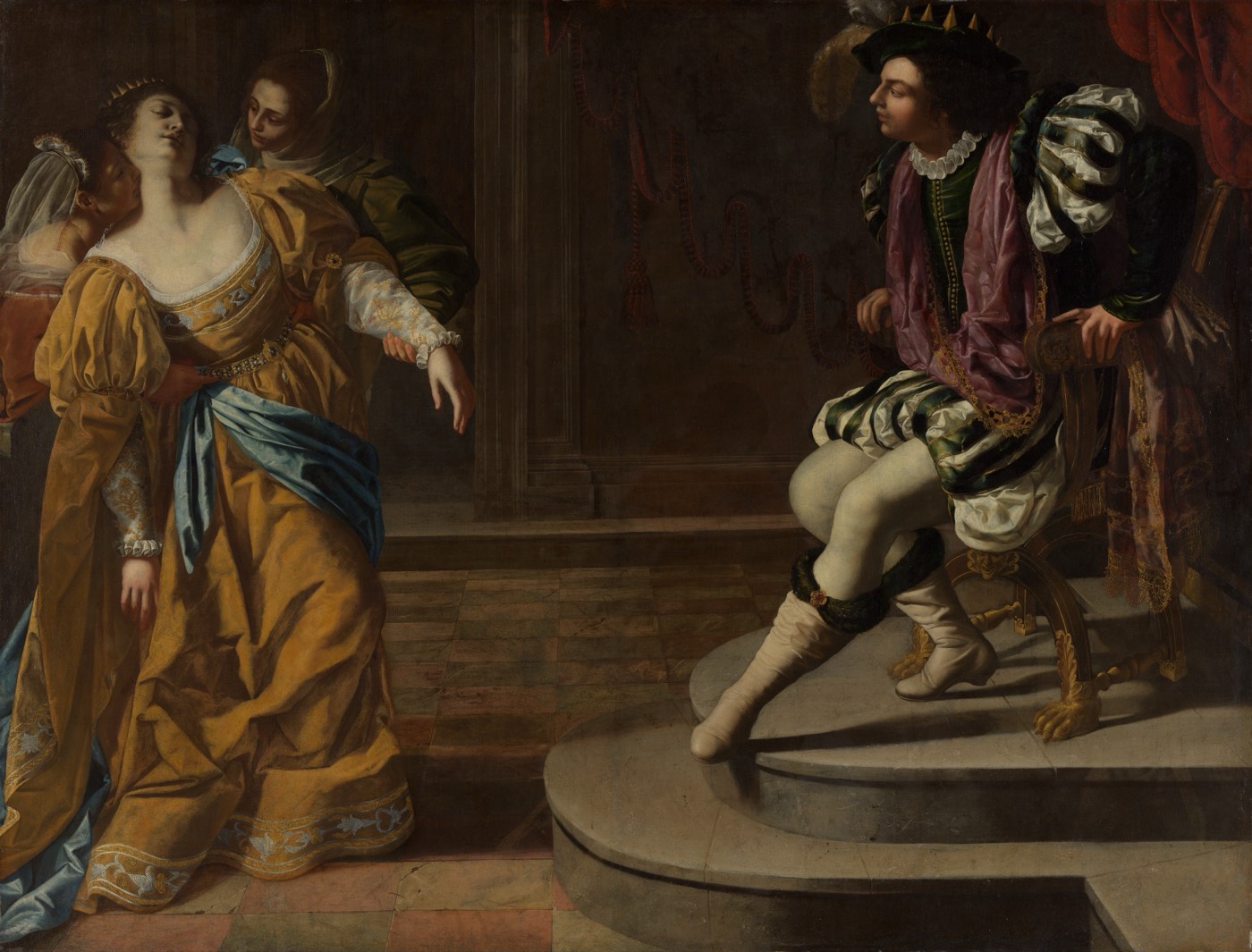
Esther’s head falls back; her eyes are closed.
Bible in art · Esther
Esther before Ahasuerus
Artemisia Gentileschi · 1620s
The Met, New York
Artemisia Gentileschi, one of the best-known painters of 17th-century Italy, painted this large canvas — almost three metres wide — in the 1620s. She had been trained in Rome by her father, the painter Orazio Gentileschi.
At the left Queen Esther, in a golden dress with a blue sash, faints into the arms of her maids. At the right King Ahasuerus, a young man in a plumed hat with a spiked crown, silk breeches and white boots, starts up from his throne on its round stone steps.
From the text
- Esther coming in her royal robes into the inner court of the palace (Esther 5:1)
- The king on his royal throne (Esther 5:1)
- Going to the king uncalled, after three days of fasting (Esther 4:16)
The artist’s own
- Esther fainting — this comes from the Greek additions to the book of Esther, not from the Hebrew text
- Ahasuerus dressed as a young European nobleman of the 1620s
- No golden sceptre (Esther 5:2) — the king rises from his chair instead
- A tiled floor and a tall, dark palace hall
Details
Fainting
The maid
A maid catches her from behind.
Royal robes
A golden dress, a blue sash and an embroidered hem.
The king
Ahasuerus in purple and striped silk starts forward.
The throne
A gilded chair with lion’s-paw feet on round stone steps.
Artemisia Gentileschi, Italian, born Rome 1593–died Naples 1654 or later. The Metropolitan Museum of Art, New York (Gift of Elinor Dorrance Ingersoll, 1969; acc. 69.281) · Oil on canvas · Public Domain — The Met Open Access (CC0). The Met Collection API record: "isPublicDomain": true; The Met marks such works on its website "with the Creative Commons Zero (CC0) icon".