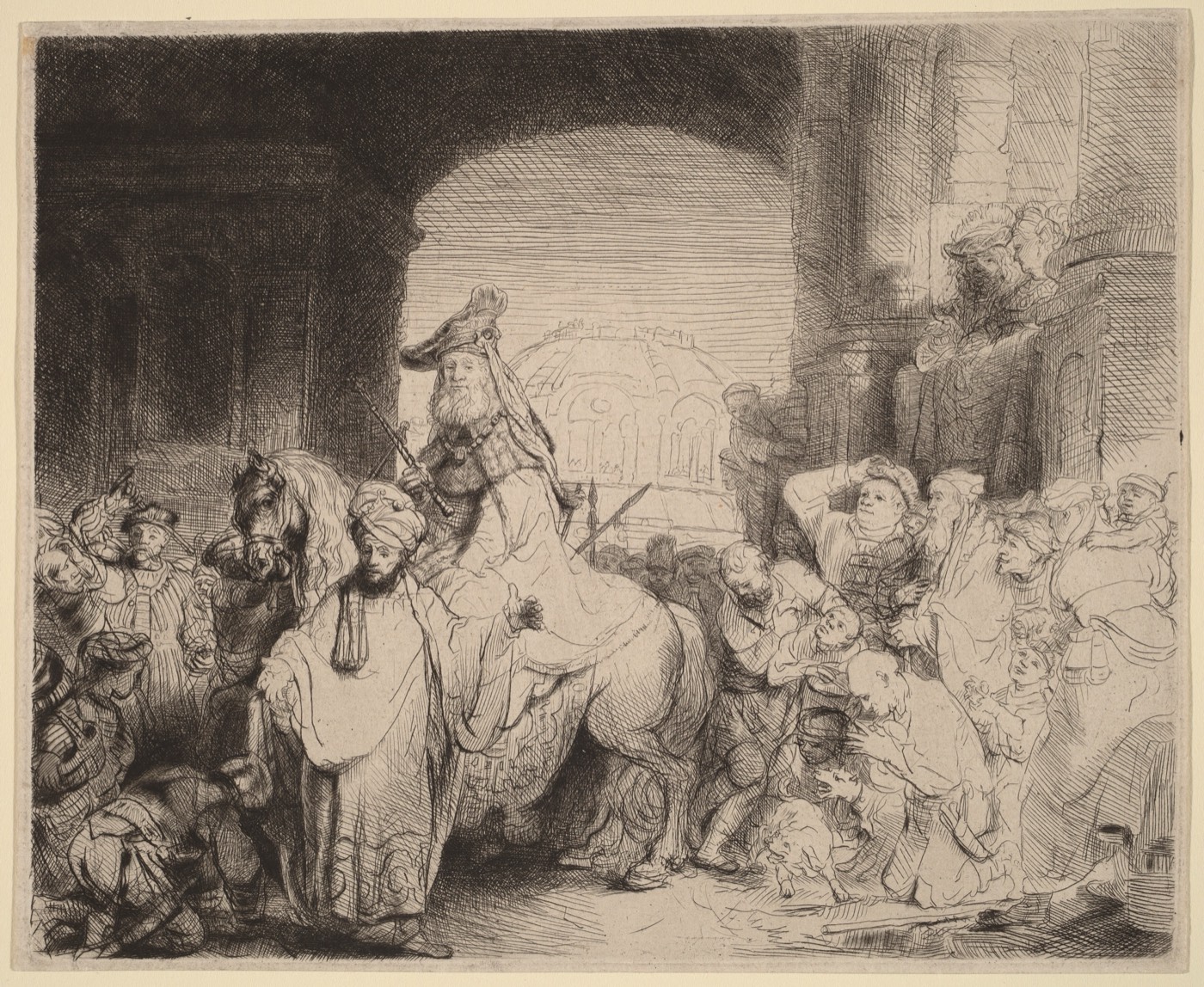
An old man in a plumed hat rides the white horse.
Bible in art · Esther
The Triumph of Mordecai
Rembrandt · c. 1641
National Gallery of Art, Washington
Rembrandt etched this print in Amsterdam around 1641, working the plate with both acid-bitten lines and drypoint. It is only about 21 centimetres wide but full of people.
Mordecai, an old man in a plumed hat and a rich robe, rides a white horse through a crowd that bows and kneels. A man in a turban walks in front leading the horse, one arm outstretched. Up on a balcony at the right, a man and a woman watch the procession.
From the text
- Haman takes the robe and the horse and leads Mordecai through the city square (Esther 6:11)
- “This is what is done for the man whom the king is delighted to honor!” (Esther 6:11)
- The robe and horse that Haman himself had proposed (Esther 6:7–10)
The artist’s own
- The couple on the balcony — often taken to be King Xerxes and Queen Esther; the text does not say they watched
- A great arch and a domed building in the background
- Turbans and robes Rembrandt used for Eastern scenes
- A small dog running in the crowd
Details
Mordecai
Haman
A man in a turban leads the horse, his arm outstretched.
On the balcony
A man and a woman look down — often taken to be the king and Esther.
Bowing crowd
People bow and kneel as the rider passes.
A domed building
Seen through the great arch.
A dog
A small dog trots through the crowd.
Rembrandt van Rijn, Dutch, 1606–1669. National Gallery of Art, Washington (Rosenwald Collection, 1943.3.7106) · Etching and drypoint · NGA Open Access: "Images of these works are available free of charge for any use, commercial or non-commercial, under Creative Commons Zero (CC0)." (NGA open data: published_images.csv openaccess = 1)