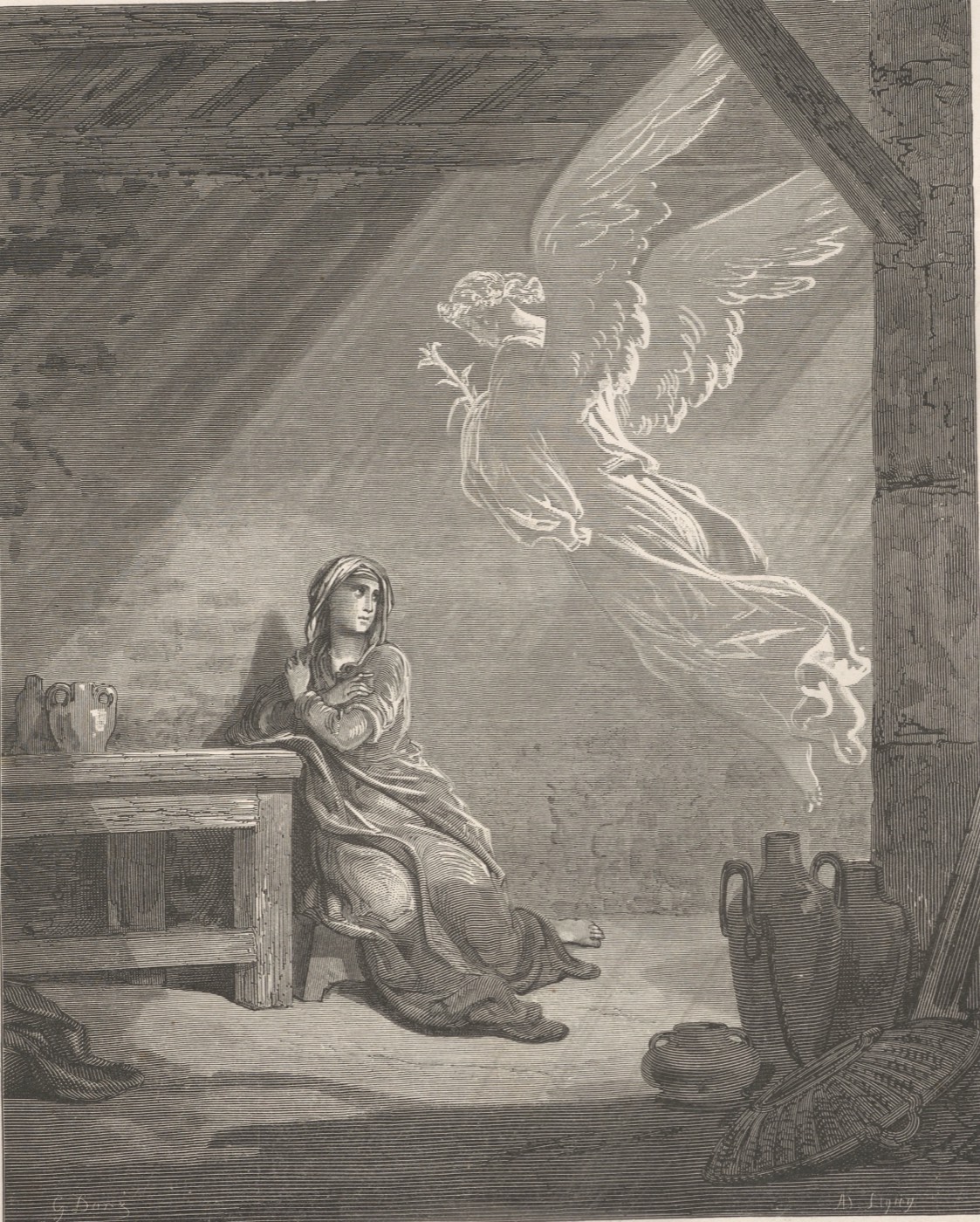
A winged figure floats in the band of light, its robe trailing behind.
Bible in art · Luke
The Annunciation
Gustave Doré · 1866 (designs for La Sainte Bible, Tours); this printing 1873–1874
National Library of Poland, Warsaw
In this plate of the Tours Bible of 1866 Doré drew the design and A. Ligny cut it in wood; both names stand at the foot of the sheet, Doré’s at the left, the engraver’s at the right.
The scene is a plain room under a slanting roof of beams. A wide band of light pours in from the top right, and in it floats a winged figure holding a lily. Mary sits on a low stool by a wooden table, her arms crossed on her chest, turning toward the light with wide eyes.
From the text
- God sent the angel Gabriel to Nazareth, to a virgin named Mary (Luke 1:26–27)
- “Greetings, you who are highly favored! The Lord is with you.” (Luke 1:28)
- “Mary was greatly troubled at his words” (Luke 1:29)
The artist’s own
- The lily in the angel’s hand — a custom of painters in scenes of the Annunciation, not in the text
- A poor room with a rough table, clay jars and a basket on the floor
- The angel made of light, almost transparent, with bare feet
Details
The angel
The lily
A stem of lily flowers in the angel’s hand.
Mary
She sits on a stool, arms crossed on her chest, and looks up in surprise.
Clay jars
Tall jars and a round pot stand on the floor, with a basket beside them.
Gustave Doré, French, 1832–1883. National Library of Poland (Biblioteka Narodowa), Warsaw — «Pismo Święte Starego i Nowego Testamentu», vol. 2, Warsaw: M. Glücksberg, 1874 (acc. 75.267 A) · Wood engraving after Gustave Doré’s design · National Library of Poland (Polona): the record of the volume gives the licence «Domena Publiczna» (Public Domain), «copyrightProtected»: false; the scan was uploaded to Wikimedia Commons by the library itself («Polona Upload», GLAM-Wiki partnership: “This file was uploaded to Wikimedia Commons as part of a GLAM-Wiki partnership between the National Library of Poland and Wikimedia Polska”), linking its Polona record.