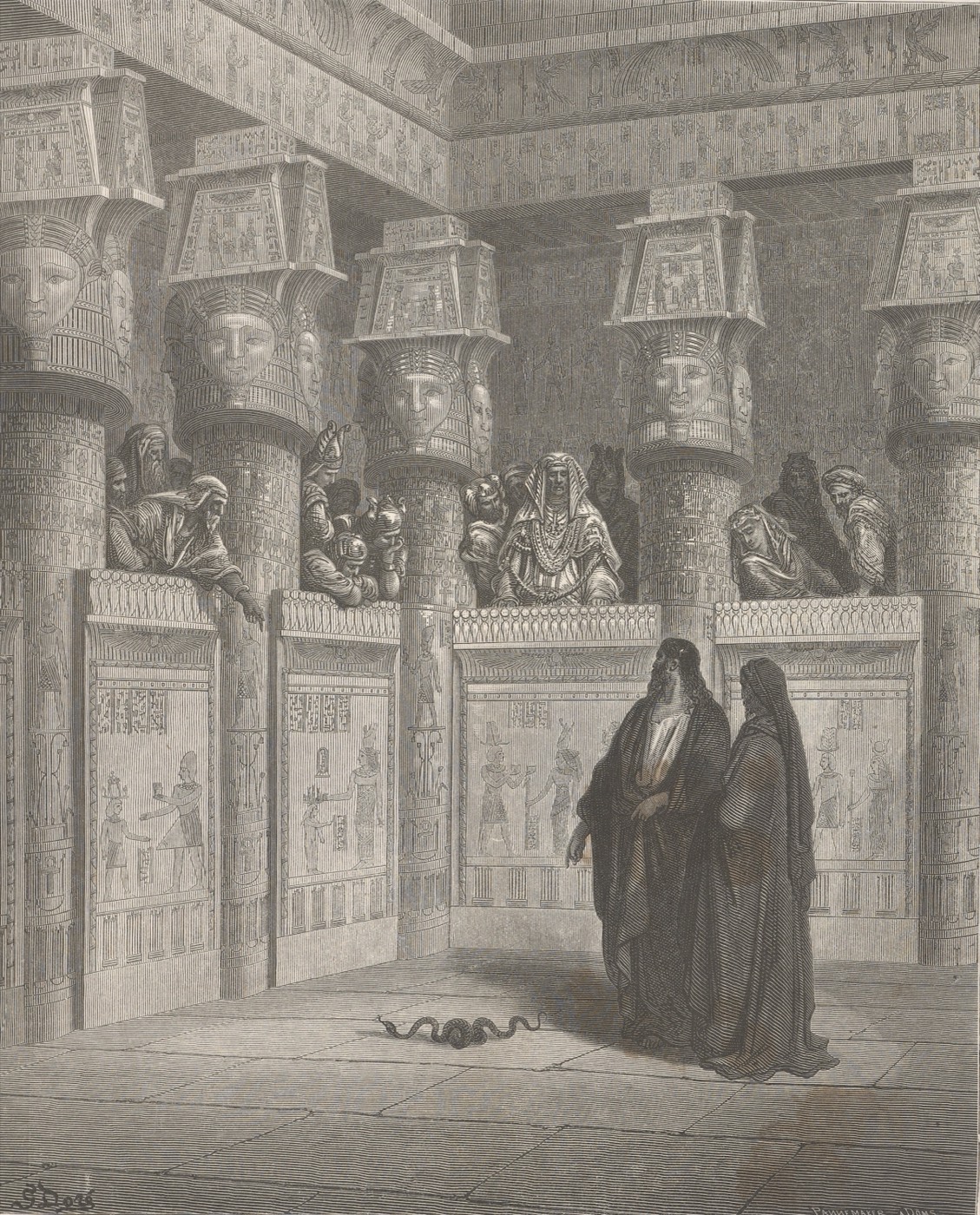
Two bearded men in dark cloaks stand before the court.
Bible in art · Exodus
Aaron's Staff Becomes a Serpent
Gustave Doré · 1866 (designs for La Sainte Bible, Tours); this printing 1873–1874
National Library of Poland, Warsaw
For the court of Pharaoh Doré drew a temple hall modeled on the great Egyptian temples, with column tops carved as women’s faces with cow’s ears, like those of the goddess Hathor at Dendera. Almost the whole plate is architecture.
Moses and Aaron stand small and dark on the bright stone floor, wrapped in long cloaks. Before them a serpent writhes on the pavement. Above, behind a low wall carved with Egyptian reliefs, Pharaoh sits among his courtiers, and his officials lean over the edge to look down.
From the text
- “Aaron threw his staff down before Pharaoh and his officials, and it became a serpent” (Exodus 7:10)
- The magicians of Egypt “did the same things by their magic arts” (Exodus 7:11)
- “Aaron’s staff swallowed up the other staffs” (Exodus 7:12)
The artist’s own
- Hathor-head columns and painted reliefs copied from Egyptian temples
- Only one serpent: the magicians’ staffs are not shown
- Pharaoh high above, behind a wall, like a spectator in a box
Details
Moses and Aaron
The serpent
A snake writhes on the pavement in front of them.
Pharaoh
The king sits behind the wall among his courtiers.
The columns
Column tops carved as faces of the goddess Hathor.
Gustave Doré, French, 1832–1883. National Library of Poland (Biblioteka Narodowa), Warsaw — «Pismo Święte Starego i Nowego Testamentu», vol. 1, Warsaw: M. Glücksberg, 1873 (acc. 75.267 A), tabl. 32 · Wood engraving after Gustave Doré’s design · National Library of Poland (Polona): the record of the volume gives the licence «Domena Publiczna» (Public Domain), «copyrightProtected»: false; the scan was uploaded to Wikimedia Commons by the library itself («Polona Upload», GLAM-Wiki partnership: “This file was uploaded to Wikimedia Commons as part of a GLAM-Wiki partnership between the National Library of Poland and Wikimedia Polska”), linking its Polona record.