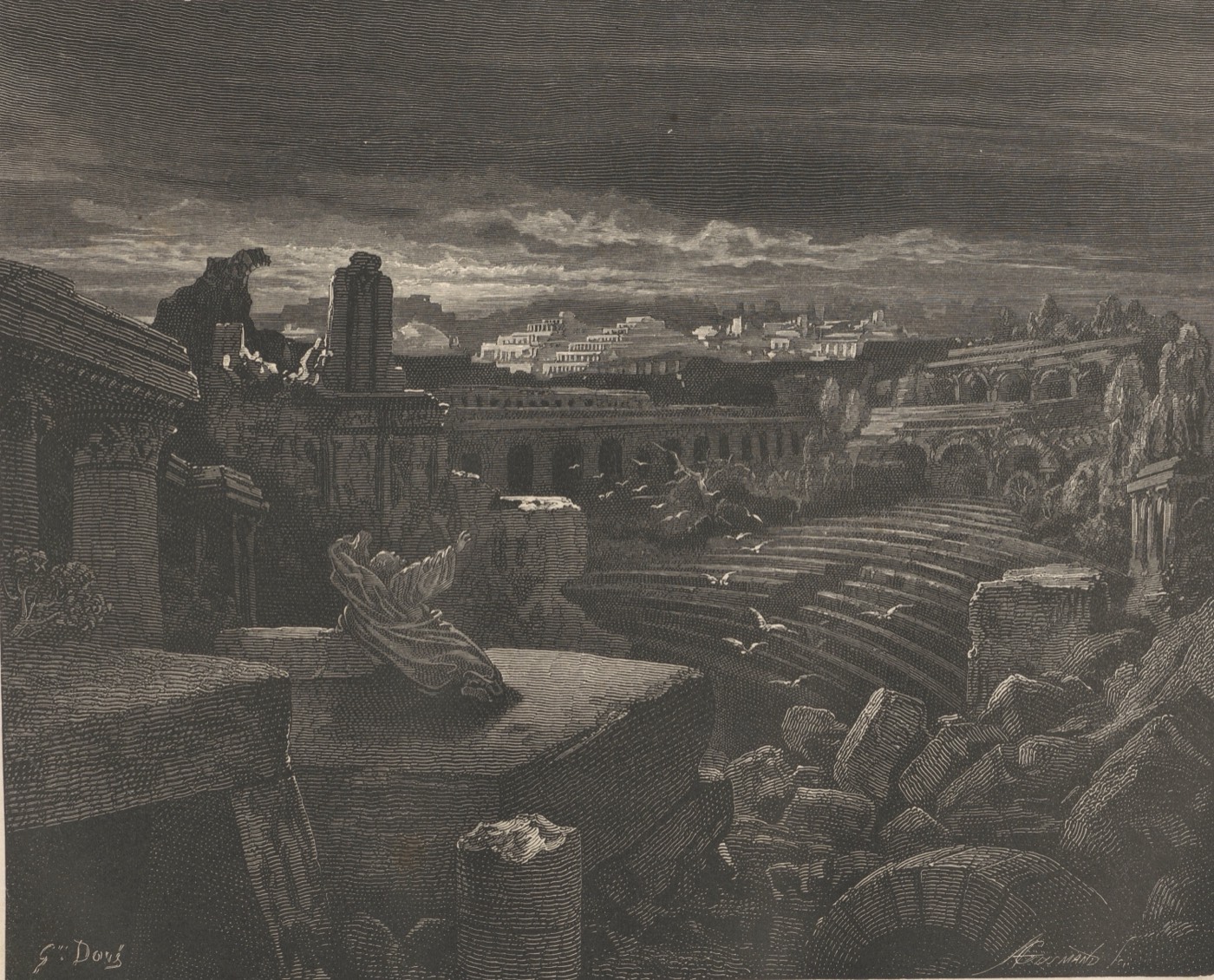
A small figure in a billowing robe raises his arm over the ruins.
Bible in art · Isaiah
Isaiah's Vision of the Destruction of Babylon
Gustave Doré · 1866 (designs for La Sainte Bible, Tours); this printing 1873–1874
National Library of Poland, Warsaw
This plate belongs to the Bible that Gustave Doré designed for the Tours publisher Alfred Mame in 1866. The engraver A. Gusmand, who signed at the lower right, cut it into an end-grain block. This copy comes from the Polish edition printed in Warsaw in 1873–1874.
A lone prophet in a wind-blown robe stands on a fallen block and lifts his arm over a dead city. Broken columns, the empty tiers of a vast theater and long arcades fade into the dusk, and birds wheel over the steps under a heavy band of cloud.
From the text
- Babylon, “the jewel of the kingdoms,” will be overthrown like Sodom and Gomorrah (Isaiah 13:19)
- “She will never be inhabited or settled from generation to generation” (Isaiah 13:20)
- Wild creatures will live in her houses and palaces (Isaiah 13:21–22)
The artist’s own
- Babylon drawn as a ruined Roman city, with the tiers of a theater and arched arcades, not the mud brick of Mesopotamia
- The prophet standing in the ruins himself; in the text he speaks of what will come
- Flocks of birds instead of the ostriches, hyenas and jackals of the verses
Details
The prophet
The empty theater
Tier after tier of stone seats, with no one left to sit on them.
Birds
White birds wheel over the steps, the only life in the city.
The far city
Pale houses on a hill catch the last light under the clouds.
Gustave Doré, French, 1832–1883. National Library of Poland (Biblioteka Narodowa), Warsaw — «Pismo Święte Starego i Nowego Testamentu», vol. 2, Warsaw: M. Glücksberg, 1874 (acc. 75.267 A) · Wood engraving after Gustave Doré’s design · National Library of Poland (Polona): the record of the volume gives the licence «Domena Publiczna» (Public Domain), «copyrightProtected»: false; the scan was uploaded to Wikimedia Commons by the library itself («Polona Upload», GLAM-Wiki partnership: “This file was uploaded to Wikimedia Commons as part of a GLAM-Wiki partnership between the National Library of Poland and Wikimedia Polska”), linking its Polona record.