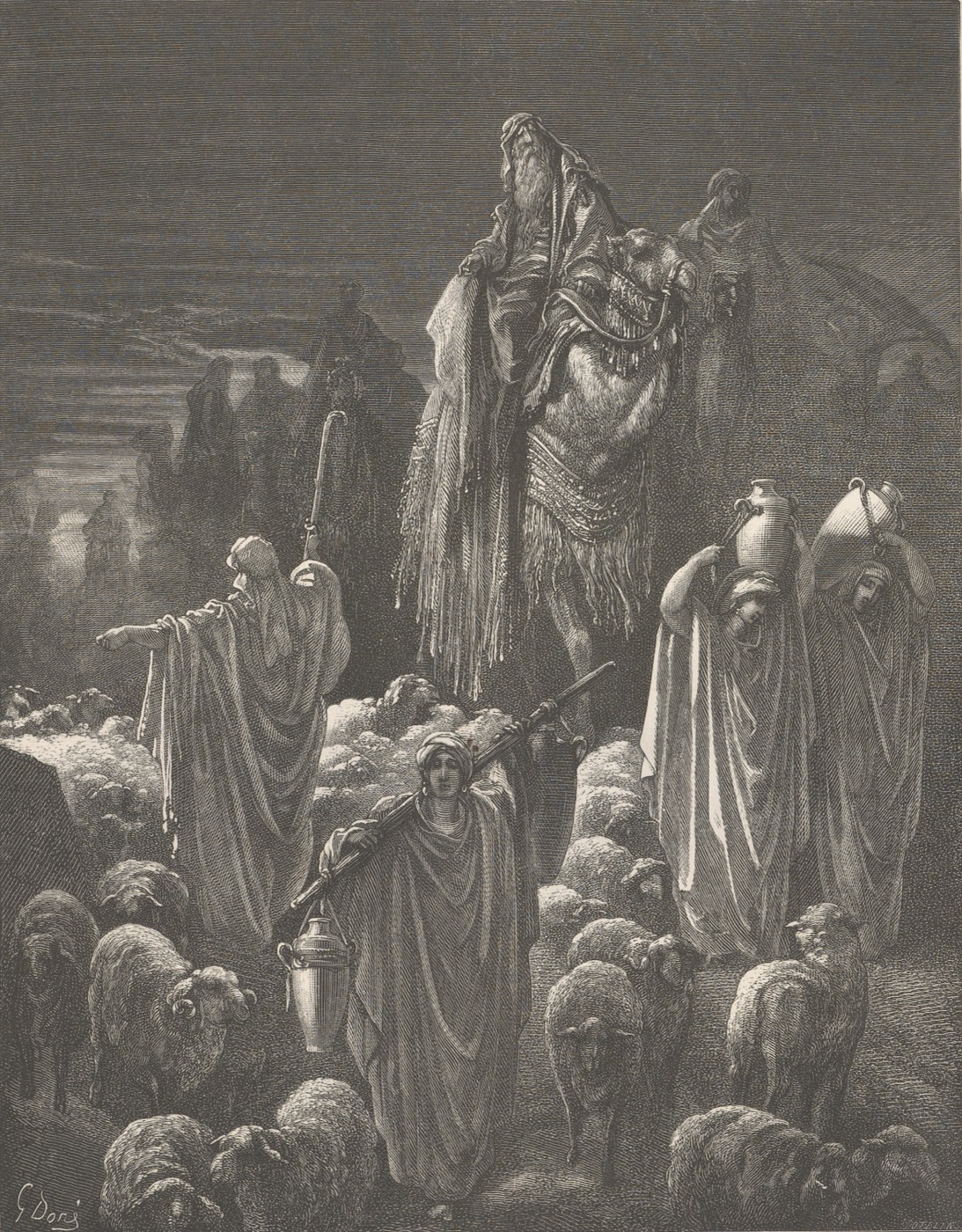
The old man rides high on a camel hung with fringed cloths.
Bible in art · Genesis
Jacob Goes Down to Egypt
Gustave Doré · 1866 (designs for La Sainte Bible, Tours); this printing 1873–1874
National Library of Poland, Warsaw
Here a whole family is on the move, and Doré fills the plate with figures and animals as far as the eye can go. It is one of the plates of the Polish Doré Bible printed by M. Glücksberg in Warsaw in 1873–1874.
Old Jacob rides high on a camel hung with fringed cloths. Around him walk his people: a youth with a vessel slung from a pole, women carrying jars on their shoulders, a man pointing the way ahead. Sheep crowd the foreground, and the rest of the long column fades into the dusk.
From the text
- “Israel set out with all that he had” (Genesis 46:1)
- They took the livestock and possessions they had acquired in Canaan (Genesis 46:6)
- His sons and grandsons, his daughters and granddaughters went with him (Genesis 46:7)
The artist’s own
- Jacob on a camel — the text says his sons carried him in the wagons Pharaoh had sent (Genesis 46:5)
- Water jars and a carrying pole, details of travel in Doré’s own picture of the East
Details
Jacob
The youth with the pole
A young man carries a vessel on a pole over his shoulder.
Women with jars
Two women carry tall jars on their shoulders.
The flock
Sheep crowd the road in the foreground.
Gustave Doré, French, 1832–1883. National Library of Poland (Biblioteka Narodowa), Warsaw — «Pismo Święte Starego i Nowego Testamentu», vol. 1, Warsaw: M. Glücksberg, 1873 (acc. 75.267 A), tabl. 29 · Wood engraving after Gustave Doré’s design · National Library of Poland (Polona): the record of the volume gives the licence «Domena Publiczna» (Public Domain), «copyrightProtected»: false; the scan was uploaded to Wikimedia Commons by the library itself («Polona Upload», GLAM-Wiki partnership: “This file was uploaded to Wikimedia Commons as part of a GLAM-Wiki partnership between the National Library of Poland and Wikimedia Polska”), linking its Polona record.