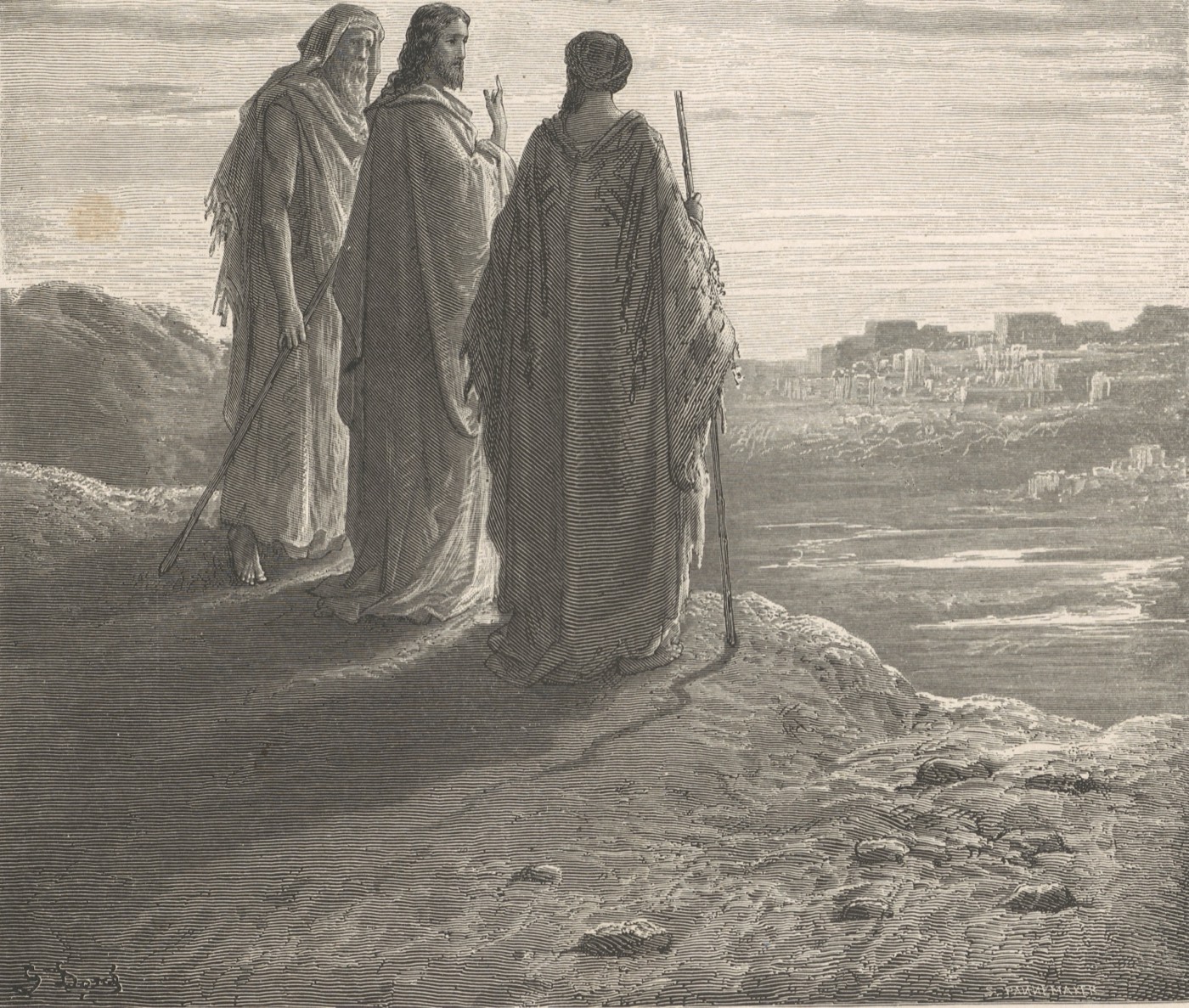
In the middle, a long-haired man raises his hand as he talks.
Bible in art · Luke
On the Road to Emmaus
Gustave Doré · 1866 (designs for La Sainte Bible, Tours); this printing 1873–1874
National Library of Poland, Warsaw
One of the few wide plates among Doré’s New Testament scenes, this one was cut in the Pannemaker workshop for the Bible of 1866.
Three men walk along a ridge in the low sun of evening, their long shadows stretching back across the path. The one in the middle, long-haired, raises a hand as he talks; an old man listens, and the third, seen from behind, leans on his staff. Below them lies a valley, and a town glows on the far hills. Doré gives the stranger no halo.
From the text
- Two of them were going to “a village called Emmaus, about seven miles from Jerusalem” (Luke 24:13)
- “Jesus Himself came up and walked along with them” (Luke 24:15)
- “their eyes were kept from recognizing Him” (Luke 24:16)
The artist’s own
- No halo, so that He looks like any traveler, as the two saw Him
- Evening light and long shadows — the text says later that “the day is almost over” (Luke 24:29)
- A town on the hills, perhaps Emmaus ahead or Jerusalem behind
Details
The stranger
The old disciple
A bearded old man with a staff walks beside him and listens.
Seen from behind
The third man leans on a tall staff, his striped cloak hanging down.
The town
Buildings stand on the far hills in the evening light.
Gustave Doré, French, 1832–1883. National Library of Poland (Biblioteka Narodowa), Warsaw — «Pismo Święte Starego i Nowego Testamentu», vol. 2, Warsaw: M. Glücksberg, 1874 (acc. 75.267 A) · Wood engraving after Gustave Doré’s design · National Library of Poland (Polona): the record of the volume gives the licence «Domena Publiczna» (Public Domain), «copyrightProtected»: false; the scan was uploaded to Wikimedia Commons by the library itself («Polona Upload», GLAM-Wiki partnership: “This file was uploaded to Wikimedia Commons as part of a GLAM-Wiki partnership between the National Library of Poland and Wikimedia Polska”), linking its Polona record.