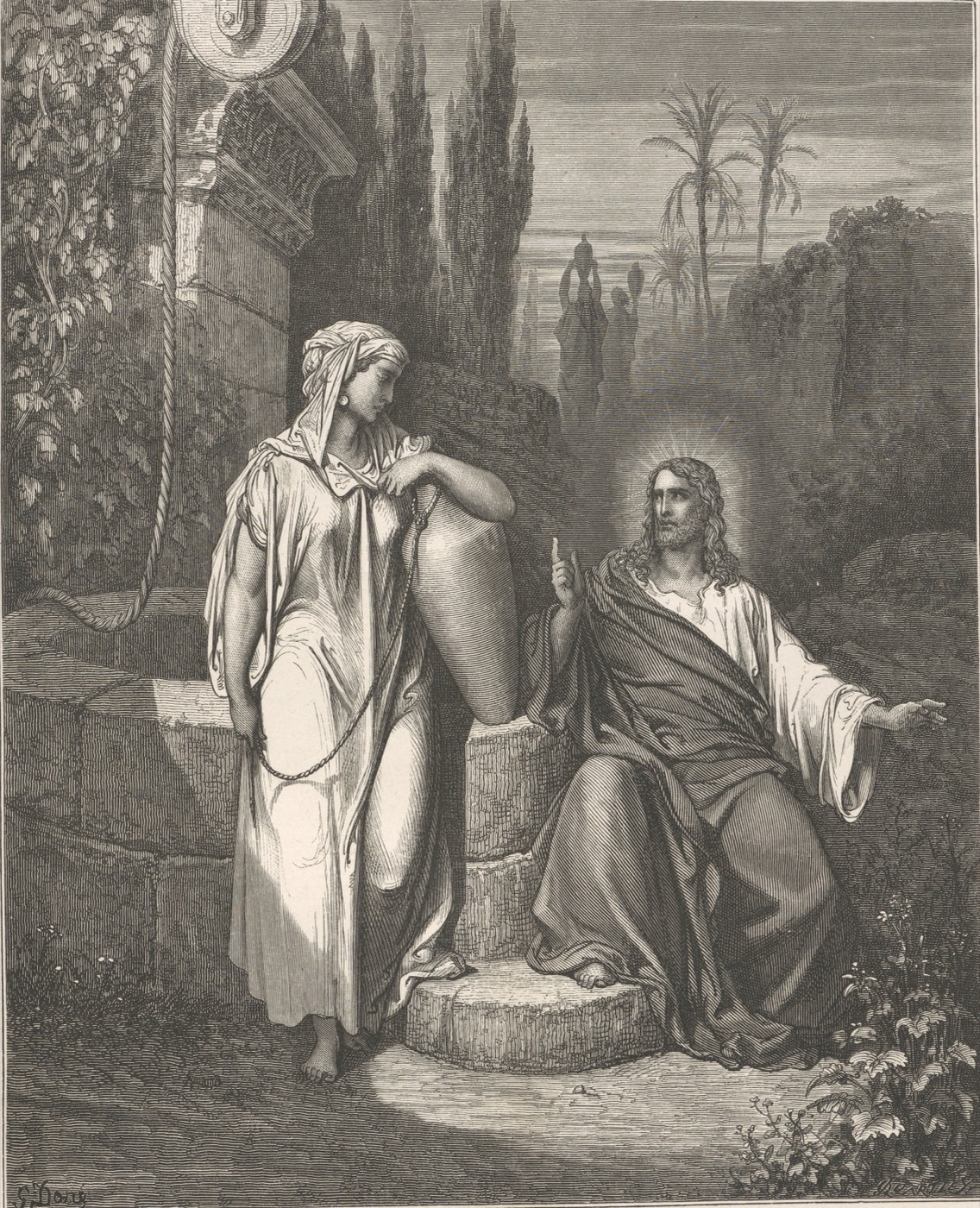
In a white dress and headscarf, she holds the rope and looks down at Him.
Bible in art · John
Jesus and the Woman of Samaria
Gustave Doré · 1866 (designs for La Sainte Bible, Tours); this printing 1873–1874
National Library of Poland, Warsaw
This engraving after Doré is from the Bible he illustrated in 1866, a book whose plates were soon printed in English, German, Polish and many other editions.
The woman stands at the well in a long white dress, a scarf on her head and a rope in her hand, leaning on her tall jar. Jesus, with a halo, sits on the stone steps of the well and points as He speaks. Behind them rise dark cypresses and palms, a carved well-house with a pulley, and far off, other women carry jars on their heads.
From the text
- “Jesus, weary from His journey, sat down by the well” (John 4:6)
- When a Samaritan woman came to draw water, Jesus said to her, “Give Me a drink.” (John 4:7)
- “You are a Jew,” said the woman. “How can You ask for a drink from me” (John 4:9)
The artist’s own
- A grand well with a carved stone frame and a pulley wheel
- Cypresses, palms and vines around Jacob’s well
- The woman in a white dress and earrings, standing in full light
Details
The woman
The water jar
A tall clay jar rests on the rim of the well.
Jesus
With a halo, He sits on the steps and raises a finger as He speaks.
Far away
Small figures carry jars on their heads under the palms.
Gustave Doré, French, 1832–1883. National Library of Poland (Biblioteka Narodowa), Warsaw — «Pismo Święte Starego i Nowego Testamentu», vol. 2, Warsaw: M. Glücksberg, 1874 (acc. 75.267 A) · Wood engraving after Gustave Doré’s design · National Library of Poland (Polona): the record of the volume gives the licence «Domena Publiczna» (Public Domain), «copyrightProtected»: false; the scan was uploaded to Wikimedia Commons by the library itself («Polona Upload», GLAM-Wiki partnership: “This file was uploaded to Wikimedia Commons as part of a GLAM-Wiki partnership between the National Library of Poland and Wikimedia Polska”), linking its Polona record.