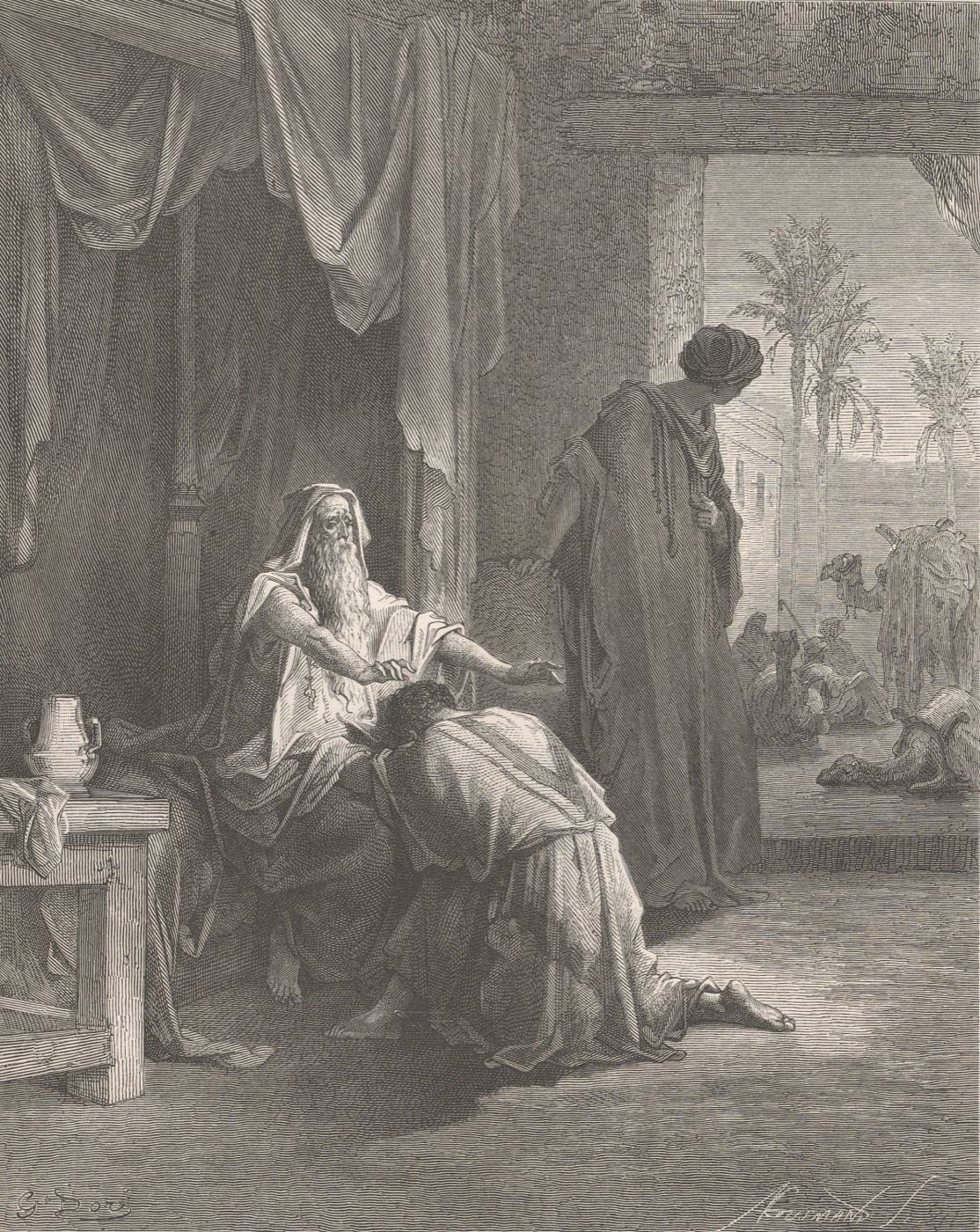
The old blind man sits on his bed, his arms stretched out over his son.
Bible in art · Genesis
Isaac Blesses Jacob
Gustave Doré · 1866 (designs for La Sainte Bible, Tours); this printing 1873–1874
National Library of Poland, Warsaw
An interior scene, rare among the early plates of Genesis. Doré sets the old man’s bed in deep shadow under heavy curtains and opens a bright doorway at the right, so the eye moves from the darkness of the room to the sunny yard.
Blind Isaac, white-bearded, sits on the bed with his arms stretched out; Jacob kneels with his head bowed into his father’s lap. A figure at the door looks out into the yard — perhaps Rebekah watching for Esau. Outside are palm trees and resting camels.
From the text
- “So he came near and kissed him” (Genesis 27:27)
- Isaac said, “Ah, the smell of my son is like the smell of a field that the LORD has blessed” (Genesis 27:27)
- Jacob’s hands were hairy like his brother’s, so Isaac did not know him (Genesis 27:23)
The artist’s own
- A curtained bed and a stone house with a courtyard — the family lived in tents
- The watcher at the door, who adds suspense: the text does not place Rebekah here
Details
Isaac
Jacob
Jacob kneels with his face bowed into his father’s lap.
At the door
A figure stands in the doorway and looks out into the yard.
The yard
Palm trees and camels in the sunlight outside.
Gustave Doré, French, 1832–1883. National Library of Poland (Biblioteka Narodowa), Warsaw — «Pismo Święte Starego i Nowego Testamentu», vol. 1, Warsaw: M. Glücksberg, 1873 (acc. 75.267 A), tabl. 20 · Wood engraving after Gustave Doré’s design · National Library of Poland (Polona): the record of the volume gives the licence «Domena Publiczna» (Public Domain), «copyrightProtected»: false; the scan was uploaded to Wikimedia Commons by the library itself («Polona Upload», GLAM-Wiki partnership: “This file was uploaded to Wikimedia Commons as part of a GLAM-Wiki partnership between the National Library of Poland and Wikimedia Polska”), linking its Polona record.