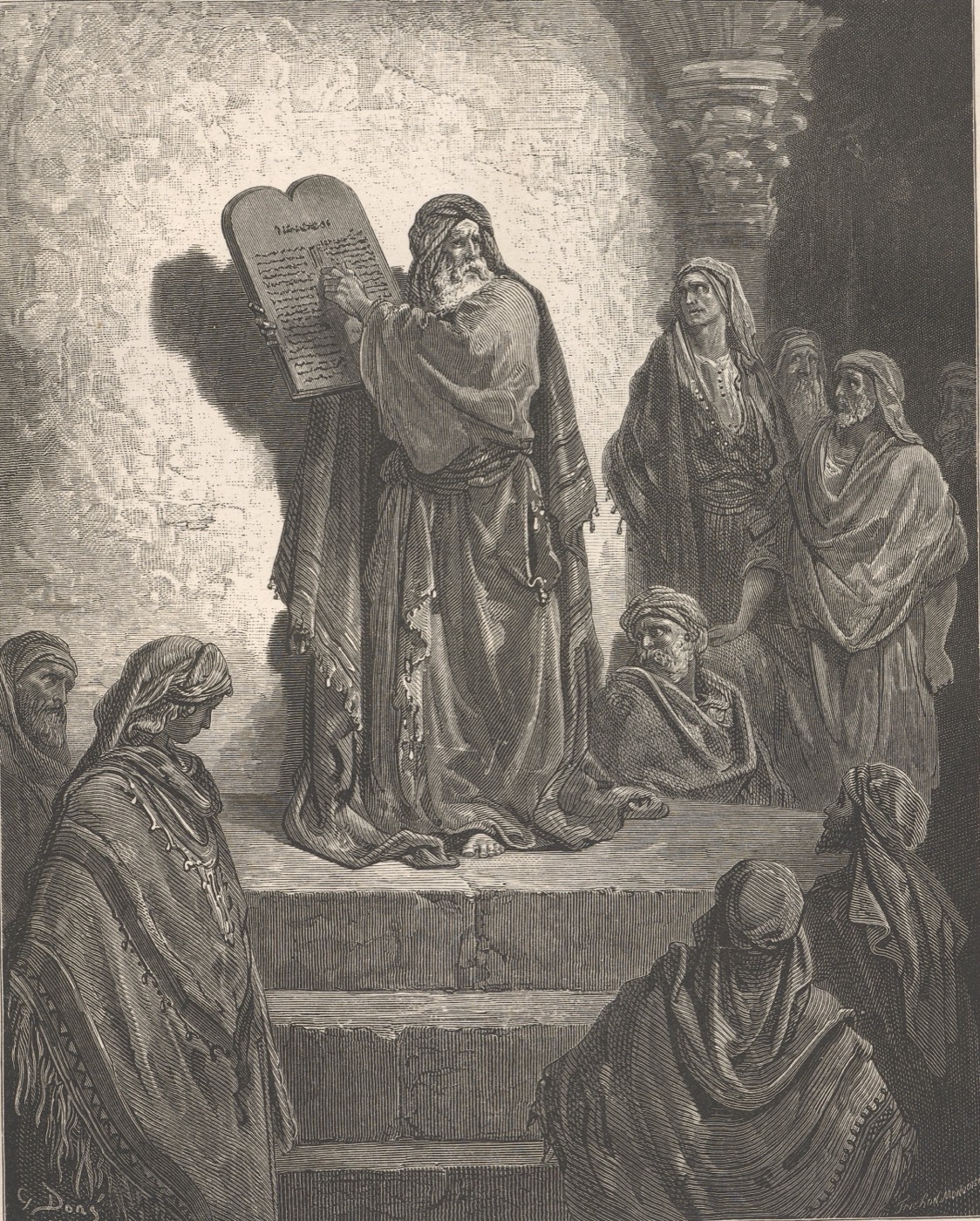
The old scribe stands on the platform and points to the text.
Bible in art · Nehemiah
Ezra Reads the Law to the People
Gustave Doré · 1866 (designs for La Sainte Bible, Tours); this printing 1873–1874
National Library of Poland, Warsaw
Doré drew this plate for the Tours Bible of 1866; within a few years it was printed in Bibles across Europe and America, often with English captions in place of the French.
Ezra, an old man with a white beard and a striped headcloth, stands on a stone platform and points to the writing on a pair of round-topped tablets. Men stand beside and below him, some looking up, some bowing their heads. A bright wall behind throws his shadow and sets him off from the dark crowd.
From the text
- “Ezra the priest brought the Law before the assembly” (Nehemiah 8:2)
- “Ezra the scribe stood on a high wooden platform” (Nehemiah 8:4)
- “Ezra opened the book in full view of all the people” (Nehemiah 8:5)
The artist’s own
- Two stone tablets in place of the book — the shape painters long used for the Ten Commandments
- A stone platform with steps instead of a wooden one
- A carved column capital behind the listeners
Details
Ezra
The tablets
Two round-topped tablets covered with writing.
Listeners
Men stand beside the platform and look up at him.
In the crowd
A figure in a striped cloak bows its head.
Gustave Doré, French, 1832–1883. National Library of Poland (Biblioteka Narodowa), Warsaw — «Pismo Święte Starego i Nowego Testamentu», vol. 1, Warsaw: M. Glücksberg, 1873 (acc. 75.267 A), tabl. 106 · Wood engraving after Gustave Doré’s design · National Library of Poland (Polona): the record of the volume gives the licence «Domena Publiczna» (Public Domain), «copyrightProtected»: false; the scan was uploaded to Wikimedia Commons by the library itself («Polona Upload», GLAM-Wiki partnership: “This file was uploaded to Wikimedia Commons as part of a GLAM-Wiki partnership between the National Library of Poland and Wikimedia Polska”), linking its Polona record.