Encyclopedia › Languages of the Bible
Languages of the Bible
The square script
Aramaic letters taken up after the exile · five final forms · the Hebrew letters printed today
The Hebrew letters printed today come from the Aramaic script of the Persian empire, whose officials wrote to every province “in its own script” and language (Esther 8:9). Jews in Babylonia and Judea took it up during and after the exile, and by the time of the Dead Sea Scrolls, in the last centuries BC, it was the usual hand for books. Its letters fill an even square, hence the Hebrew name ketav meruba, “square writing”. The Talmud calls it Ashurit, “Assyrian”, and a tradition recorded there links the change of script with Ezra the scribe (Ezra 7:6).
Five letters — kaf, mem, nun, pe and tsade — take another shape at the end of a word. Some pairs look alike, such as dalet and resh or he and het, and copyists sometimes confused them. Yod is the smallest letter, the “jot” of Matthew 5:18. Scribes copying a Torah scroll still follow old rules for this script: ruled lines, a special ink, and every letter copied from a written text, not from memory.
In art
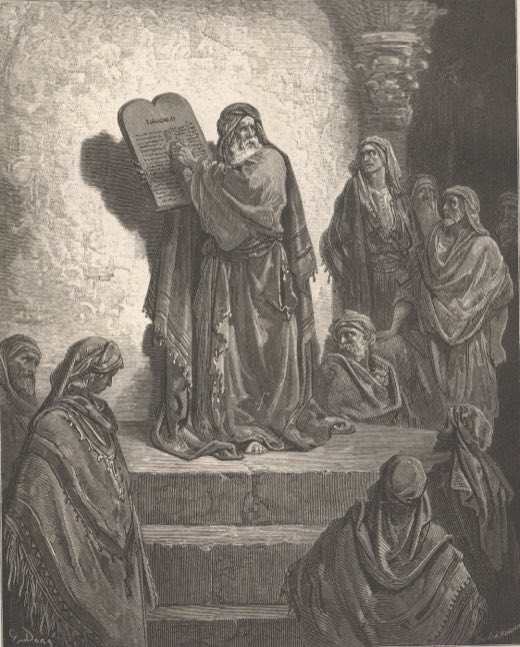 Ezra Reads the Law to the People
Key verses
At once the royal scribes were summoned, and on the twenty-third day of the third month (the month of Sivan), they recorded all of Mordecai’s orders to the Jews and to the satraps, governors, and princes of the 127 provinces from India to Cush—writing to each province in its own script, to every people in their own language, and to the Jews in their own script and language.this Ezra came up from Babylon. He was a scribe skilled in the Law of Moses, which the LORD, the God of Israel, had given. The king had granted Ezra all his requests, for the hand of the LORD his God was upon him.At that time all the people gathered together in the square before the Water Gate, and they asked Ezra the scribe to bring out the Book of the Law of Moses, which the LORD had commanded for Israel.For I tell you truly, until heaven and earth pass away, not a single jot, not a stroke of a pen, will disappear from the Law until everything is accomplished.See also
- Hebrew, Aramaic and GreekWriting and books
- The old Hebrew scriptLanguages of the Bible
- Consonants and vowel pointsLanguages of the Bible
- ScribeWork and trades
- Dating by handwritingHow the Bible’s world is studied
- EzraPeople
Sources: Tyndale Open Bible Dictionary © 2023 Tyndale House Publishers, CC BY-SA 4.0 — adapted and shortened; the original work is available for free at tyndaleopenresources.com · Sources and rights