Encyclopedia › Languages of the Bible
Languages of the Bible
How the first Greek Bibles looked
Capitals without spaces · nomina sacra, the holy names shortened · accents added later
The oldest manuscripts of the Greek Bible look very unlike a printed page. They are written in capitals, called uncials, with no spaces between words, little punctuation and no accents — all of these were added by later copyists. The reader had to find where each word ended, one reason why texts were read aloud. Small joined letters, the minuscule hand, took over in the 9th century, and most later manuscripts use them.
Christian copyists shortened certain holy names to their first and last letters with a line above: theos, “God”, kyrios, “Lord”, and the names Jesus and Christ. Scholars call them nomina sacra, “sacred names”; they are already in the earliest papyri, of the 2nd and 3rd centuries. The Greek word ichthys, “fish”, could be read as the first letters of “Jesus Christ, Son of God, Saviour”, and early Christians used the fish as a sign. Paul often dictated his letters — Tertius “wrote down” Romans (Romans 16:22) — and added the closing greeting himself: “This greeting is in my own hand — Paul” (2 Thessalonians 3:17).
In art
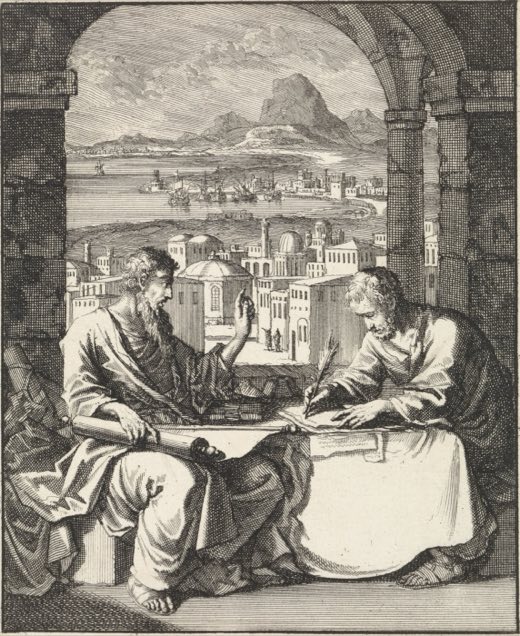 Paul Dictates the Letter to the Romans
Key verses
I, Tertius, who wrote down this letter, greet you in the Lord.This greeting is in my own hand—Paul. This is my mark in every letter; it is the way I write.This greeting is in my own hand—Paul. Remember my chains. Grace be with you.See also
- The great codicesHow the Bible came to be
- Koine: the common GreekThe Greek world of Paul
- Right to left, left to rightLanguages of the Bible
- Reading aloudWriting and books
- Bible manuscriptsExplore · Gospel books copied and painted by hand from the 9th to the 17th century — Armenian, Greek, Ethiopian, Arabic and Latin. Turn the pages and zoom in.
- PaulPeople
Sources: Tyndale Open Bible Dictionary © 2023 Tyndale House Publishers, CC BY-SA 4.0 — adapted and shortened; the original work is available for free at tyndaleopenresources.com · Sources and rights