Encyclopedia › Writing and books
Writing and books
Hebrew, Aramaic and Greek
Old Hebrew letters, then the Aramaic “square” script · Aramaic in Ezra and Daniel · Greek New Testament
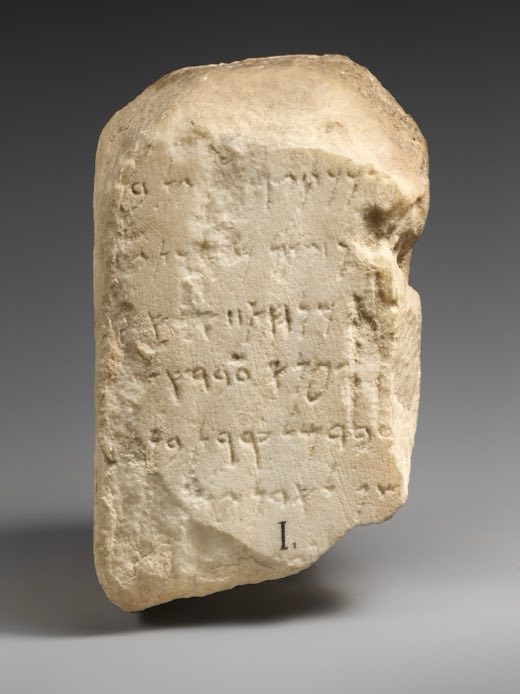
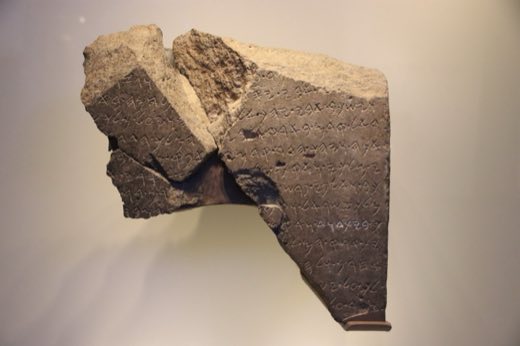
The Old Testament is written mostly in Hebrew, with some chapters in Aramaic, the language of trade and government in the Assyrian, Babylonian and Persian empires: Ezra 4:8–6:18 and 7:12–26, and Daniel 2:4–7:28. About 700 BC the officials of Jerusalem asked the Assyrian envoy, “Please speak to your servants in Aramaic, since we understand it” (2 Kings 18:26). Before the exile Hebrew was written in the old Hebrew letters, close to the Phoenician ones; after it, Jews took up the Aramaic “square” script, in which Hebrew is still printed. The Samaritans kept the old letters.
In the square script yod is the smallest letter. “Not a single jot, not a stroke of a pen, will disappear from the Law,” says Jesus (Matthew 5:18): the jot is the yod, the Greek iota. The New Testament was written in koine, the common Greek of the eastern Mediterranean after Alexander the Great. The notice on the cross “was written in Hebrew, Latin, and Greek” (John 19:20) — “Hebrew” here perhaps meaning Aramaic, the everyday speech of the land. A few of Jesus’ Aramaic words are kept in the Gospels, such as “Talitha koum!” (Mark 5:41).
Key verses
Then Eliakim son of Hilkiah, along with Shebnah and Joah, said to the Rabshakeh, “Please speak to your servants in Aramaic, since we understand it. Do not speak with us in Hebrew in the hearing of the people on the wall.”And in the days of Artaxerxes king of Persia, Bishlam, Mithredath, Tabeel, and the rest of his associates wrote a letter to Artaxerxes. It was written in Aramaic and then translated.Then the astrologers answered the king in Aramaic, “O king, may you live forever! Tell your servants the dream, and we will give the interpretation.”For I tell you truly, until heaven and earth pass away, not a single jot, not a stroke of a pen, will disappear from the Law until everything is accomplished.Many of the Jews read this sign, because the place where Jesus was crucified was near the city, and it was written in Hebrew, Latin, and Greek.Taking her by the hand, Jesus said, “Talitha koum!” which means, “Little girl, I say to you, get up!”See also
- Latin in the New TestamentJewish groups and the Roman world
- ArameansPeoples and gods around Israel
- GreeksPeoples and gods around Israel
- Koine: the common GreekThe Greek world of Paul
- Biblical HebrewLanguages of the Bible
- Aramaic in the Old TestamentLanguages of the Bible
- Aramaic words in the New TestamentLanguages of the Bible
- Latin words that stayed: Calvary, INRI, Ecce homoLanguages of the Bible
- The square scriptLanguages of the Bible
- Bible manuscriptsExplore · Gospel books copied and painted by hand from the 9th to the 17th century — Armenian, Greek, Ethiopian, Arabic and Latin. Turn the pages and zoom in.
Sources: Tyndale Open Bible Dictionary © 2023 Tyndale House Publishers, CC BY-SA 4.0 — adapted and shortened; the original work is available for free at tyndaleopenresources.com · Sources and rights