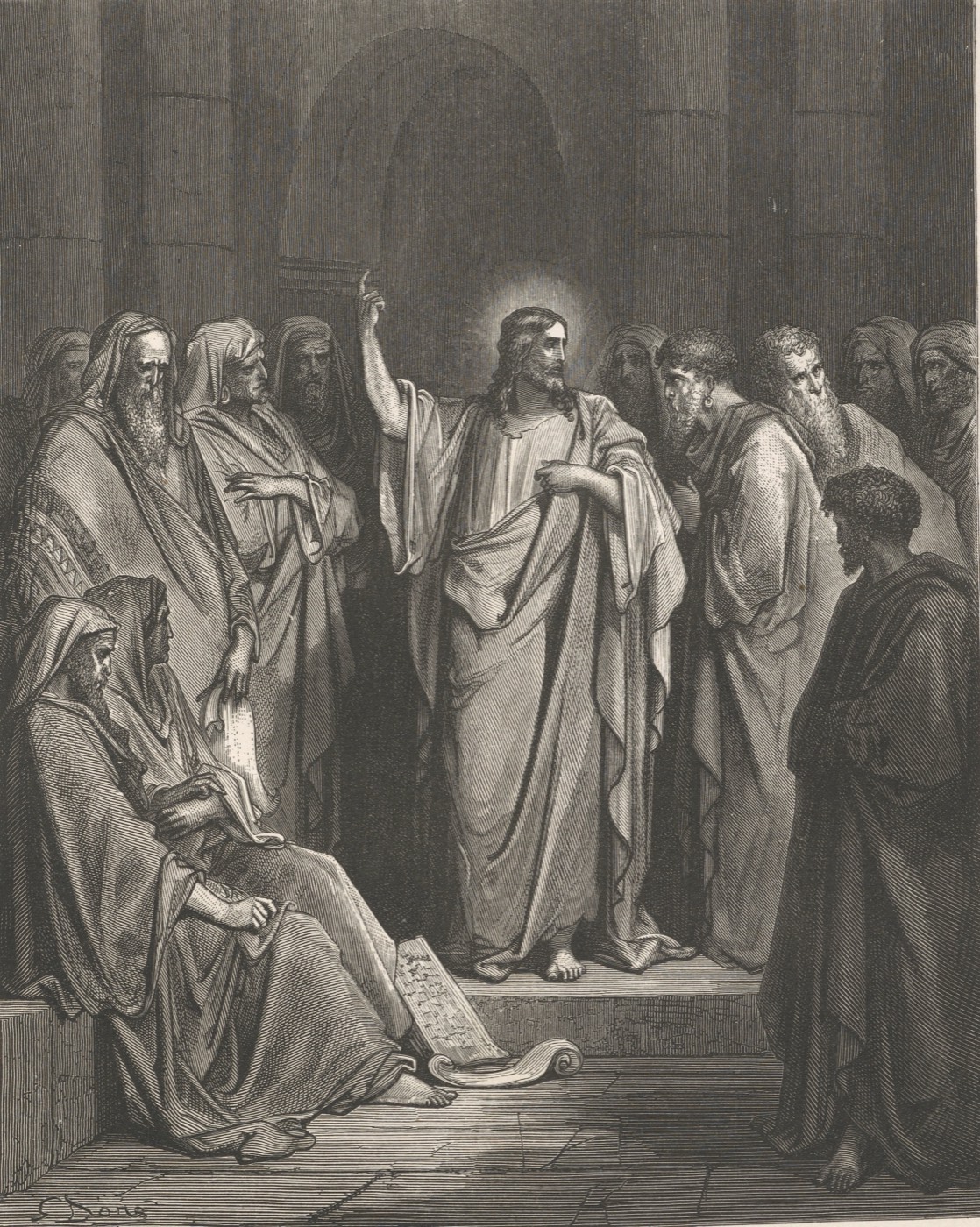
With a halo and a raised hand, He stands in the brightest part of the hall.
Bible in art · Luke
Jesus in the Synagogue at Nazareth
Gustave Doré · 1866 (designs for La Sainte Bible, Tours); this printing 1873–1874
National Library of Poland, Warsaw
This wood engraving after Doré comes from his Bible of 1866, a book of some 230 full-page plates. Here no engraver’s name can be read, only Doré’s signature at the bottom left.
Jesus, with a halo, stands on a low step in the dim synagogue, His right hand raised. The men of Nazareth gather close in long hooded robes; some lean in, some fold their arms, and old men sit on a bench at the left. Behind Him an arched doorway opens into darkness, and at His feet lies a scroll.
From the text
- “As was His custom, He entered the synagogue on the Sabbath.” (Luke 4:16)
- “the scroll of the prophet Isaiah was handed to Him” (Luke 4:17)
- “The eyes of everyone in the synagogue were fixed on Him” (Luke 4:20)
The artist’s own
- He stands to speak, while the text says He rolled up the scroll, gave it back and sat down
- The scroll left lying on the step at His feet
- Heavy stone pillars and an arch in deep shadow
Details
Jesus
The scroll
An open scroll with lines of writing lies on the step.
The elders
Old men in hoods sit on a stone bench and listen.
The arch
A dark arched doorway rises behind Him.
Gustave Doré, French, 1832–1883. National Library of Poland (Biblioteka Narodowa), Warsaw — «Pismo Święte Starego i Nowego Testamentu», vol. 2, Warsaw: M. Glücksberg, 1874 (acc. 75.267 A) · Wood engraving after Gustave Doré’s design · National Library of Poland (Polona): the record of the volume gives the licence «Domena Publiczna» (Public Domain), «copyrightProtected»: false; the scan was uploaded to Wikimedia Commons by the library itself («Polona Upload», GLAM-Wiki partnership: “This file was uploaded to Wikimedia Commons as part of a GLAM-Wiki partnership between the National Library of Poland and Wikimedia Polska”), linking its Polona record.