Encyclopedia › How the Bible’s world is studied
How the Bible’s world is studied
Biblical archaeology and its debates
Edward Robinson, 1838 · Albright’s «biblical archaeology» · minimalists and maximalists · a field still arguing
Modern study of the Bible lands began with travelers who looked for biblical places. In 1838 the American Edward Robinson identified dozens of sites by their Arabic names, and in 1865 the Palestine Exploration Fund was founded in London to survey and excavate. In the mid-20th century William Foxwell Albright and his students made “biblical archaeology” a field of its own; many of them hoped excavation would confirm the Bible’s history, and they read finds in its light. Kathleen Kenyon’s work at Jericho in the 1950s, which found no walled city there at the time usually given for Joshua, was one of the first results to challenge that approach.
From the 1970s the field changed. Archaeologists began to study the whole life of ancient societies — villages, farming, trade, climate — and not only the questions the Bible raised. In the 1990s scholars sometimes called minimalists argued that the biblical history was largely a late creation with little behind it; others, called maximalists, defended much of its historical core. The finding of the Tel Dan stele in 1993, with “the house of David”, was one of many finds that shaped the argument. Today most scholars stand somewhere between, and debate case by case: the patriarchs, the exodus, the conquest, the size of David’s kingdom. Many people of faith and of none take part in the work.
In art
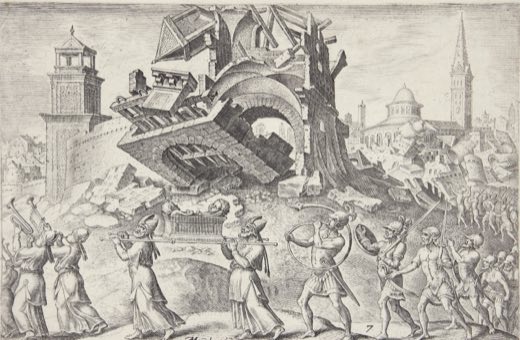 The Destruction of Jericho
See also
- How a biblical place is identifiedHow the Bible’s world is studied
- Walking the land: surveysHow the Bible’s world is studied
- Digging by layersHow the Bible’s world is studied
- The fall of JerichoWeapons and warfare
- The Tel Dan SteleThe Bible in stone
- David and Solomon in archaeology: the tenth-century debateHow the Bible’s world is studied
Sources: Tyndale Open Bible Dictionary © 2023 Tyndale House Publishers, CC BY-SA 4.0 — adapted and shortened; the original work is available for free at tyndaleopenresources.com · Sources and rights