Encyclopedia › The Bible in stone
The Bible in stone
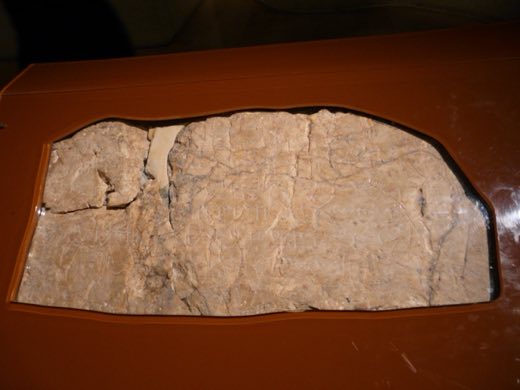
The Tel Dan Stele
Aramaic inscription on basalt · 9th century BC · found 1993–94 at Tel Dan
In 1993, at Tel Dan by the springs of the Jordan, Gila Cook, the surveyor of Avraham Biran’s excavation, noticed a piece of inscribed basalt reused in a later wall by the city gate. Two smaller pieces turned up in 1994. They come from a stele written in Aramaic in the 9th century BC by a king of Aram whose name is lost; most scholars think he was Hazael of Damascus. The stones are now in the Israel Museum.
The king says that the king of Israel had once entered his father’s land, and that he himself killed [Jo]ram son of [Ahab], king of Israel, and [Ahaz]iah son of [Joram], king of the house of David. The brackets mark letters lost and restored by most editors. The words “house of David”, written as one word, are the first mention of David’s dynasty found outside the Bible, set down about a century and a half after his time. A few scholars read them as the name of a place or a god; most take them as the name of the kingdom of Judah after its founder, as the Assyrians named Israel after Omri.
In Kings the same two kings die in the same year, but at the hand of Jehu: “Jehu drew his bow and shot Joram” (2 Kings 9:24), and Ahaziah too was struck down. The stele claims the deed for its own king. By one view Jehu acted as Hazael’s ally; by another the king of Aram simply took the credit.
See also
- Dan: the city at the springs of the JordanCities of the Bible
- Moabite Stone (Mesha Stele)The Bible in stone
- Black Obelisk of Shalmaneser IIIThe Bible in stone
- David and Solomon in archaeology: the tenth-century debateHow the Bible’s world is studied
- Biblical archaeology and its debatesHow the Bible’s world is studied
- Hazael of DamascusRulers around the Bible
- HazaelPeople
- JehuPeople
- Joram, son of AhabPeople
- DanPlaces
Sources: Tyndale Open Bible Dictionary © 2023 Tyndale House Publishers, CC BY-SA 4.0 — adapted and shortened; the original work is available for free at tyndaleopenresources.com · Sources and rights