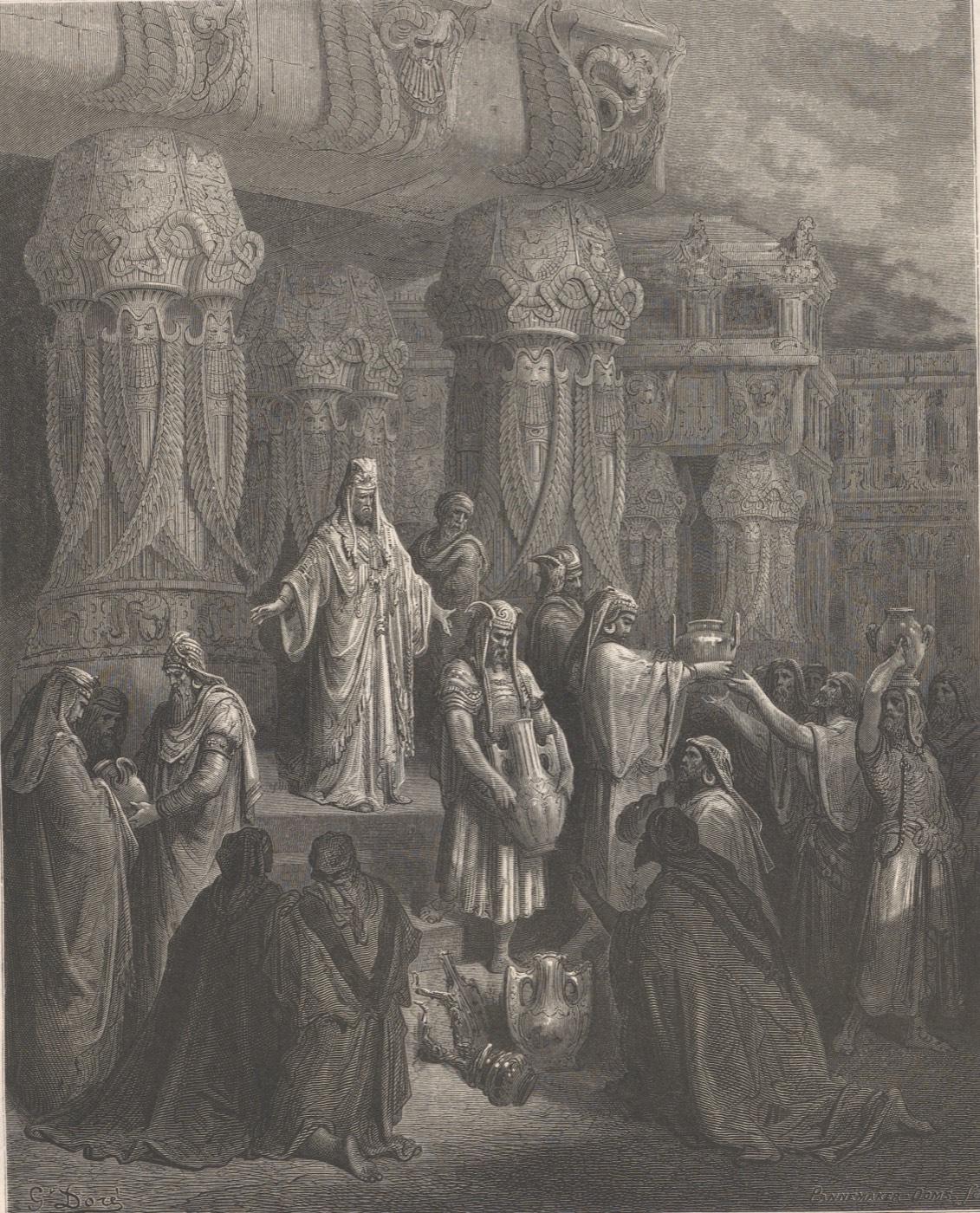
The king stands on the step with his arms spread out.
Bible in art · Ezra
Cyrus Returns the Vessels of the Temple
Gustave Doré · 1866 (designs for La Sainte Bible, Tours); this printing 1873–1874
National Library of Poland, Warsaw
The engraving firm Pannemaker-Doms signed this plate. Doré drew it for the 1866 Bible, imagining a Persian palace out of what was then known of ancient Near Eastern ruins, and adding plenty of his own fantasy.
Cyrus stands on a low step between massive columns, his arms spread wide. Around him servants carry out jugs and bowls — one lifts a vase high, others kneel — and more vessels lie at his feet. Daylight comes in from the open side and glints on the metal.
From the text
- “King Cyrus also brought out the articles belonging to the house of the LORD” (Ezra 1:7)
- Nebuchadnezzar had carried them away from Jerusalem (Ezra 1:7)
- Mithredath the treasurer counted them out to Sheshbazzar (Ezra 1:8)
The artist’s own
- Huge columns with carved capitals like bundled leaves and coiled serpents
- Cyrus handing over the vessels in person — the text has the treasurer do it
- Guards in scale armor and tall caps
Details
Cyrus
Lifting a vase
A servant raises a two-handled vessel.
Vessels
Jugs and bowls lie on the ground at the foot of the step.
The columns
Massive columns with heavily carved capitals hold up the hall.
Gustave Doré, French, 1832–1883. National Library of Poland (Biblioteka Narodowa), Warsaw — «Pismo Święte Starego i Nowego Testamentu», vol. 1, Warsaw: M. Glücksberg, 1873 (acc. 75.267 A), tabl. 83 · Wood engraving after Gustave Doré’s design · National Library of Poland (Polona): the record of the volume gives the licence «Domena Publiczna» (Public Domain), «copyrightProtected»: false; the scan was uploaded to Wikimedia Commons by the library itself («Polona Upload», GLAM-Wiki partnership: “This file was uploaded to Wikimedia Commons as part of a GLAM-Wiki partnership between the National Library of Poland and Wikimedia Polska”), linking its Polona record.