It shines through ragged clouds over the ruins.
Bible in art · Revelation
Babylon Fallen
Gustave Doré · 1866 (designs for La Sainte Bible, Tours); this printing 1873–1874
National Library of Poland, Warsaw
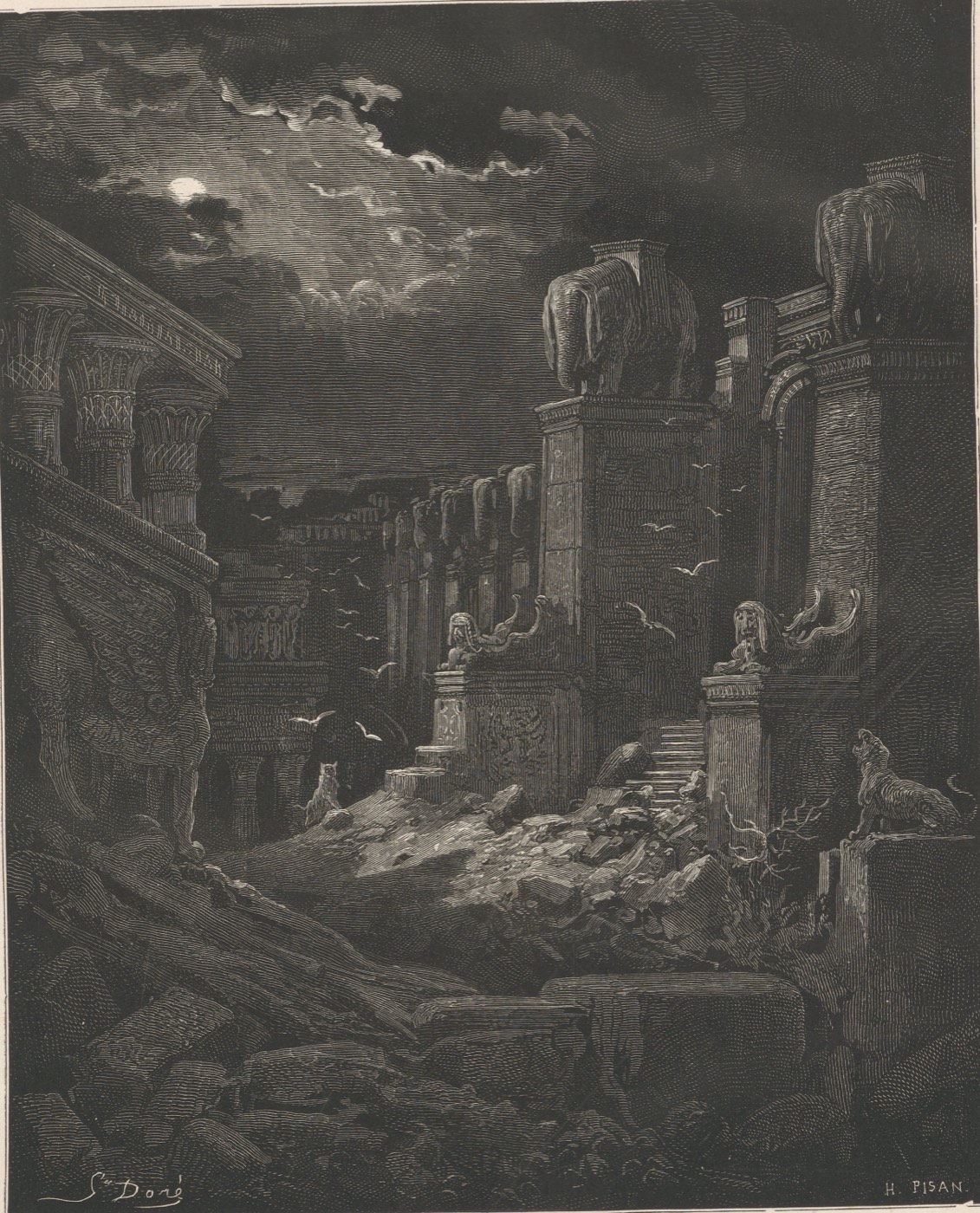
H. Pisan, whose name stands at the lower right, cut this night scene for the Bible of 1866. It shows no people at all, only a ruined city under the moon.
Broken steps and fallen blocks fill the foreground. Around them rise columns with Egyptian lotus capitals, giant elephants on tall pillars, and winged sphinxes on the stair rails. Birds circle in the moonlight, a jackal prowls among the stones, and a wild beast howls on a pedestal at the right. The moon shines through ragged clouds.
From the text
- “Fallen, fallen is Babylon the great!” (Revelation 18:2)
- “She has become a lair for demons and a haunt for every unclean spirit, every unclean bird, and every detestable beast.” (Revelation 18:2)
The artist’s own
- Architecture of many lands mixed together: Egyptian columns, winged sphinxes and Indian-looking elephants
- Night and moonlight over the empty ruins
- Wild animals and birds for the “unclean” creatures of the verse
Details
The moon
Stone elephants
Giant elephants stand on tall pillars.
A winged sphinx
A crouching sphinx with wings sits on the stair rail.
A howling beast
A wild animal raises its head and howls on a pedestal.
Gustave Doré, French, 1832–1883. National Library of Poland (Biblioteka Narodowa), Warsaw — «Pismo Święte Starego i Nowego Testamentu», vol. 2, Warsaw: M. Glücksberg, 1874 (acc. 75.267 A) · Wood engraving after Gustave Doré’s design · National Library of Poland (Polona): the record of the volume gives the licence «Domena Publiczna» (Public Domain), «copyrightProtected»: false; the scan was uploaded to Wikimedia Commons by the library itself («Polona Upload», GLAM-Wiki partnership: “This file was uploaded to Wikimedia Commons as part of a GLAM-Wiki partnership between the National Library of Poland and Wikimedia Polska”), linking its Polona record.