Encyclopedia › Work and trades
Work and trades
Stewards and household managers
Hebrew asher al-habbayit, “who is over the house” · Greek oikonomos · Joseph, Obadiah, Chuza
A rich household or a palace had a manager who ran it for the master: he kept the stores, gave the servants their work and their food, received guests and looked after the property. Joseph rose to this post in Egypt: “Potiphar put him in charge of his household and entrusted him with everything he owned”, and “did not concern himself with anything except the food he ate” (Genesis 39:4, 6). Later Joseph had a steward of his own, who prepared the feast for his brothers and hid the silver cup in Benjamin’s sack (Genesis 43:16; 44:1–2). In a palace the man “in charge of the palace” was one of the king’s chief officers. Ahab’s steward Obadiah used his post to hide a hundred prophets from Jezebel (1 Kings 18:3–4), and Isaiah pictures Eliakim receiving the office with “the key to the house of David” on his shoulder (Isaiah 22:22).
In the Gospels the Greek oikonomos is the steward. Among the women who supported Jesus was “Joanna the wife of Herod’s household manager Chuza” (Luke 8:3). Jesus told of “the faithful and wise manager” whom the master sets over his servants (Luke 12:42), and of a dishonest manager who, about to lose his post, wrote down his master’s debtors’ bills (Luke 16:1–8). Paul used the word of himself: “it is required of stewards that they be found faithful” (1 Corinthians 4:2).
In art
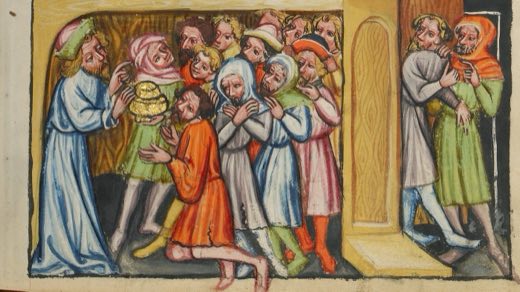 The Silver Cup Discovered; Joseph Reveals His Identity to His Brothers (Ms. 33, fol. 53, from the Weltchronik)
See also
- Servants in the householdHome and family
- The householdHome and family
- The king’s officialsWork and trades
- TreasurersWork and trades
- The women who followed JesusJewish groups and the Roman world
- JosephPeople
- Obadiah (1 Kings)People
- ChuzaPeople
- Eliakim, son of HilkiahPeople
Sources: Tyndale Open Bible Dictionary © 2023 Tyndale House Publishers, CC BY-SA 4.0 — adapted and shortened; the original work is available for free at tyndaleopenresources.com · Sources and rights