Encyclopedia › Roads and travel
Roads and travel
Into exile: the long road to Assyria and Babylon
Samaria taken, 722/720 BC · Jerusalem, 597 and 586 BC · about 1,500 km by the Fertile Crescent
The longest journeys many Israelites ever made were forced. Assyrian and Babylonian kings moved conquered peoples to other lands. When Samaria fell, the king of Assyria “carried away the Israelites to Assyria, where he settled them in Halah, in Gozan by the Habor River, and in the cities of the Medes” (2 Kings 17:6). In 597 BC Nebuchadnezzar took King Jehoiachin and “ten thousand captives” to Babylon (2 Kings 24:14), and after the city fell in 586 BC the captain of the guard “carried into exile the people who remained in the city” (2 Kings 25:11). Jeremiah gives smaller numbers for three deportations, “in all, 4,600 people” (Jeremiah 52:30); scholars explain the difference in several ways.
No one crossed the open desert. The road went north through Syria — the Babylonian king had his headquarters at Riblah — and then down along the Euphrates, some 1,500 kilometers, a march of months on foot. Assyrian palace reliefs show such columns: men with bundles, women and children on carts, a few animals. The prophet Jeremiah was found “bound in chains among all the captives” at Ramah and set free (Jeremiah 40:1). In Babylon the exiles remembered the march’s end in a psalm: “By the rivers of Babylon we sat and wept when we remembered Zion” (Psalm 137:1).
In art
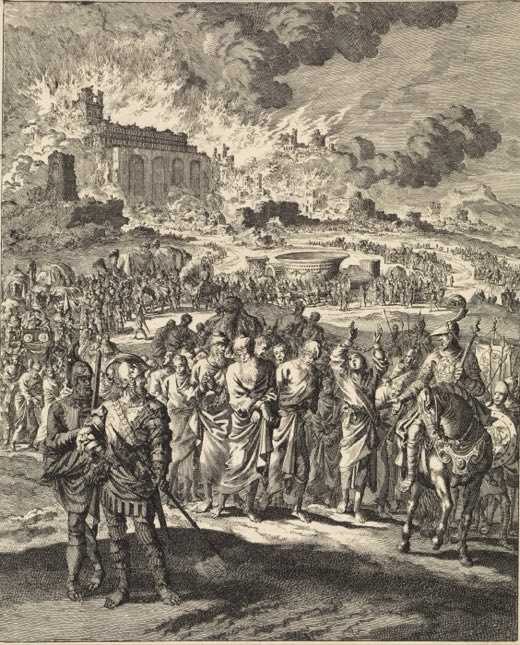 Captives Led from Jerusalem
See also
- The fall of SamariaWeapons and warfare
- Jerusalem taken, 597 BCWeapons and warfare
- The siege and fall of Jerusalem, 587/586 BCWeapons and warfare
- The Lachish reliefsThe Bible in stone
- Babylon: the city of NebuchadnezzarCities of the Bible
- Jews abroad: the DiasporaJewish groups and the Roman world
- Captives and spoilWeapons and warfare
- RoutesExplore · Abraham, the Exodus, David, Paul’s journeys — stop by stop on the map
- BabylonPlaces
- RiblahPlaces
Sources: Tyndale Open Bible Dictionary © 2023 Tyndale House Publishers, CC BY-SA 4.0 — adapted and shortened; the original work is available for free at tyndaleopenresources.com · Sources and rights