Encyclopedia › How the Bible came to be
How the Bible came to be
How Revelation was written
John on Patmos · to seven churches · about AD 95 · long disputed in the East
Revelation names its writer and says where it was written: “I, John, your brother and partner in the tribulation … was on the island of Patmos because of the word of God and my testimony about Jesus” (Revelation 1:9). On the Lord’s day he heard a voice like a trumpet: “Write on a scroll what you see and send it to the seven churches: to Ephesus, Smyrna, Pergamum, Thyatira, Sardis, Philadelphia, and Laodicea” (Revelation 1:11). So the book is at once a vision and a letter, meant to be read aloud: “Blessed is the one who reads aloud the words of this prophecy” (Revelation 1:3). It ends with a warning to anyone who would add to its words or take away from them (Revelation 22:18–19).
Irenaeus, about AD 180, wrote that the vision was seen near the end of the reign of the emperor Domitian, about AD 95, and most scholars agree; some date it earlier, after Nero, in the late 60s. Tradition identified John with the apostle; in the 3rd century Dionysius of Alexandria noticed that its Greek differs from the Gospel of John’s and thought it was written by another John. In the West the book was accepted early. In the Greek East it was long disputed and joined the list of books only slowly.
In art
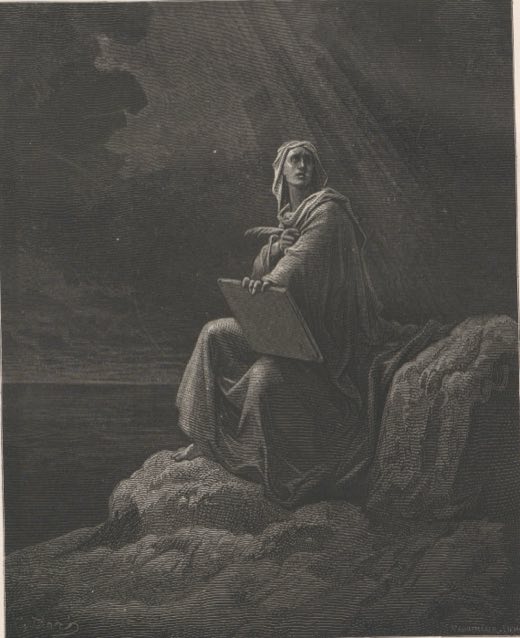 John on PatmosGustave Doré
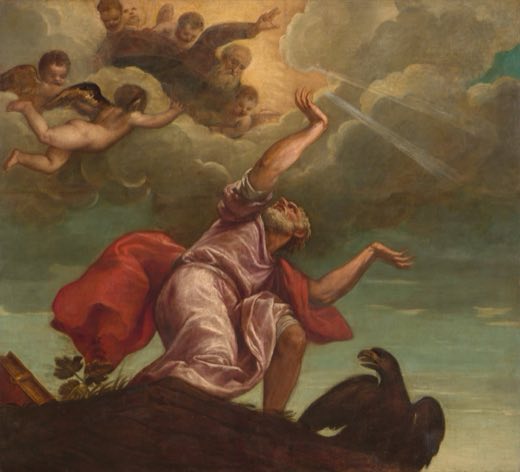 Saint John the Evangelist on PatmosTitian
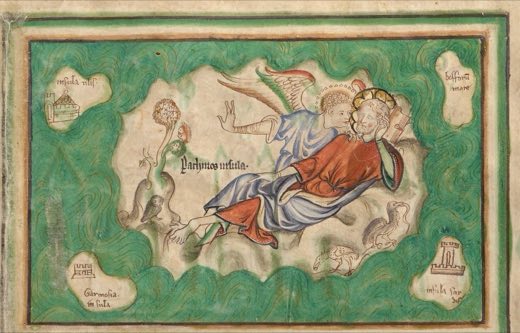 Saint John on Patmos (Ms. Ludwig III 1, fol. 2, from the Getty Apocalypse)Unknown English painter
See also
- Islands and coastlandsThe sea
- The sea in RevelationThe sea
- The first lists of New Testament booksHow the Bible came to be
- Reading aloudWriting and books
- Scrolls in visionsWriting and books
- DomitianRulers around the Bible
- PatmosPlaces
Scholars disagree
Sources: Tyndale Open Bible Dictionary © 2023 Tyndale House Publishers, CC BY-SA 4.0 — adapted and shortened; the original work is available for free at tyndaleopenresources.com · Sources and rights