Encyclopedia › Human life in Bible times
Human life in Bible times
How children learned
Teaching at home · the Law read aloud · abecedaries on potsherds · “at the feet of Gamaliel”
The first school was the house. The Law told parents, “you shall teach them diligently to your children and speak of them when you sit at home and when you walk along the road” (Deuteronomy 6:7), and Proverbs speaks to a son who learns from both parents: “Listen, my son, to your father’s instruction, and do not forsake the teaching of your mother” (Proverbs 1:8). Boys learned their father’s trade, girls their mother’s work. Every seventh year the Law was to be read aloud to all the people, “men, women, children, and the foreigners”, so that children “who do not know the law will listen and learn” (Deuteronomy 31:12–13). Isaiah’s scoffers compared his preaching to a drill for small children: “line on line, line on line; a little here, a little there” (Isaiah 28:10).
Some learned to write. A young man of Succoth could write down the names of seventy-seven elders for Gideon (Judges 8:14). Archaeologists have found abecedaries — the alphabet scratched in order on potsherds and stones, as at Izbet Sartah and Tel Zayit — which look like writing practice; whether Israel had real schools before the exile is debated. By Jesus’ day boys learned to read the Scriptures in the synagogue, and later rabbis spoke of schools in every town. Timothy had known the Scriptures “from infancy” (2 Timothy 3:15). At twelve, Jesus sat in the temple “among the teachers, listening to them and asking them questions” (Luke 2:46); Paul was “educated at the feet of Gamaliel” (Acts 22:3).
In art
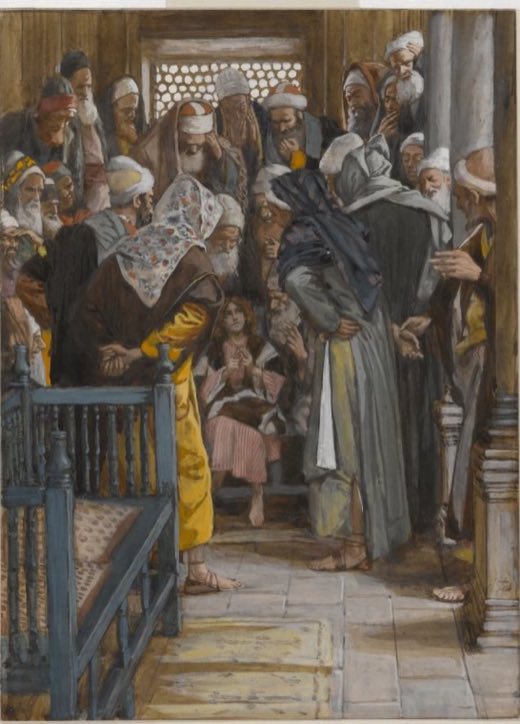 Jesus Among the Doctors (Jésus parmi les docteurs)James Tissot
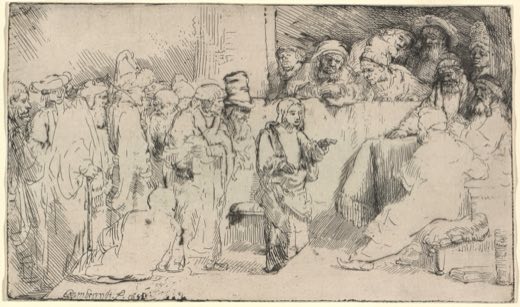 Christ Disputing with the Doctors: a SketchRembrandt
See also
- ChildrenHome and family
- Who could read and writeWriting and books
- Greek schooling and the paidagogosThe Greek world of Paul
- Teachers of the Law and rabbisJewish groups and the Roman world
- Coming of ageHuman life in Bible times
- Honor your father and motherHome and family
- Gamaliel (Acts)People
- TimothyPeople
Sources: Tyndale Open Bible Dictionary © 2023 Tyndale House Publishers, CC BY-SA 4.0 — adapted and shortened; the original work is available for free at tyndaleopenresources.com · Sources and rights