Encyclopedia › Field, orchard and water
Field, orchard and water
Planting, grafting and the first three years
Fruit of a new tree not eaten for three years · fruit trees spared in war · grafting
Planting an orchard was work for the years ahead. The Law forbade eating the fruit of a newly planted tree for three years; the fruit of the fourth year was to be “consecrated as a praise offering to the LORD”, and only “in the fifth year you may eat its fruit” (Leviticus 19:23–25). Even in war fruit trees were to be spared: “you must not destroy its trees by putting an axe to them, because you can eat their fruit” (Deuteronomy 20:19). In Jesus’ parable the owner of a fig tree has come “for the past three years” looking for fruit, and the keeper of the vineyard asks for one more year (Luke 13:7–8).
Olive and fig trees send up new shoots from their roots, and an old tree cut down can grow again; this is Job’s “hope for a tree”: “at the scent of water it will bud and put forth twigs like a sapling” (Job 14:7, 9). Fruit trees were also grafted: a shoot of a good kind was set into a wild or older stock, so that the root gave strength and the shoot gave fruit. Paul uses this work in Romans, speaking to believers from the nations as to “a wild olive shoot” grafted in “among the others to share in the nourishment of the olive root” (Romans 11:17). He himself notes that this is “contrary to nature” (Romans 11:24): farmers usually grafted a cultivated shoot onto a wild tree, not a wild one onto a cultivated tree.
In art
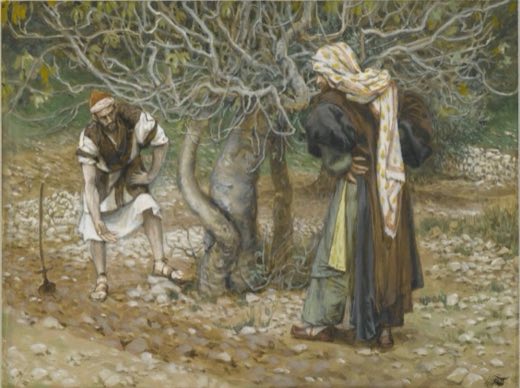 The Vine Dresser and the Fig Tree (Le vigneron et le figuier)
See also
- Work in the vineyard: hedges, pruning and watchmenField, orchard and water
- Fallow ground, manure and ashesField, orchard and water
- Olive treePlants of the Bible
- Fig treePlants of the Bible
- Rules for war in DeuteronomyWeapons and warfare
Sources: Tyndale Open Bible Dictionary © 2023 Tyndale House Publishers, CC BY-SA 4.0 — adapted and shortened; the original work is available for free at tyndaleopenresources.com · Sources and rights