Encyclopedia › Plants of the Bible
Plants of the Bible
Caper bush
Hebrew ’aviyonah · KJV “desire” · Capparis spinosa · grows from cracks in old walls
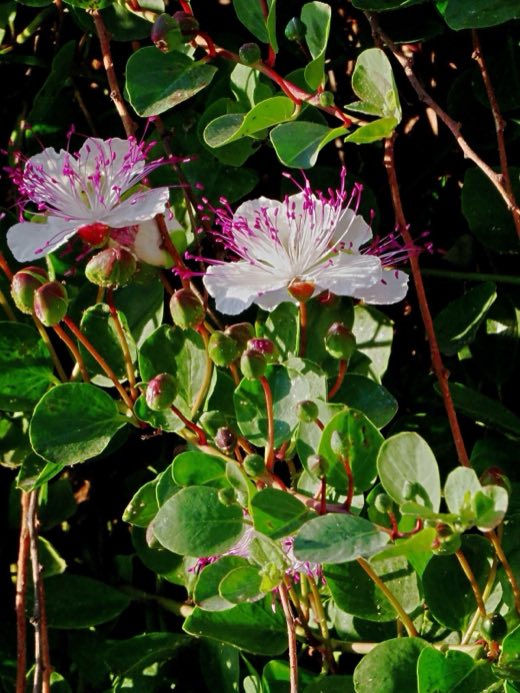
The caper bush is a sprawling plant with round gray-green leaves and thorny stems that hangs from cliffs, rocks and the cracks of old walls — it still grows from the Western Wall in Jerusalem. Its large, beautiful flowers, with four white or pinkish petals and a tuft of long purple stamens, open in the evening and wilt by the next morning. The unopened flower buds are the capers that people pickle in vinegar or salt; they were eaten this way in Israel, Egypt and Arabia before the time of Christ, and the fruit was eaten too.
The caper appears in the Bible only once, in the picture of old age at the end of Ecclesiastes, where “the caper berry shrivels” (Ecclesiastes 12:5). The Hebrew word ’aviyonah is found only here. The Greek and Latin Bibles took it as the caper berry, which was eaten to sharpen the appetite; but the word looks like the Hebrew for “desire”, and older English Bibles have “desire shall fail”. Both readings fit the line, and translations still divide over it.
In nature
All verses with this plant (1)
Where the Hebrew, Aramaic or Greek word for it stands in the text.
Ecclesiastes1
when men fear the heights and dangers of the road, when the almond tree blossoms, the grasshopper loses its spring, and the caper berry shrivels— for then man goes to his eternal home and mourners walk the streets.See also
- Almond treePlants of the Bible
- Saltwort and the food of the hungryPlants of the Bible
- Herbs and seasoningFood and drink
Sources: Tyndale Open Bible Dictionary © 2023 Tyndale House Publishers, CC BY-SA 4.0 — adapted and shortened; the original work is available for free at tyndaleopenresources.com · Plants and Trees in the Bible © United Bible Societies 2025, adapted from R. Koops, Each According to its Kind © 2012 UBS, CC BY-SA 4.0 · Sources and rights