Encyclopedia › Plants of the Bible
Plants of the Bible
Wild gourd
Hebrew paqqu‘ot · Citrullus colocynthis, colocynth · a bitter, poisonous fruit of the desert
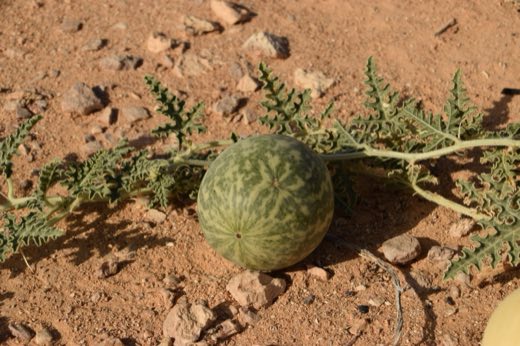
The colocynth, or wild gourd, is a creeping vine of the dry lands from North Africa to India, related to the watermelon. Its stems run along the ground and its leaves are deeply lobed like a melon’s. Its round fruits, about the size of an orange, are green striped with yellow, turning yellow when ripe, with a hard, smooth rind and a spongy pulp that is intensely bitter. In small doses the pulp was used as a strong purge, and Bedouin still sell it for medicine; eaten as food, it is poisonous.
During a famine at Gilgal, one of the company of prophets with Elisha went out to gather herbs, found a wild vine and filled his garment with its gourds, which were cut into the pot of stew. When the men tasted it, they cried out, “There is death in the pot!” (2 Kings 4:40). The yellow fruits are easy to mistake for edible melons, which is why such an accident was possible. Gourd-shaped ornaments, named with a related Hebrew word, were carved on the cedar panels of Solomon’s temple and cast below the rim of its great bronze basin.
In nature
All verses with this plant (4)
Where the Hebrew, Aramaic or Greek word for it stands in the text.
Deuteronomy1
But their vine is from the vine of Sodom and from the fields of Gomorrah. Their grapes are poisonous; their clusters are bitter.1 Kings2
The cedar paneling inside the temple was carved with gourds and open flowers. Everything was cedar; not a stone could be seen.Below the rim, ornamental buds encircled it, ten per cubit all the way around the Sea, cast in two rows as a part of the Sea.2 Kings1
One of them went out to the field to gather herbs, and he found a wild vine from which he gathered as many wild gourds as his garment could hold. Then he came back and cut them up into the pot of stew, though no one knew what they were.See also
- Jonah’s plantPlants of the Bible
- Cucumbers and melonsPlants of the Bible
- Locusts, wild honey and food from the wildFood and drink
- PlacesExplore · How it looked in the 1890s
Sources: Tyndale Open Bible Dictionary © 2023 Tyndale House Publishers, CC BY-SA 4.0 — adapted and shortened; the original work is available for free at tyndaleopenresources.com · Plants and Trees in the Bible © United Bible Societies 2025, adapted from R. Koops, Each According to its Kind © 2012 UBS, CC BY-SA 4.0 · Sources and rights