Encyclopedia › Human life in Bible times
Human life in Bible times
Whom one could marry
Close relatives forbidden · a wife from one’s own kin · within the tribe · foreign wives
Leviticus 18 lists the close relatives a man may not marry or sleep with — mother, stepmother, sister and half-sister, granddaughter, aunt, daughter-in-law, a wife’s sister while the wife lives: “None of you are to approach any close relative” (Leviticus 18:6). Some of the patriarchs lived before these rules. Abraham said of Sarah, “she really is my sister, the daughter of my father… and she became my wife” (Genesis 20:12), Jacob married two sisters, and Moses’ father married his aunt (Exodus 6:20).
Within those limits families liked to marry close kin. Abraham sent his servant “to my country and my kindred” for a wife for Isaac, not to the Canaanites (Genesis 24:3–4), and Jacob married his cousins. When land passed to daughters, as with Zelophehad’s five, they had to marry “within a clan of the tribe of their father” so the land stayed there (Numbers 36:6). The Law forbade marriage with the peoples of Canaan, lest they turn Israel to other gods (Deuteronomy 7:3–4), yet Moses married a Midianite, Boaz married Ruth the Moabite, and David’s line came from her. After the exile Nehemiah found Jews married to women of Ashdod, Ammon and Moab, whose children “could not speak the language of Judah”, and he beat some of the men and “pulled out their hair” (Nehemiah 13:24–25). Paul allowed a widow to remarry “anyone she wishes, as long as he belongs to the Lord” (1 Corinthians 7:39).
In art
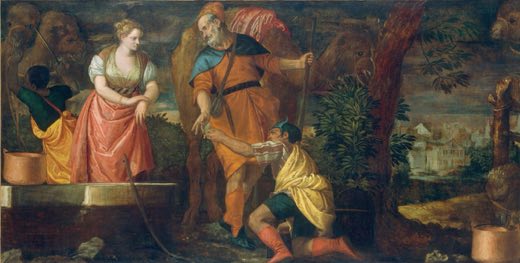 Rebecca at the Well
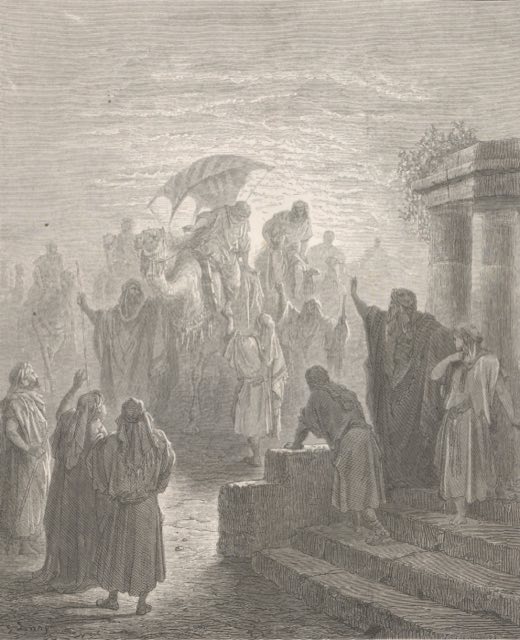 Isaac Receives Rebekah
See also
- Betrothal and weddingHome and family
- Levirate marriageHuman life in Bible times
- Bride-price and dowryHuman life in Bible times
- Divorce in the Law and the GospelsHuman life in Bible times
- InheritanceHome and family
- RuthPeople
- Amram, son of KohathPeople
- Nehemiah, son of HacaliahPeople
Sources: Tyndale Open Bible Dictionary © 2023 Tyndale House Publishers, CC BY-SA 4.0 — adapted and shortened; the original work is available for free at tyndaleopenresources.com · Sources and rights