Encyclopedia › Human life in Bible times
Human life in Bible times
Friends and friendship
Hebrew rea and ohev · David and Jonathan · Ruth and Naomi · “the king’s friend”
The Bible’s best-known friendship is David’s and Jonathan’s. After David killed Goliath, “the souls of Jonathan and David were knit together, and Jonathan loved him as himself” (1 Samuel 18:1). The king’s son made a covenant with the shepherd and gave him his robe, his sword, his bow and his belt (1 Samuel 18:3–4). When Saul turned against David, Jonathan warned him, and at their parting they “kissed each other and wept together” (1 Samuel 20:41). David’s lament for him says, “your love to me was extraordinary, surpassing the love of women” (2 Samuel 1:26) — words most read as the loyalty of a covenant friend, though some modern readers have read more into them. Ruth’s loyalty to her mother-in-law Naomi is another such bond: “wherever you go, I will go” (Ruth 1:16).
At court “the king’s friend” was a title: Hushai the Archite, “David’s friend”, risked his life as a spy in Absalom’s council (2 Samuel 15:37). Job’s three friends came to “sympathize with Job and comfort him”, and sat with him seven days in silence (Job 2:11). Proverbs has much to say: “A friend loves at all times” (Proverbs 17:17), and “The wounds of a friend are faithful, but the kisses of an enemy are deceitful” (Proverbs 27:6). God spoke with Moses “as a man speaks to his friend” (Exodus 33:11), and Jesus told the disciples, “I have called you friends” (John 15:15).
In art
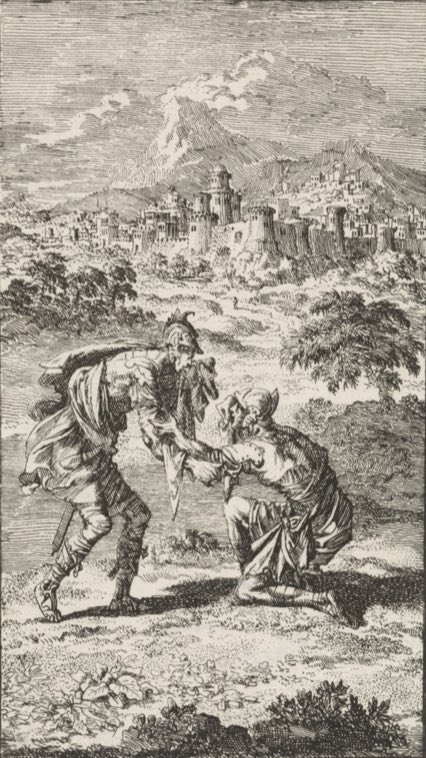 David and Jonathan Part
 Naomi and Her Daughters-in-Law
See also
- NeighborsHome and family
- Bowing, kissing and other gesturesHuman life in Bible times
- HospitalityHome and family
- The king’s officialsWork and trades
- Mourning and lamentHuman life in Bible times
- JonathanPeople
- DavidPeople
- RuthPeople
- NaomiPeople
- HushaiPeople
Sources: Tyndale Open Bible Dictionary © 2023 Tyndale House Publishers, CC BY-SA 4.0 — adapted and shortened; the original work is available for free at tyndaleopenresources.com · Sources and rights