Encyclopedia › Field, orchard and water
Field, orchard and water
Gleaning: the edges of the field for the poor
Hebrew leqet (gleanings), pe’ah (corner) · for the poor, the foreigner, the fatherless and the widow
The Law built care for the poor into the harvest itself: “When you reap the harvest of your land, you are not to reap to the very edges of your field or gather the gleanings of your harvest.” The vineyard was not to be stripped bare either: “Leave them for the poor and the foreigner” (Leviticus 19:9–10). A sheaf forgotten in the field was to stay there “for the foreigner, the fatherless, and the widow, so that the LORD your God may bless you in all the work of your hands” (Deuteronomy 24:19), and so with olives and grapes. The Mishnah later gave a whole tractate, Peah, “corner”, to the part of the field left standing.
The book of Ruth shows the law at work. Ruth, a widow from Moab, said to Naomi, “Please let me go into the fields and glean heads of grain” (Ruth 2:2), and she followed the reapers in the field of Boaz, a kinsman of Naomi’s husband. He told his young men to let her gather among the sheaves and to “pull out for her some stalks from the bundles and leave them for her to gather” (Ruth 2:16). She gleaned until evening, beat out what she had gathered, and had “about an ephah of barley” (Ruth 2:17) — some 11 to 14 kilograms. A hungry traveler might also eat from a neighbor’s field: “you may pluck the heads of grain with your hand, but you must not put a sickle to your neighbor’s grain” (Deuteronomy 23:25), as Jesus’ disciples did (Matthew 12:1).
In art
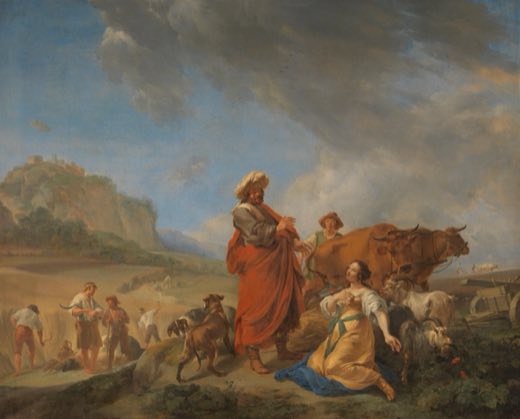 Ruth and Boas
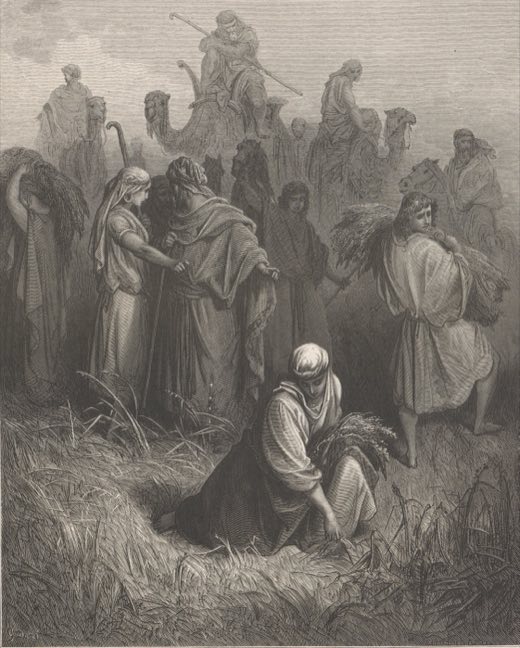 Ruth Gleans in the Field of Boaz
All verses on this topic
See also
- Reapers and hired workersField, orchard and water
- Sickles and sheavesWork and trades
- Widows, orphans and foreignersHuman life in Bible times
- The olive harvestField, orchard and water
- The grape harvestField, orchard and water
- Threshing floors in the Bible’s storiesField, orchard and water
- A woman’s work at homeHome and family
- Rich and poorHuman life in Bible times
- The Valley of Rephaim: Jerusalem’s southwestern plainThe land of the Bible
- RuthPeople
- BoazPeople
Sources: Tyndale Open Bible Dictionary © 2023 Tyndale House Publishers, CC BY-SA 4.0 — adapted and shortened; the original work is available for free at tyndaleopenresources.com · Sources and rights