Encyclopedia › How the Bible’s world is studied
How the Bible’s world is studied
Potsherds as a clock
Sherds are the commonest find · shapes change from age to age · Albright at Tell Beit Mirsim
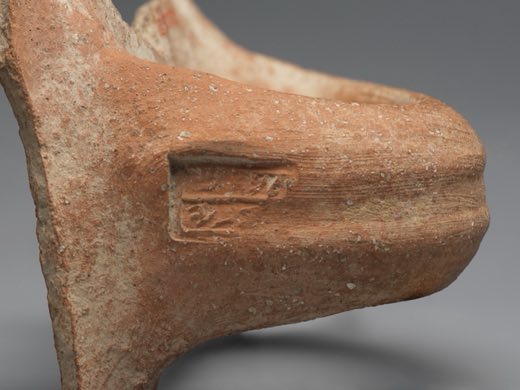
Clay pots broke easily, cost little and were thrown away, but the broken pieces, the sherds, do not rot. They are by far the commonest find on any dig. Isaiah pictures a jar smashed so thoroughly that “not a shard will be found in the dust large enough to scoop the coals from a hearth or to skim the water from a cistern” (Isaiah 30:14) — a good sherd was still useful. Potters followed the habits of their time and place: the shape of a rim, a handle or a base, the clay, the firing and the decoration changed slowly from generation to generation. Once the sequence is known from layers dated in other ways, a handful of rims can date a new layer, often to within a century.
Petrie laid the foundation in 1890; W. F. Albright refined the sequence for the land of Israel at Tell Beit Mirsim in 1926–1932, and excavators have kept correcting it since. Some kinds are easy to recognize: the painted Philistine ware with birds and spirals of the 12th–11th centuries BC, the “collared-rim” storage jars of the hill villages of the same age, the open saucer lamp with a pinched spout of the Iron Age and the closed, mold-made lamp of Roman times. Under the microscope the grains of minerals in the clay show where a pot was made, and so where goods traveled. Jeremiah watched the potter “working at the wheel” (Jeremiah 18:3); the work of such potters is now one of the archaeologist’s clocks.
In art
 Jeremiah Breaks the Jar
Key verses
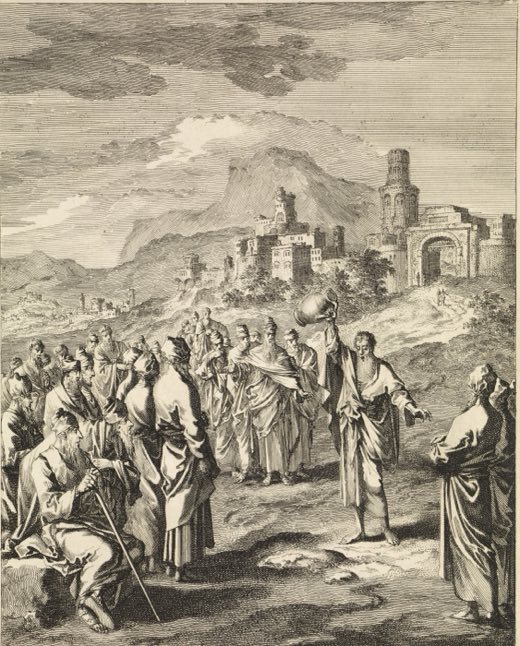
It will break in pieces like a potter’s jar, shattered so that no fragment can be found. Not a shard will be found in the dust large enough to scoop the coals from a hearth or to skim the water from a cistern.”So I went down to the potter’s house and saw him working at the wheel. But the vessel that he was shaping from the clay became flawed in his hand; so he formed it into another vessel, as it seemed best for him to do.How the precious sons of Zion, once worth their weight in pure gold, are now esteemed as jars of clay, the work of a potter’s hands!Then you are to shatter the jar in the presence of the men who accompany you, and you are to proclaim to them that this is what the LORD of Hosts says: I will shatter this nation and this city, like one shatters a potter’s jar that can never again be repaired. They will bury the dead in Topheth until there is no more room to bury them.See also
- PotterWork and trades
- Jars, jugs and potsherdsHome and family
- Lamps and the light of the houseHome and family
- Digging by layersHow the Bible’s world is studied
Sources: Tyndale Open Bible Dictionary © 2023 Tyndale House Publishers, CC BY-SA 4.0 — adapted and shortened; the original work is available for free at tyndaleopenresources.com · Sources and rights