Encyclopedia › How the Bible’s world is studied
How the Bible’s world is studied
The Rosetta Stone and the reading of hieroglyphs
Found 1799 near Rashid · a decree of 196 BC in three scripts · Champollion, 1822
For some fourteen centuries no one could read Egyptian hieroglyphs. In July 1799, during Napoleon’s expedition to Egypt, French soldiers rebuilding a fort near Rashid, which Europeans called Rosetta, found a broken slab of dark stone bearing one text in three scripts: hieroglyphs, demotic — the everyday Egyptian script of the time — and Greek. It was a decree of the priests of Egypt issued in 196 BC in honor of King Ptolemy V. After the French defeat the stone passed to the British, and since 1802 it has been in the British Museum. The Greek could be read at once, and it said that the other two texts said the same.
The English scholar Thomas Young saw that the oval rings, the cartouches, held royal names. In 1822 Jean-François Champollion showed how the script works: some signs stand for sounds, others for whole words, and the two are mixed. His knowledge of Coptic, the last form of the Egyptian language, still used in the worship of Egypt’s Christians, helped him find the words behind the signs. Since then the inscriptions of Egypt can be read — among them the list of Pharaoh Shishak at Karnak, naming towns of Israel and Judah, and the stele of Merneptah, which names Israel. Joseph’s brothers in Egypt needed an interpreter (Genesis 42:23), and Moses, Stephen says, “was educated in all the wisdom of the Egyptians” (Acts 7:22).
In art
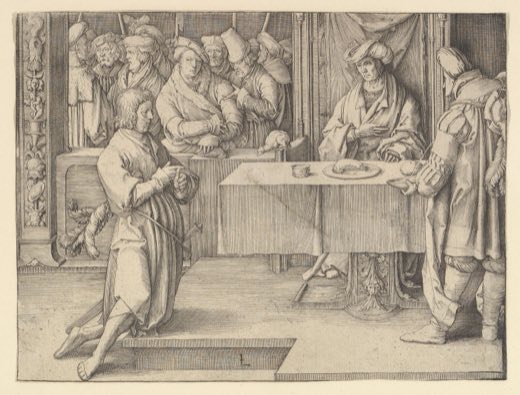 Joseph Interpreting Pharaoh's Dreams
Key verses
In the morning his spirit was troubled, so he summoned all the magicians and wise men of Egypt. Pharaoh told them his dreams, but no one could interpret them for him.They did not realize that Joseph understood them, since there was an interpreter between them.So Moses was educated in all the wisdom of the Egyptians and was powerful in speech and action.In the fifth year of Rehoboam’s reign, Shishak king of Egypt came up and attacked Jerusalem. He seized the treasures of the house of the LORD and of the royal palace. He took everything, including all the gold shields that Solomon had made.See also
- Merneptah SteleThe Bible in stone
- Shishak (Sheshonq I)Rulers around the Bible
- The Coptic BibleHow the Bible was translated around the world
- Behistun and the reading of cuneiformHow the Bible’s world is studied
Sources: Tyndale Open Bible Dictionary © 2023 Tyndale House Publishers, CC BY-SA 4.0 — adapted and shortened; the original work is available for free at tyndaleopenresources.com · Sources and rights