Encyclopedia › Plants of the Bible
Plants of the Bible
Walnut
Hebrew ’egoz · KJV “garden of nuts” · Juglans regia · named once, in Song of Songs
“I went down to the walnut grove to see the blossoms of the valley,” says a voice in Song of Songs 6:11. The Hebrew ’egoz is the word for walnut in later Hebrew and is related to the Arabic and Persian names, so many scholars accept it, though other Bibles say only “nut orchard”. The walnut is a large, broad tree of six to twenty meters with a stout gray trunk, big compound leaves that smell sharp when crushed, and green fruit whose husk stains the hands brown and encloses the familiar wrinkled nut.
The tree is native to the mountains from the Balkans and the Caucasus to Persia and Central Asia. It was probably brought into the land from Persia or Asia Minor and grown in gardens and orchards; the Jewish historian Josephus later praised the walnut trees around the Sea of Galilee. Walnuts gave food rich in oil, a brown dye from their husks, and hard, handsome wood for furniture.
In nature
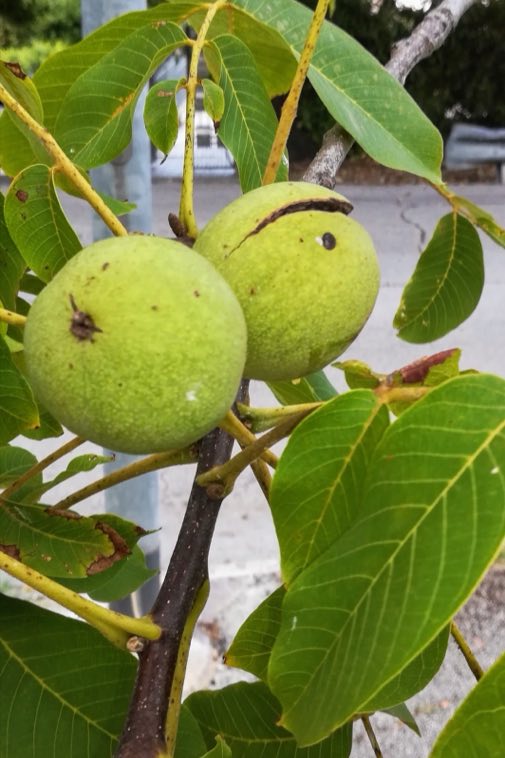
All verses with this plant (1)
Where the Hebrew, Aramaic or Greek word for it stands in the text.
Song of Songs1
I went down to the walnut grove to see the blossoms of the valley, to see if the vines were budding or the pomegranates were in bloom.See also
Sources: Tyndale Open Bible Dictionary © 2023 Tyndale House Publishers, CC BY-SA 4.0 — adapted and shortened; the original work is available for free at tyndaleopenresources.com · Plants and Trees in the Bible © United Bible Societies 2025, adapted from R. Koops, Each According to its Kind © 2012 UBS, CC BY-SA 4.0 · Sources and rights