Encyclopedia › Jewish groups and the Roman world
Jewish groups and the Roman world
The praetorium and the barracks
Latin praetorium, the commander’s quarters · Herod’s palace at Caesarea · the Antonia fortress
Praetorium first meant a Roman general’s tent, then any governor’s residence and seat of judgment. At Caesarea the governor used the palace Herod the Great had built on a promontory over the sea; Felix kept Paul “under guard in Herod’s Praetorium” (Acts 23:35), and its remains have been excavated. In Jerusalem Jesus was led “into the palace (that is, the Praetorium)” (Mark 15:16). Where it stood is debated: many scholars think of Herod’s palace on the western hill, where governors later stayed; an older tradition, followed by the Way of the Cross, places it in the Antonia fortress. The stone pavement shown today under the Sisters of Zion convent was laid in the 2nd century.
The Antonia, named by Herod after Mark Antony, stood at the northwest corner of the temple courts. Josephus says soldiers watched the crowds from its colonnades at the feasts. From it the commander came down to rescue Paul, ordered him “brought into the barracks” and let him speak to the crowd from the steps (Acts 21:34, 40). When Paul writes from prison of “the whole palace guard” (Philippians 1:13), he means either the emperor’s guard in Rome or a governor’s praetorium elsewhere.
In art
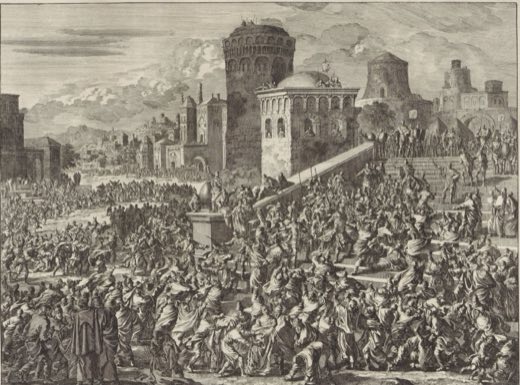 Paul Carried Up the Steps
See also
- Fortresses and watchtowersBuildings and structures
- The governor’s court and the appeal to CaesarJewish groups and the Roman world
- Legions, cohorts and centurionsJewish groups and the Roman world
- Provinces and governorsJewish groups and the Roman world
- Soldiers in the Gospels and ActsWeapons and warfare
- CaesareaPlaces
Sources: Tyndale Open Bible Dictionary © 2023 Tyndale House Publishers, CC BY-SA 4.0 — adapted and shortened; the original work is available for free at tyndaleopenresources.com · Sources and rights