Encyclopedia › Jewish groups and the Roman world
Jewish groups and the Roman world
Legions, cohorts and centurions
Legion of about 5,000 · cohorts of about 500 · centuries of 80 under a centurion
A Roman legion had about 5,000 heavy infantry, all citizens, in ten cohorts; each cohort had six centuries of about 80 men, each led by a centurion. The centurion was the officer who lived and fought with his men, usually risen from the ranks, and he carried a vine stick as a sign of rank; the centurion of Capernaum describes the chain of command: “I tell one to go, and he goes” (Matthew 8:9). Above the centurions stood tribunes; the “commander” who rescued Paul in Jerusalem, Claudius Lysias, was a tribune over a cohort (Acts 21:31). “Legion” was also a word for a great number (Mark 5:9; Matthew 26:53).
Before the war of AD 66 no legion was stationed in Judea; the legions were in Syria. The governor had auxiliary cohorts, recruited mostly from non-Jews of the land, at Caesarea and in Jerusalem. Acts names an “Italian Regiment” at Caesarea (Acts 10:1) and an “Imperial Regiment” (Acts 27:1); inscriptions attest cohorts with such names in the East. Soldiers served about 25 years. The Gospels and Acts name several centurions: at Capernaum, at the cross (Mark 15:39), Cornelius, and Julius, who took Paul to Rome.
In art
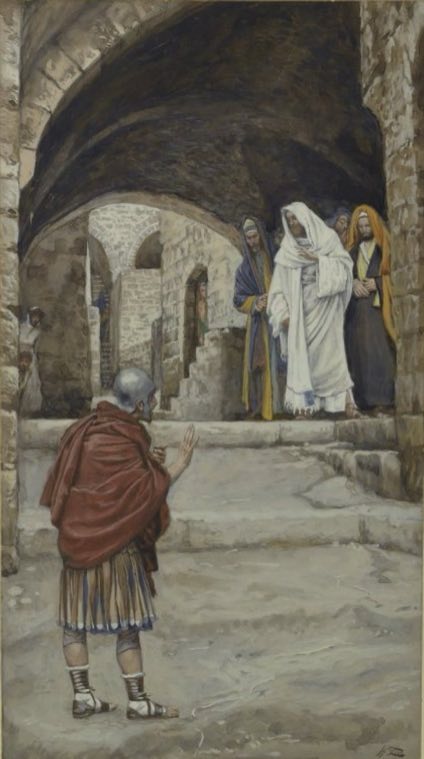 Lord, I Am Not Worthy (Domine Non Sum Dignus)
See also
- The praetorium and the barracksJewish groups and the Roman world
- Roman citizenshipJewish groups and the Roman world
- Latin in the New TestamentJewish groups and the Roman world
- Tens, fifties and thousands; halves and tenthsHuman life in Bible times
- How the Romans besieged a cityWeapons and warfare
- Israel’s army: from tribal levy to standing armyWeapons and warfare
- Soldiers in the Gospels and ActsWeapons and warfare
- CorneliusPeople
- JuliusPeople
- Claudius (Acts 23:26)People
Sources: Tyndale Open Bible Dictionary © 2023 Tyndale House Publishers, CC BY-SA 4.0 — adapted and shortened; the original work is available for free at tyndaleopenresources.com · Sources and rights