Encyclopedia › Field, orchard and water
Field, orchard and water
Conduits and aqueducts
The conduit of the upper pool · Hezekiah’s tunnel, about 540 m · Roman aqueducts
Some towns brought their water from farther off in channels. Outside Jerusalem the prophet Isaiah met King Ahaz “at the end of the aqueduct that feeds the upper pool, on the road to the Launderer’s Field” (Isaiah 7:3), and about thirty years later the officers of the king of Assyria stood at the same spot to call on the city to surrender (2 Kings 18:17). Hezekiah made “the pool and the tunnel to bring water into the city” (2 Kings 20:20), a channel about 540 metres long cut through the rock from the Gihon spring, and Isaiah says that the people “built a reservoir between the walls for the waters of the ancient pool” (Isaiah 22:11). Far to the east, Sennacherib brought water to Nineveh by canals, crossing a valley at Jerwan on a stone aqueduct whose remains still stand.
The Romans made the aqueduct a great work of engineering. From the 1st century BC channels brought water to Jerusalem from springs south of Bethlehem, through the reservoirs now called Solomon’s Pools, winding along the hills for tens of kilometres. Josephus writes that Pontius Pilate spent money from the temple treasury, the sacred korban, on an aqueduct for the city, and that the crowds who protested were beaten by his soldiers. Herod’s port of Caesarea took its water by an aqueduct on arches from springs at the foot of Mount Carmel; long rows of its arches still stand on the beach. By the 3rd century AD Rome itself was fed by eleven aqueducts.
In art
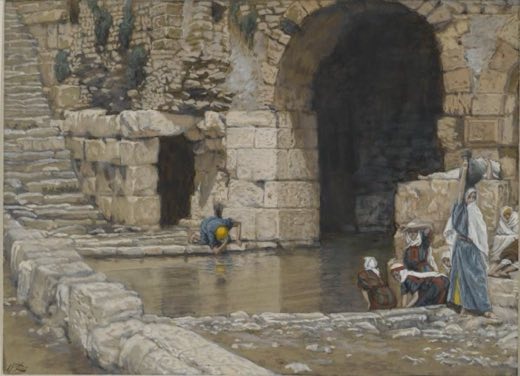 The Blind Man Washes in the Pool of Siloam (Le aveugle-né se lave à la piscine de Siloë)James Tissot
See also
- Irrigation: Egypt, Babylon and the gardensField, orchard and water
- Washing clothes: launderers and lyeField, orchard and water
- Pools and water tunnelsBuildings and structures
- The Gihon spring and the waters of SiloamThe land of the Bible
- Laodicea: rich, and neither hot nor coldCities of the Bible
- HezekiahPeople
- CaesareaPlaces
Sources: Tyndale Open Bible Dictionary © 2023 Tyndale House Publishers, CC BY-SA 4.0 — adapted and shortened; the original work is available for free at tyndaleopenresources.com · Sources and rights