Encyclopedia › Field, orchard and water
Field, orchard and water
Ritual baths (mikvaot)
Hebrew miqveh, “gathering” of water · stepped pools cut in rock · hundreds found from Jesus’ time
The Law asks for washing in many cases of ritual impurity — after a skin disease, a discharge or touching the dead. The person “must wash his clothes and bathe in water, and that evening he will be clean” (Numbers 19:19); in some cases it had to be “fresh water”, in Hebrew “living water” (Leviticus 15:13). In the last two centuries before Christ and in the time of Jesus this bathing took a fixed form: a stepped pool, cut in the rock or built and plastered, deep enough for the whole body to go under, filled with rainwater or spring water that ran in by itself — by the rules later written down in the Mishnah, water drawn in vessels would not do. Such a pool is called a mikveh, “a gathering” of water; in the plural, mikvaot.
Archaeologists have found hundreds of them in Judea and Galilee: in the houses of the upper city of Jerusalem, at Qumran and Masada, and many by the steps leading up to the Temple Mount, where pilgrims purified themselves before going in. John notes that many “went up from the country to Jerusalem to purify themselves before the Passover” (John 11:55), and Paul, on his last visit, purified himself with four men and then entered the temple (Acts 21:26). At Cana six stone water jars stood ready “for the Jewish rites of purification” (John 2:6), and Mark explains for his readers that the Pharisees and all the Jews “do not eat until they wash their hands ceremonially” (Mark 7:3).
In art
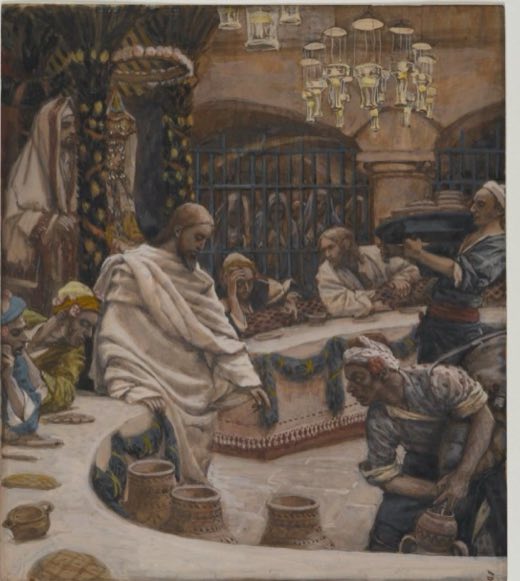 The Marriage at Cana (Les noces de Cana)
See also
- Washing clothes: launderers and lyeField, orchard and water
- Stone vesselsTrade, craft and color
- Pools and water tunnelsBuildings and structures
- Offerings after birth, healing and deathTabernacle and temple
- The Pool of SiloamThe Bible in stone
- CanaPlaces
Sources: Tyndale Open Bible Dictionary © 2023 Tyndale House Publishers, CC BY-SA 4.0 — adapted and shortened; the original work is available for free at tyndaleopenresources.com · Sources and rights