Encyclopedia › The Bible in culture
The Bible in culture
Dostoevsky and the Gospels
Fyodor Dostoevsky · Crime and Punishment (1866) · Demons (1871–1872) · The Brothers Karamazov (1879–1880)
On his way to penal servitude in Siberia in January 1850, Fyodor Dostoevsky was given a New Testament in Tobolsk by the wives of exiled Decembrists. It was the only book he was allowed in the prison at Omsk, and he kept it for the rest of his life; it survives, with his marks in the margins. In his novels the Gospels are read aloud or quoted at turning points of the story.
In Crime and Punishment (1866) Sonya Marmeladova reads to Raskolnikov the raising of Lazarus from John 11. Demons (1871–1872) opens with an epigraph from Luke 8:32–36, the demons who entered the herd of pigs, and the same passage is read near the end of the book. His last novel, The Brothers Karamazov (1879–1880), takes as its epigraph the words of Jesus about the grain of wheat: “unless a kernel of wheat falls to the ground and dies, it remains only a seed; but if it dies, it bears much fruit” (John 12:24). In the same novel Ivan’s poem “The Grand Inquisitor” is built on the three temptations of Jesus in the wilderness (Matthew 4:1–11).
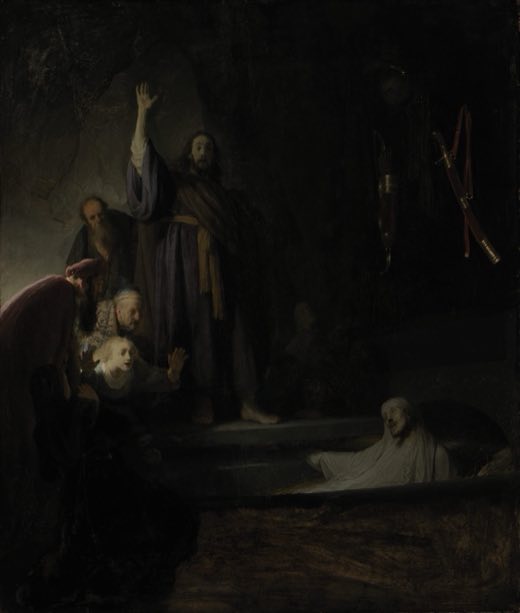 The Raising of Lazarus