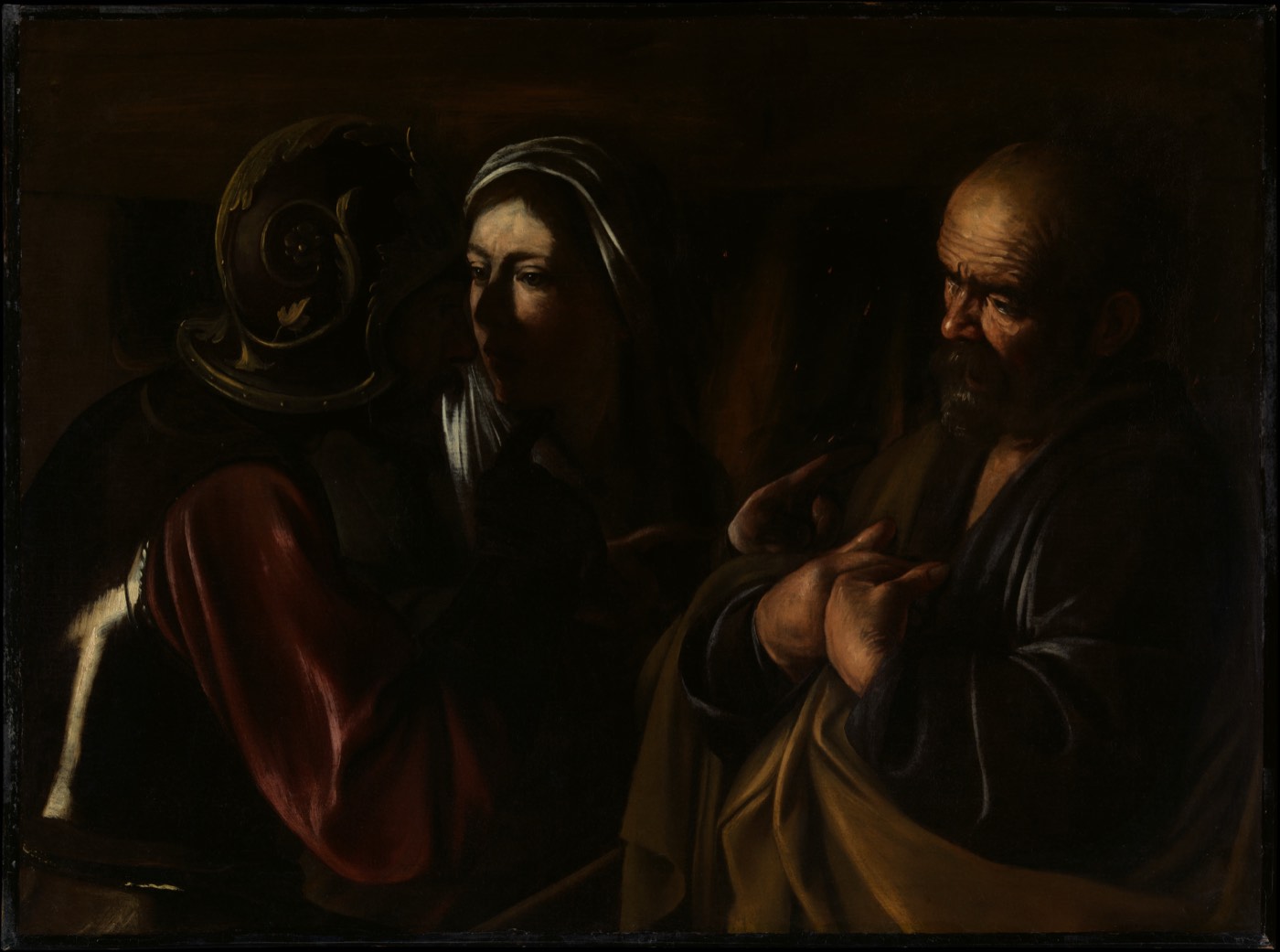
Seen from behind; only his scrolled helmet and red sleeve catch the light.
Bible in art · Matthew
The Denial of Saint Peter
Caravaggio · 1610
The Met, New York
Caravaggio painted this canvas in 1610, the last year of his life, probably in Naples. There are only three half-figures, pressed close to the viewer and caught in a sharp light against darkness.
A soldier and a young woman turn on Peter; Peter, an old man with a furrowed forehead, turns his hands to his own chest as if to say “Me?” The paint is laid on fast and thin, with almost no detail — the way Caravaggio worked at the very end.
From the text
- Peter sitting out in the courtyard of the high priest (Matthew 26:69)
- A servant girl came up to him: “You also were with Jesus” (Matthew 26:69)
- Those standing nearby: “Surely you are one of them” (Matthew 26:73)
- “I do not know the man!” (Matthew 26:74)
The artist’s own
- A soldier in a helmet of the painter’s own time
- Nothing of the courtyard or the fire — only faces and hands in a dark room
- Peter shown as an old, bald man, as painters usually showed him
Details
The soldier
The servant girl
A white cloth over her hair, she looks towards the soldier.
Peter
Bald and grey-bearded, his forehead deeply lined.
“Not me”
Peter turns both hands towards his own chest.
A pointing hand
A hand reaches out of the shadow towards Peter.
Caravaggio (Michelangelo Merisi), Italian, Milan or Caravaggio 1571–1610 Porto Ercole. The Metropolitan Museum of Art, New York (Gift of Herman and Lila Shickman, and Purchase, Lila Acheson Wallace Gift, 1997; acc. 1997.167) · Oil on canvas · Public Domain — The Met Open Access (CC0). The Met Collection API record: "isPublicDomain": true; The Met marks such works on its website "with the Creative Commons Zero (CC0) icon".