Encyclopedia › Weather and the forces of nature
Weather and the forces of nature
The Flood and the floods of Mesopotamia
Forty days of rain · Woolley’s flood layer at Ur · river floods · the Black Sea theory
Genesis tells that “all the fountains of the great deep burst forth, and the floodgates of the heavens were opened. And the rain fell upon the earth for forty days and forty nights” (Genesis 7:11–12). “The waters prevailed upon the earth for 150 days” (Genesis 7:24), until “God sent a wind over the earth, and the waters began to subside” (Genesis 8:1), and the ark came to rest “on the mountains of Ararat” (Genesis 8:4). Jesus spoke of the days before the flood, when people went on eating and marrying “until the flood came and swept them all away” (Matthew 24:39). Mesopotamia had flood stories of its own, in the epics of Atrahasis and Gilgamesh.
In 1929 Leonard Woolley, digging at Ur, found a layer of clean silt some 3 meters thick and announced that he had found the Flood. Similar layers then turned up at Kish, Shuruppak and Uruk, but at different dates, and none covered a whole city; they record floods of the Tigris and Euphrates, which in that flat land could spread far and were remembered for generations. Woolley’s claim is not accepted today. In 1997 the geologists William Ryan and Walter Pitman proposed that the Mediterranean broke into a smaller, lower Black Sea about 5600 BC and flooded its shores; others dispute how fast and how high the water rose. Many readers take the Flood of Genesis as worldwide, others as a regional flood; science has not settled what lies behind the stories.
In art
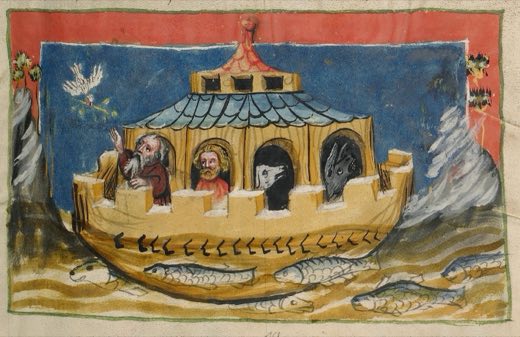 The Deluge; The Dove Returning to the Ark with a Branch of an Olive Tree (Ms. 33, fol. 9, from the Weltchronik)
See also
- Gilgamesh and the flood storyAncient texts beside the Bible
- The Atrahasis epicAncient texts beside the Bible
- Ur: the city of the royal tombsCities of the Bible
- The expanse and the windows of heavenThe sky of the Bible
- The mountains of AraratThe land of the Bible
- The Euphrates: «the great river»The land of the Bible
- NoahPeople
Sources: Tyndale Open Bible Dictionary © 2023 Tyndale House Publishers, CC BY-SA 4.0 — adapted and shortened; the original work is available for free at tyndaleopenresources.com · Sources and rights