Encyclopedia › Plants of the Bible
Plants of the Bible
Mandrake
Hebrew duda’im · Mandragora autumnalis · the “love apple” of folk belief
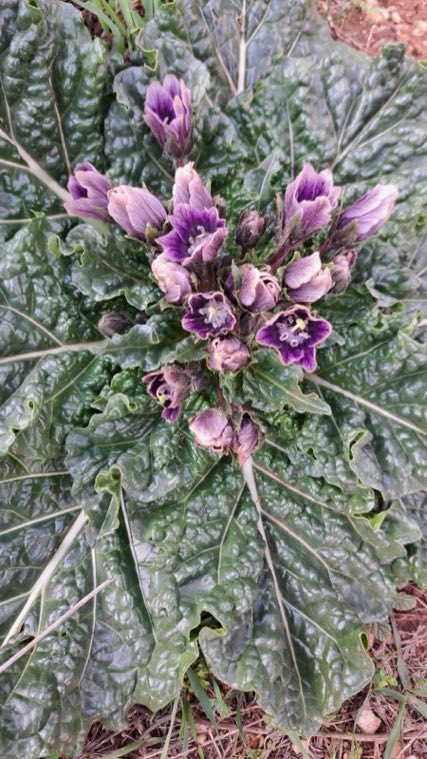
The mandrake is a low plant of the nightshade family, without a stem: a rosette of large dark green, wrinkled leaves lies flat on the ground, and from its center rise purple flowers in autumn and winter. In spring come round yellow fruits, about the size of a small plum, with a strong smell that some find sweet. They ripen at the time of the wheat harvest. Its thick root is often forked so that it looks a little like a human figure, and the whole plant contains drugs that cause sleep; it was used in medicine as a painkiller.
From ancient times people believed that mandrakes helped a woman to conceive. That is the background of the story in Genesis 30: Reuben found mandrakes in the field during the wheat harvest and brought them to his mother Leah, and Rachel, who had no children, bargained with Leah for them. Song of Songs speaks of the fragrance of mandrakes in spring. Later folklore told many strange stories about the plant, for example that it screamed when pulled up. Some scholars doubt that duda’im meant the mandrake, but most accept it.
In nature
All verses with this plant (4)
Where the Hebrew, Aramaic or Greek word for it stands in the text.
Genesis3
Now during the wheat harvest, Reuben went out and found some mandrakes in the field. When he brought them to his mother, Rachel begged Leah, “Please give me some of your son’s mandrakes.”But Leah replied, “Is it not enough that you have taken away my husband? Now you want to take my son’s mandrakes as well?” “Very well,” said Rachel, “he may sleep with you tonight in exchange for your son’s mandrakes.”When Jacob came in from the field that evening, Leah went out to meet him and said, “You must come with me, for I have hired you with my son’s mandrakes.” So he slept with her that night.Song of Songs1
The mandrakes send forth a fragrance, and at our door is every delicacy, new as well as old, that I have treasured up for you, my beloved.See also
Sources: Tyndale Open Bible Dictionary © 2023 Tyndale House Publishers, CC BY-SA 4.0 — adapted and shortened; the original work is available for free at tyndaleopenresources.com · Plants and Trees in the Bible © United Bible Societies 2025, adapted from R. Koops, Each According to its Kind © 2012 UBS, CC BY-SA 4.0 · Sources and rights