Encyclopedia › Plants of the Bible
Plants of the Bible
The four species of the Feast of Booths
Hebrew peri ‘ets hadar · palm, myrtle, willow · the etrog, or citron, of Jewish tradition
For the Feast of Booths the Law says: “On the first day you are to gather the fruit of majestic trees, the branches of palm trees, and the boughs of leafy trees and of willows of the brook” (Leviticus 23:40). Only the palm and the willow are named; “majestic trees” and “leafy trees” are general words, and older Bibles say “boughs of goodly trees”. When the feast was kept again in Nehemiah’s time, the people went out to the hills for “branches of olive, wild olive, myrtle, palm, and other leafy trees” to build their booths (Nehemiah 8:15).
Jewish tradition settled the four kinds as the citron, called etrog, a palm branch, myrtle and willow, and Jews still carry them at the feast today. The citron is a small thorny citrus tree with dark evergreen leaves, fragrant white flowers and large yellow fruit, very sour and with a thick rind. Jewish coins of the revolts against Rome show it beside a palm branch. Many scholars think “fruit of majestic trees” was a general phrase and the citron a later reading; others think it was meant from the start.
In art
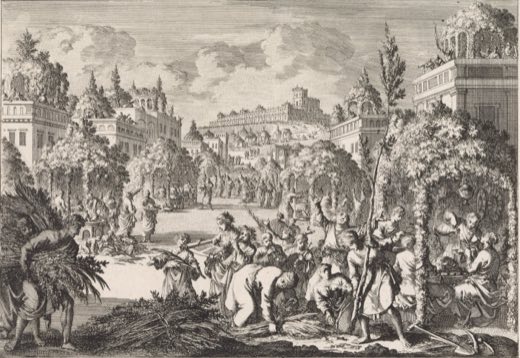 Making Booths for the Feast
All verses with this plant (1)
Where the Hebrew, Aramaic or Greek word for it stands in the text.
Leviticus1
On the first day you are to gather the fruit of majestic trees, the branches of palm trees, and the boughs of leafy trees and of willows of the brook. And you are to rejoice before the LORD your God for seven days.See also
- Feast of BoothsFeasts and festivals
- MyrtlePlants of the Bible
- Date palmPlants of the Bible
- Willow and poplarPlants of the Bible
- Pollen in the lake mudHow the Bible’s world is studied
Sources: Tyndale Open Bible Dictionary © 2023 Tyndale House Publishers, CC BY-SA 4.0 — adapted and shortened; the original work is available for free at tyndaleopenresources.com · Plants and Trees in the Bible © United Bible Societies 2025, adapted from R. Koops, Each According to its Kind © 2012 UBS, CC BY-SA 4.0 · Sources and rights