Encyclopedia › The land of the Bible
The land of the Bible
Jacob’s well
Near Shechem · cut through rock, about 30 m deep · shown since the 4th century
John tells that Jesus came to a town of Samaria called Sychar, «near the plot of ground that Jacob had given to his son Joseph», and sat down by Jacob’s well. Genesis says that Jacob bought a field at Shechem, and Joshua that Joseph’s bones were buried in it, but the Old Testament never mentions the well itself; the Samaritan woman’s words, «our father Jacob, who gave us this well», show a local tradition. Tired from the road, Jesus asked her for a drink and spoke of the «living water» He would give (John 4:10). Sychar is usually placed at the village of Askar under Mount Ebal, though some think it another name for Shechem itself.
The well shown today lies at the foot of Gerizim, a few hundred metres from the old mound of Shechem, where the road from Jerusalem to Galilee forks. It is cut through the limestone, a little under a metre across and, by one measurement, about 30 metres deep, so that the woman could rightly say, «the well is deep». It is fed by groundwater seeping from the mountains. The Pilgrim of Bordeaux saw it in AD 333, and a church stood over it by the end of the 4th century. A new church over it was finished in 2007.
In art
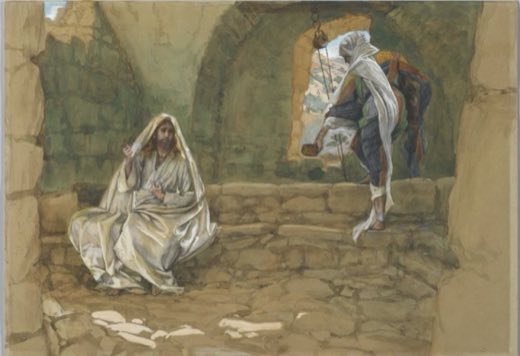 The Woman of Samaria at the Well (La Samaritaine à la fontaine)James Tissot
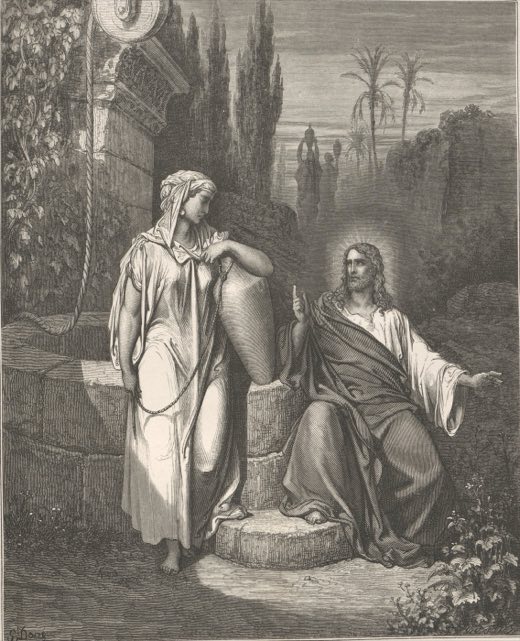 Jesus and the Woman of SamariaGustave Doré
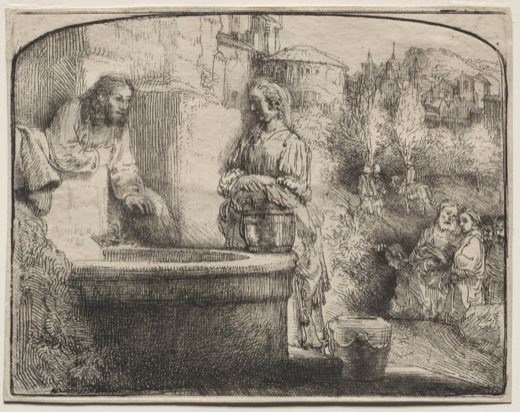 Christ and the Woman of Samaria: An Arched PrintRembrandt
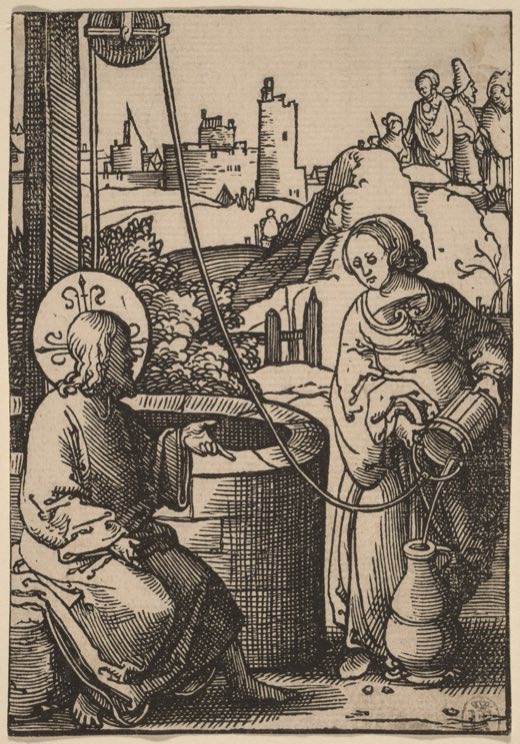 Christ and the Woman of SamariaLucas van Leyden
See also
- Ebal and Gerizim: two mountains over ShechemThe land of the Bible
- Shechem: the city between two mountainsCities of the Bible
- Springs, wells and oasesThe desert
- Samaria: the open hills of the northThe land of the Bible
- Drawing water: stones, ropes and troughsField, orchard and water
- Drinking waterFood and drink
- JacobPeople
- SycharPlaces
Sources: Tyndale Open Bible Dictionary © 2023 Tyndale House Publishers, CC BY-SA 4.0 — adapted and shortened; the original work is available for free at tyndaleopenresources.com · Sources and rights