Encyclopedia › The Greek world of Paul
The Greek world of Paul
Greek inscriptions in Jerusalem
The temple warning notice · the Theodotus synagogue inscription · Greek names on ossuaries
Greek was cut in stone in Jerusalem too. Around the inner courts of Herod’s temple ran a low barrier with notices in Greek and Latin forbidding foreigners to go further. A complete Greek notice was found in 1871 and is kept in Istanbul; a broken one, with traces of red paint in its letters, was found in 1935. The notice warns that whoever is caught inside will have himself to blame for the death that follows. Acts tells how Paul was seized when people supposed he had “brought Greeks into the temple” (Acts 21:28).
In 1913 a Greek inscription was found on the Ophel, south of the temple: Theodotus son of Vettenus, priest and synagogue leader, built a synagogue “for the reading of the Law and the teaching of the commandments”, with guest rooms and water for visitors from abroad; most scholars date it before AD 70. Many ossuaries, the stone boxes for bones, bear Greek names. One, found in the Kidron valley in 1941, names “Alexander son of Simon”, with a word read as “of Cyrene”; whether he is the son of Simon of Cyrene (Mark 15:21) cannot be known.
In art
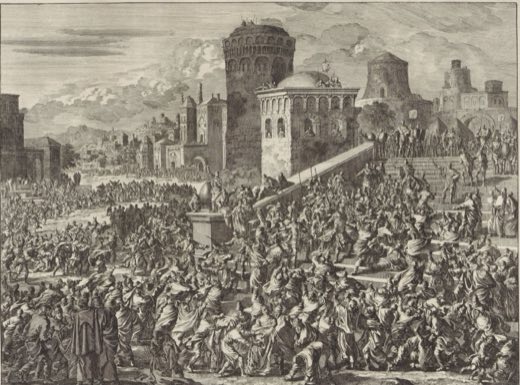 Paul Carried Up the Steps
See also
- Koine: the common GreekThe Greek world of Paul
- Herod’s templeTabernacle and temple
- SynagogueTabernacle and temple
- The courts and gates of Herod’s templeTabernacle and temple
- Synagogues of Jesus’ day in GalileeThe Bible in stone
- TrophimusPeople
- Alexander, son of SimonPeople
Sources: Tyndale Open Bible Dictionary © 2023 Tyndale House Publishers, CC BY-SA 4.0 — adapted and shortened; the original work is available for free at tyndaleopenresources.com · Sources and rights