Encyclopedia › Tabernacle and temple
Tabernacle and temple
The courts and gates of Herod’s temple
Court of the Gentiles, Court of the Women, Court of Israel · the Beautiful Gate
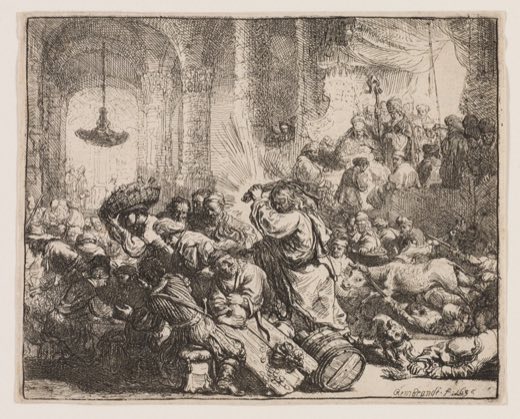
In the 1st century the temple was reached through a series of courts, each one higher and holier than the last. The great outer court, paved and lined with colonnades, was open to everyone, Jews and Gentiles alike; here the crowds gathered, teachers taught and the money changers and dove sellers had their tables. A low stone barrier ran around the inner courts, and notices in Greek and Latin warned foreigners not to pass it on pain of death. Paul was seized when people from Asia thought he had brought Trophimus, a Greek from Ephesus, beyond it: “he has brought Greeks into the temple and defiled this holy place” (Acts 21:28). Paul later writes of Christ, who “has torn down the dividing wall of hostility” (Ephesians 2:14).
Beyond the barrier, steps led up to the Court of the Women, where Jewish women as well as men could go; the offering chests stood here, and Simeon and Anna met the infant Jesus in these courts. A lame man sat begging every day at the gate called Beautiful (Acts 3:2) — by one view the bronze gate on the east of the Court of the Women, which Josephus says was more costly than the gates plated with gold. Higher still came the Court of Israel for Jewish men and the Court of the Priests around the altar, with the sanctuary rising behind. The Mishnah, a later Jewish law book, describes the courts in detail, with their gates, rooms for wood, oil and lepers, and the place where the Sanhedrin met.
See also
- Herod’s templeTabernacle and temple
- Porch, colonnades and pinnacleTabernacle and temple
- Treasuries and offering chestsTabernacle and temple
- Greek inscriptions in JerusalemThe Greek world of Paul
- Gatekeepers and the temple guardTabernacle and temple
- The Songs of AscentsMusic and instruments
Sources: Tyndale Open Bible Dictionary © 2023 Tyndale House Publishers, CC BY-SA 4.0 — adapted and shortened; the original work is available for free at tyndaleopenresources.com · Sources and rights