Encyclopedia › Buildings and structures
Buildings and structures
The walls and gates of Jerusalem
Hezekiah’s Broad Wall · Nehemiah’s fifty-two days · the gates of Nehemiah 3 · Josephus’s three walls
Jerusalem’s walls were built, destroyed and rebuilt many times. Before the Assyrian attack of 701 BC Hezekiah “worked resolutely to rebuild all the broken sections of the wall” and “built an outer wall” (2 Chronicles 32:5), and Isaiah says the people “counted the houses of Jerusalem and tore them down to strengthen the wall” (Isaiah 22:10). In the 1970s Nahman Avigad uncovered in the Jewish Quarter a stretch of a wall about seven meters thick, built over the remains of houses; it is usually identified with this wall and called the Broad Wall, a name found in Nehemiah 3:8.
After the Babylonians burned the city, its walls lay in ruins until Nehemiah came. He rode round them at night through “the Valley Gate toward the Well of the Serpent and the Dung Gate” (Nehemiah 2:13), and then organized the rebuilding section by section — priests at the Sheep Gate, the men of Jericho, the goldsmiths and perfumers, district rulers, each family beside its own house. “So the wall was completed in fifty-two days, on the twenty-fifth of Elul” (Nehemiah 6:15), and two thanksgiving choirs marched along its top in opposite directions (Nehemiah 12:31, 38). Nehemiah 3 is our best list of the city’s gates: the Sheep, Fish, Old, Valley, Dung, Fountain, Water, Horse, East and Inspection Gates. By the time of Jesus the city was larger; Josephus describes three walls, the third begun by Agrippa I. The walls that stand today were built by the Ottoman sultan Suleiman in the 1530s.
In art
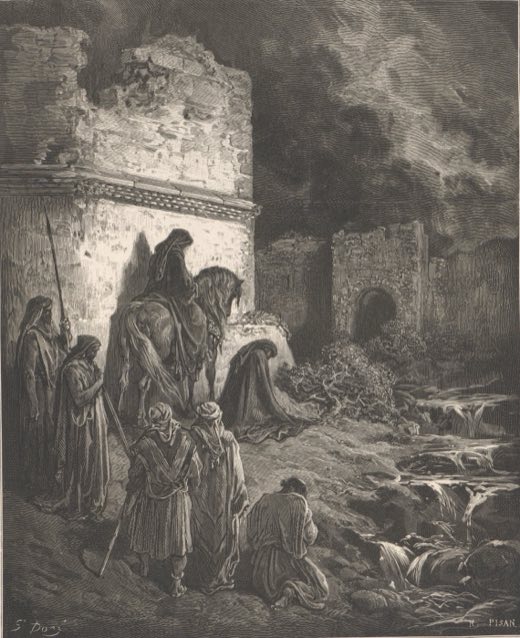 Nehemiah Views the Ruined Walls of Jerusalem
See also
- Jerusalem through the agesCities of the Bible
- The city gateBuildings and structures
- Trades that ran in familiesWork and trades
- City walls and siegesWeapons and warfare
- Sennacherib’s campaign of 701 BCWeapons and warfare
- The siege and fall of Jerusalem, 587/586 BCWeapons and warfare
- HezekiahPeople
- Nehemiah, son of HacaliahPeople
- JerusalemPlaces
Sources: Tyndale Open Bible Dictionary © 2023 Tyndale House Publishers, CC BY-SA 4.0 — adapted and shortened; the original work is available for free at tyndaleopenresources.com · Sources and rights