Home › Explore › Scholars disagree › Where were Sodom and Gomorrah?
Where was it?
Where were Sodom and Gomorrah?
South of the Dead Sea, as long tradition held — or north-east of it, at Tall el-Hammam?
Genesis sets the cities in the well-watered ‘plain of the Jordan’ and in the Valley of Siddim, ‘that is, the Salt Sea’. Two groups of excavators read these words toward opposite ends of the Dead Sea.
What the Bible says
Lot sees the whole plain of the Jordan, well wateredGen 13:10
And Lot looked out and saw that the whole plain of the Jordan, all the way to Zoar, was well watered like the garden of the LORD, like the land of Egypt. (This was before the LORD destroyed Sodom and Gomorrah.)Lot pitches his tent toward SodomGen 13:12
Abram lived in the land of Canaan, but Lot settled in the cities of the plain and pitched his tent toward Sodom.The Valley of Siddim, that is, the Salt SeaGen 14:3
The latter five came as allies to the Valley of Siddim (that is, the Salt Sea).The valley is full of tar pitsGen 14:10
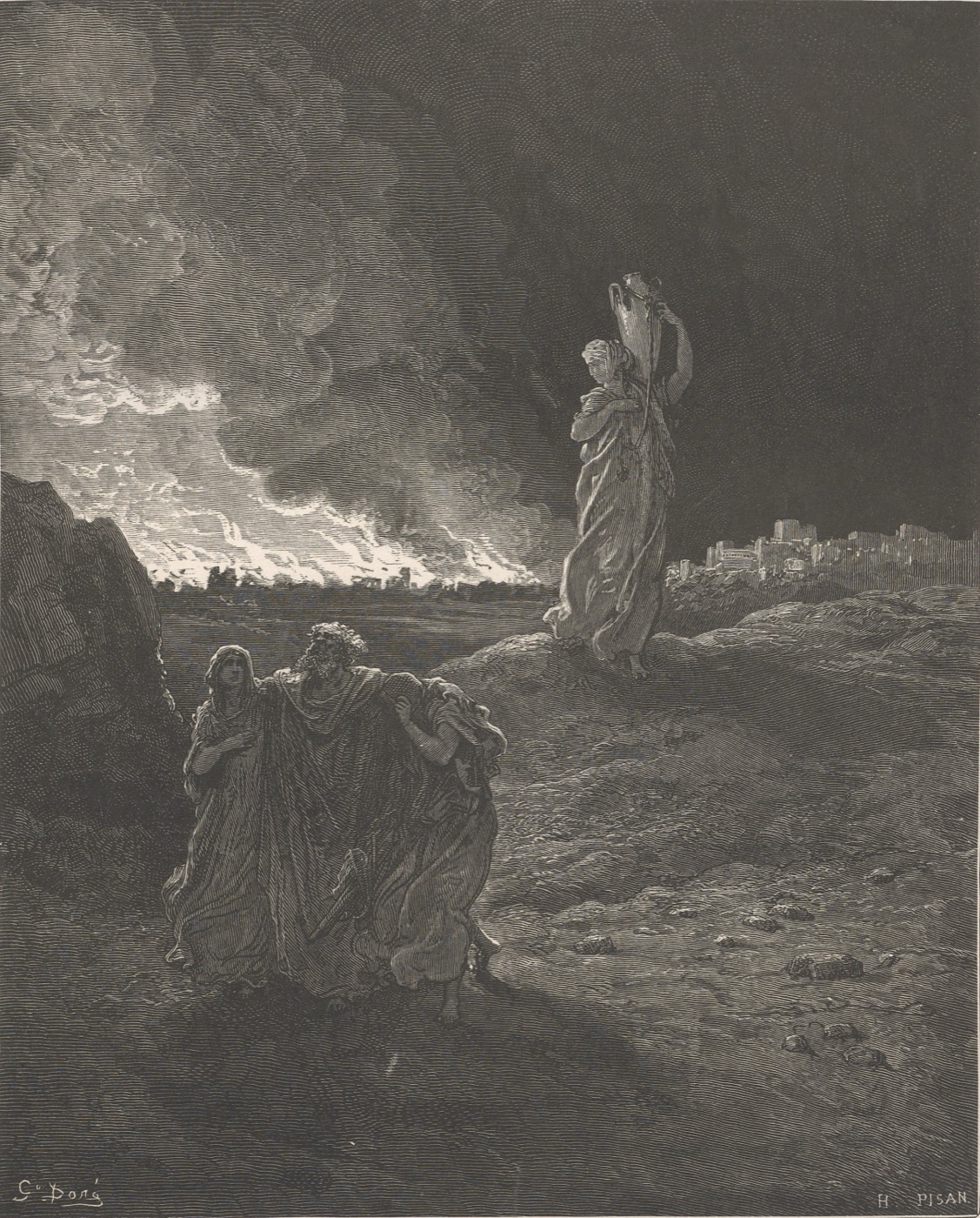
Now the Valley of Siddim was full of tar pits, and as the kings of Sodom and Gomorrah fled, some men fell into the pits, but the survivors fled to the hill country.Smoke rises from the land like a furnaceGen 19:28
He looked down toward Sodom and Gomorrah and all the land of the plain, and he saw the smoke rising from the land like smoke from a furnace.Moses sees the plain of Jericho as far as ZoarDeut 34:3
the Negev, and the region from the Valley of Jericho (the City of Palms) all the way to Zoar.The proposed sites
The numbers are the views’. No site is marked as the likeliest.
1View 1
South of the Dead Sea
William F. Albright; the excavators of Bab edh-Dhra and Numeira, Walter Rast and Thomas Schaub; ancient Jewish and Byzantine tradition.
- The 6th-century Madaba mosaic map puts Zoar at the south-east end of the sea, and Mount Sodom, a hill of rock salt, stands on its south-west shore.
- The Valley of Siddim is called ‘the Salt Sea’ and full of tar pits (14:3, 10); lumps of asphalt still float up from the Dead Sea.
- Bab edh-Dhra and Numeira, towns south-east of the sea, ended in fire at the close of the Early Bronze Age.
2View 2
North-east of the Dead Sea: Tall el-Hammam
Steven Collins and the Tall el-Hammam excavation (from 2005).
- Lot chose ‘the whole plain of the Jordan’ (13:10–11) — the round plain just north of the Dead Sea, which can be seen from the hills near Bethel.
- Tall el-Hammam was the largest walled city of that plain in the Middle Bronze Age; it was destroyed by fire and stood empty for centuries.
- In 2021 a team proposed in Scientific Reports that a blast from space destroyed it about 1650 BC; other scientists have strongly disputed that evidence.
What we know for sure
No inscription naming Sodom or Gomorrah has been found at any site.
Sources
- Walter E. Rast and R. Thomas Schaub, Bâb edh-Dhrâʿ: Excavations at the Town Site (1975–1981) (2003)
- Steven Collins and Latayne C. Scott, Discovering the City of Sodom (2013)
- Ted E. Bunch et al., “A Tunguska sized airburst destroyed Tall el-Hammam, a Middle Bronze Age city in the Jordan Valley near the Dead Sea”, Scientific Reports 11 (2021)