Home › Explore › Scholars disagree › Where is Mount Sinai?
Where was it?
Where is Mount Sinai?
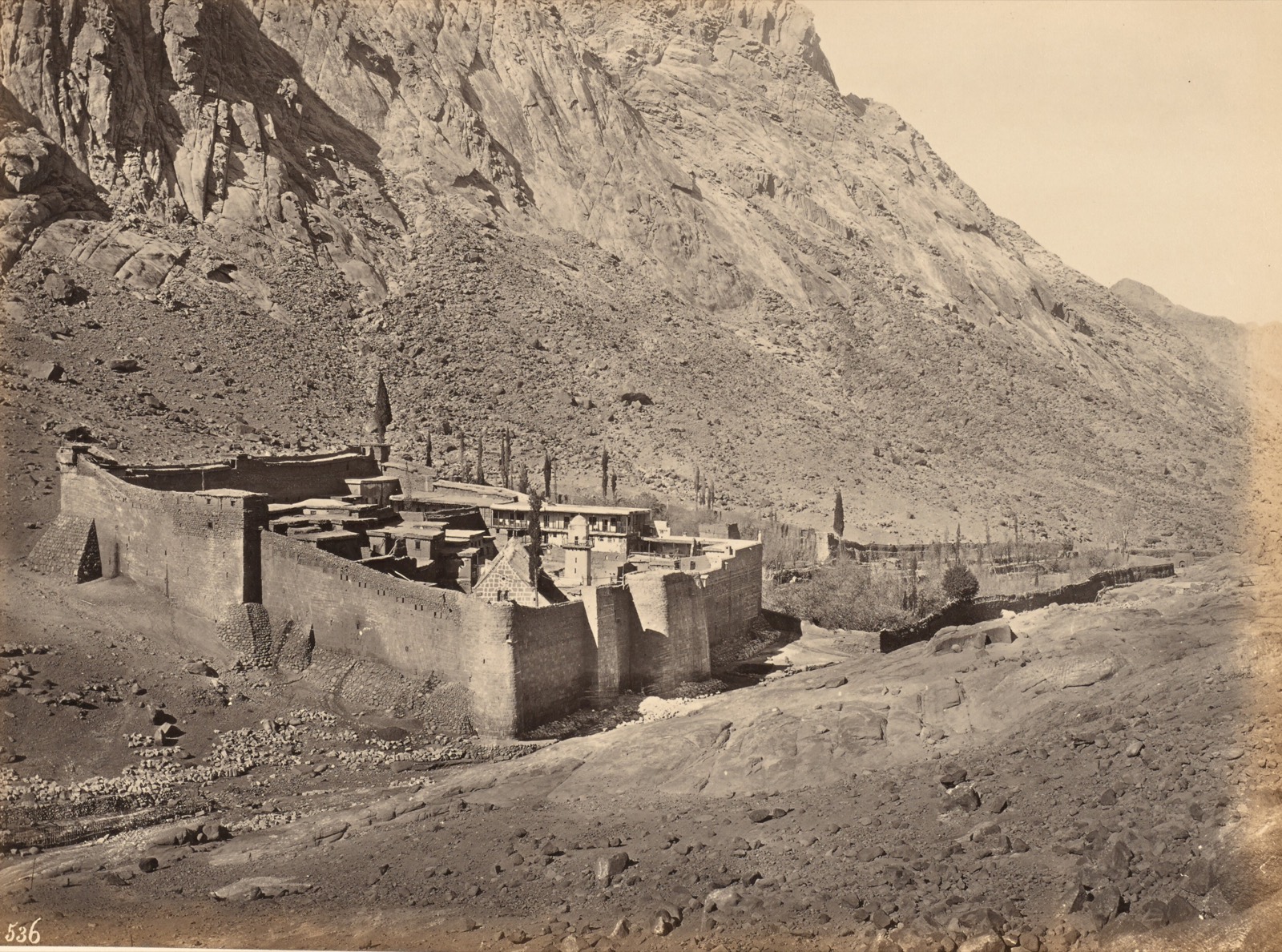
Jebel Musa in the south of the Sinai peninsula, a mountain in Arabia — or Har Karkom in the Negev?
The mountain of the Law has two names in the Bible, Sinai and Horeb, and many candidates on the map. The oldest tradition, still kept by the monks of St Catherine’s, goes back to the 4th century.
What the Bible says
Meanwhile, Moses was shepherding the flock of his father-in-law Jethro, the priest of Midian. He led the flock to the far side of the wilderness and came to Horeb, the mountain of God.In the third month, on the same day of the month that the Israelites had left the land of Egypt, they came to the Wilderness of Sinai. After they had set out from Rephidim, they entered the Wilderness of Sinai, and Israel camped there in front of the mountain.It is an eleven-day journey from Horeb to Kadesh-barnea by way of Mount Seir.He said: “The LORD came from Sinai and dawned upon us from Seir; He shone forth from Mount Paran and came with myriads of holy ones, with flaming fire at His right hand.Now Hagar stands for Mount Sinai in Arabia and corresponds to the present-day Jerusalem, because she is in slavery with her children.So he got up and ate and drank. And strengthened by that food, he walked forty days and forty nights until he reached Horeb, the mountain of God.The proposed sites
The numbers are the views’. No site is marked as the likeliest.
1View 1
Jebel Musa, in southern Sinai
Tradition since the 4th century; the pilgrim Egeria; St Catherine’s Monastery.
- Pilgrims were shown this mountain by the 4th century; Egeria climbed it about 383, and Justinian built the monastery at its foot in the 6th.
- Below it lies the wide plain of er-Raha, where a great camp could gather before the mountain (Exodus 19:2, 17).
- ‘Eleven days from Horeb to Kadesh-barnea’ (Deuteronomy 1:2) suits a journey from the south of the peninsula.
2View 2
A mountain in Arabia, in the land of Midian
Scholars who look for Sinai in Midian, among them Frank Moore Cross; popular writers who point to Jebel al-Lawz.
- Moses was keeping the flock of Jethro, priest of Midian, when he came to Horeb (Exodus 3:1) — and Midian lay east of the Gulf of Aqaba.
- Paul writes of ‘Mount Sinai in Arabia’ (Galatians 4:25).
- Old poems say the LORD came from Seir, Teman and Paran (Deuteronomy 33:2; Habakkuk 3:3) — lands south-east of Israel.
3View 3
Har Karkom, in the Negev
The archaeologist Emmanuel Anati.
- Anati found hundreds of shrines, standing stones and rock carvings on the mountain and around it.
- Most date to the 3rd millennium BC, so Anati also dates the Exodus far earlier than is usual.
What we know for sure
The Bible gives travel times to the mountain (Deuteronomy 1:2) but no landmark that can be fixed on a map today.
Sources
- Egeria, Travels (about 381–384), tr. John Wilkinson, Egeria’s Travels (1971)
- Graham I. Davies, The Way of the Wilderness (1979)
- Frank Moore Cross, From Epic to Canon (1998)
- Emmanuel Anati, The Riddle of Mount Sinai (2001)
- James K. Hoffmeier, Ancient Israel in Sinai (2005)