Encyclopedia › Trade, craft and color
Trade, craft and color
Kindling fire
Fire drill, flint and tinder · embers carried in a pot · no fire lit on the Sabbath
Making fire from nothing was slow work, so people tried never to let it go out. The usual way was a fire drill: a hard stick spun fast in a notch of soft wood, by hand or with a bow, until the dust smoldered and could be blown into flame in dry grass. Striking flint on a lump of iron pyrite also gave sparks. It was easier to take fire from a neighbor’s hearth — even a broken jar would do “to scoop the coals from a hearth” (Isaiah 30:14) — or to carry embers in a pot: on the way to Moriah Abraham “himself carried the fire and the sacrificial knife” (Genesis 22:6).
At night a household banked its fire under ash and blew it into flame again in the morning. The Law forbade lighting a fire in one’s dwellings on the Sabbath (Exodus 35:3). A fire lit outdoors was a welcome to strangers: when Paul’s ship was wrecked on Malta, the islanders “kindled a fire and welcomed all of us because it was raining and cold” (Acts 28:2), and Paul gathered sticks for it.
In art
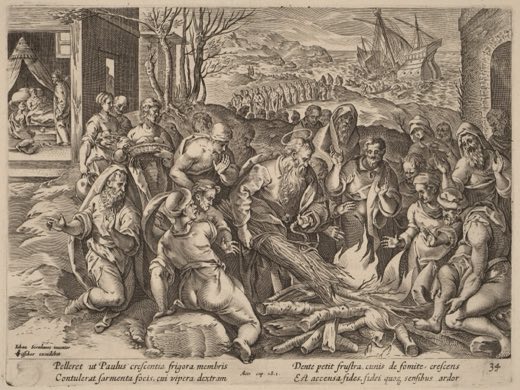 Saint Paul Shipwrecked on the Island of Melita
See also
- Hearth and brazierTrade, craft and color
- Fuel: wood, charcoal, dung and thornsTrade, craft and color
- TorchesHome and family
- Lamps and the light of the houseHome and family
- AbrahamPeople
- PaulPeople
- MaltaPlaces
Sources: Tyndale Open Bible Dictionary © 2023 Tyndale House Publishers, CC BY-SA 4.0 — adapted and shortened; the original work is available for free at tyndaleopenresources.com · Sources and rights